






Use cases / Municipality
Client case
Deepler 360 · Leadership
Leadership development with 360 feedback for the management team
A municipality invested in leadership development for its managers, with its own programme. The training was well received, but nobody knew whether anything changed in practice. With Deepler 360 , managers now receive feedback on a shared leadership profile, before and after the programme.
Sector
Government
Target group
Managers and MT
Solution
Deepler 360
Application
Leadership
In brief
The question
Does leadership really change, or does it stop at the training?
The insight
Self-image and feedback differ most on coaching.
The result
Growth per competency visible per round.
The question: what does the leadership programme deliver?
The programme consisted of training, peer consultation and coaching. Participants were enthusiastic, but the management team wanted to know whether behaviour on the work floor changed. After all, satisfaction with a training says little about what employees notice.
The approach: 360 feedback on a shared profile
Together with HR, the management team drew up a leadership profile with five competencies, described in concrete behaviour. Each manager asks for feedback from their own manager, peers and employees, and also fills in a self-score. The first round took place at the start of the programme, the second a year later.
Deepler 360 offers two routes for such a profile: choosing core competencies from Deepler’s standard library, or uploading your own custom leadership profile with competencies and behavioural indicators. Because the municipality had drawn up its own profile, that became the basis.
Shared leadership profile
Five competencies in concrete behaviour
Feedback from all sides
Manager, colleagues and team
Two rounds
At the start and after a year
The insight: the blind spot was in coaching
On most competencies, self-image and feedback were close together. Not on coaching: managers rated themselves higher than their employees did. That became a fixed part of the programme, with peer consultation focused on holding development conversations.
MT heatmap · 360 feedback per competency
Illustrative view
The result: growth you can see
By measuring the same competencies in both rounds, every manager sees where they have grown. At group level, the management team sees which parts of the programme have an effect, and where the programme needs adjusting.
- One shared language for leadership
- Blind spots as the starting point for development
- Growth per competency visible per round
Apply it yourself: 360 feedback in your leadership programme in five steps
Want to make leadership development in your own organisation just as trackable? This is how to use 360 feedback step by step within a leadership programme:
- Choose the leadership profile. Select five to seven core competencies from Deepler’s standard library, or upload your own leadership profile. Describe each competency in observable behaviour.
- Have participants record development goals. Before the first training day, each participant chooses one or more goals, each linked to a competency from the profile. For coaching leadership, this could be: in every team meeting, ask questions first and only then offer a solution.
- Gather feedback. The participant invites their own manager, peers and team members and completes a self-assessment. They give feedback on the core competencies and on the development goals. Six to eight raters, spread across the groups, give a reliable picture.
- Discuss the report. Within two weeks, schedule a conversation with the coach or trainer. The differences between self-image and feedback are the starting point. The participant then sharpens the goals and starts an improvement plan, supported by the AI improvement coach.
- Measure again. At the end of the programme, a second round follows on the same profile. Participants see their growth per competency and per development goal, and HR sees the development of the whole group.
Leadership development you can track: three lessons
What this municipality learned about measuring leadership:
Start with a shared profile
Concrete behaviour makes feedback usable.
Use the difference
The gap between self-image and feedback is the conversation.
Measure again
Only a second round shows growth.
Read more about Deepler 360, or see how a healthcare organisation develops team leaders with 360-degree feedback. Want to know first which leadership needs are at play in your teams? Read how to use a leadership survey to map this per team.
Want to experience how 360-degree feedback works? Do the free 360 mini-analysis: twelve questions, your competency profile straight away and a comparison with a colleague’s view.
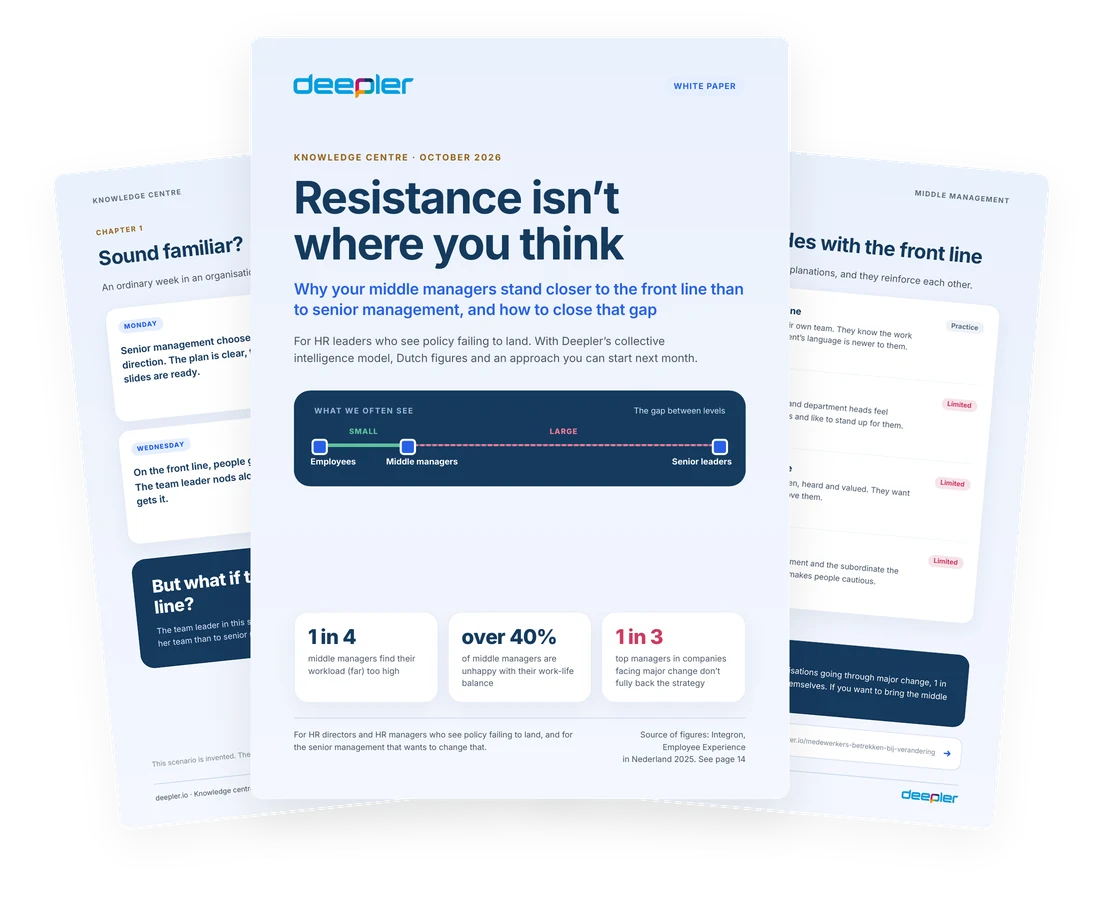
Free white paper
Resistance isn’t where you think
Why the biggest gap often lies between middle and senior management, and what really helps the middle.
- Deepler's collective intelligence model
- Six measures, ranked by evidence
- Six statements from the management team, with answers
Frequently asked questions
Frequently asked questions about leadership development with 360 feedback
Why use 360 feedback in leadership development?
Because employees and colleagues see how someone leads in practice. Their feedback shows what a programme really changes.
How many competencies do you include in a leadership profile?
Better five that really matter than fifteen. Describe them in concrete behaviour, so feedback becomes usable.
Do you choose a standard profile or a custom leadership profile?
If you do not have your own leadership profile yet, you can start quickly with core competencies from Deepler’s standard library. If your organisation already has a leadership vision, you upload a custom profile. You can also combine the two.
What makes a good development goal?
A goal that is linked to a competency from the profile and describes the behaviour you want to show, so that others can notice whether it is working.
How many raters do you need?
Six to eight raters, spread across manager, peers and team members. That makes the feedback broad enough to say something about behaviour.
How often do you run a 360 feedback round?
Many organisations choose one or two rounds a year. That leaves time to work on the development points.
Is the feedback anonymous?
Feedback from colleagues and employees is combined, so nobody can be identified. Feedback from the manager is recognisable.
Who sees the results?
The manager themselves and, depending on the agreements, their own manager or coach. At group level, the management team can follow the development.