






Use cases / Healthcare organisation
Client case
Deepler 360 · Leadership
360-degree feedback example: developing team leaders in healthcare
A healthcare organisation wants to develop its team leaders in a targeted way. Not on the basis of one appraisal interview, but on feedback from the people they work with every day. With Deepler 360, team leaders get feedback from their manager, peers and team. Blind spots become the starting point of the development conversation.
Sector
Healthcare
Target group
Team leaders
Solution
Deepler 360
Application
360-degree feedback
In brief
The question
How do you develop team leaders based on more than one perspective?
The insight
The difference between self-image and how others see you is the best starting point.
The result
A concrete development goal, and a follow-up round that shows growth.
The question: how do you develop team leaders in a targeted way?
Team leaders in healthcare are under pressure: schedules, staff shortages and high expectations. Development is easily neglected, or gets stuck in general trainings. The organisation wants to know per team leader where the growth lies, based on what the people around them experience.
The approach: 360-degree feedback on your own competencies
With Deepler 360 the organisation chooses a competency profile that suits its team leaders, for example giving direction, coaching and collaborating. Each team leader completes a self-assessment and gets feedback from their own manager, peers and team members.
Choose competencies
A profile that fits the role
Collect feedback
From manager, peers and team
Report per team leader
The insight: the blind spot as the starting point
Giving direction · team leader, example report
Blind spot: self 84, team 61. Conversation question: where do you notice that I don't make the direction clear?
Illustrative representation
The result: growth you can demonstrate
- A personal development goal per team leader
- A development conversation with concrete questions
- Growth visible in the follow-up round
Making 360-degree feedback work: three lessons
Use it for development
Choose one development goal
Measure again
Want to experience how 360-degree feedback works? Do the free 360 mini-analysis: twelve questions, your competency profile straight away and a comparison with a colleague’s view.
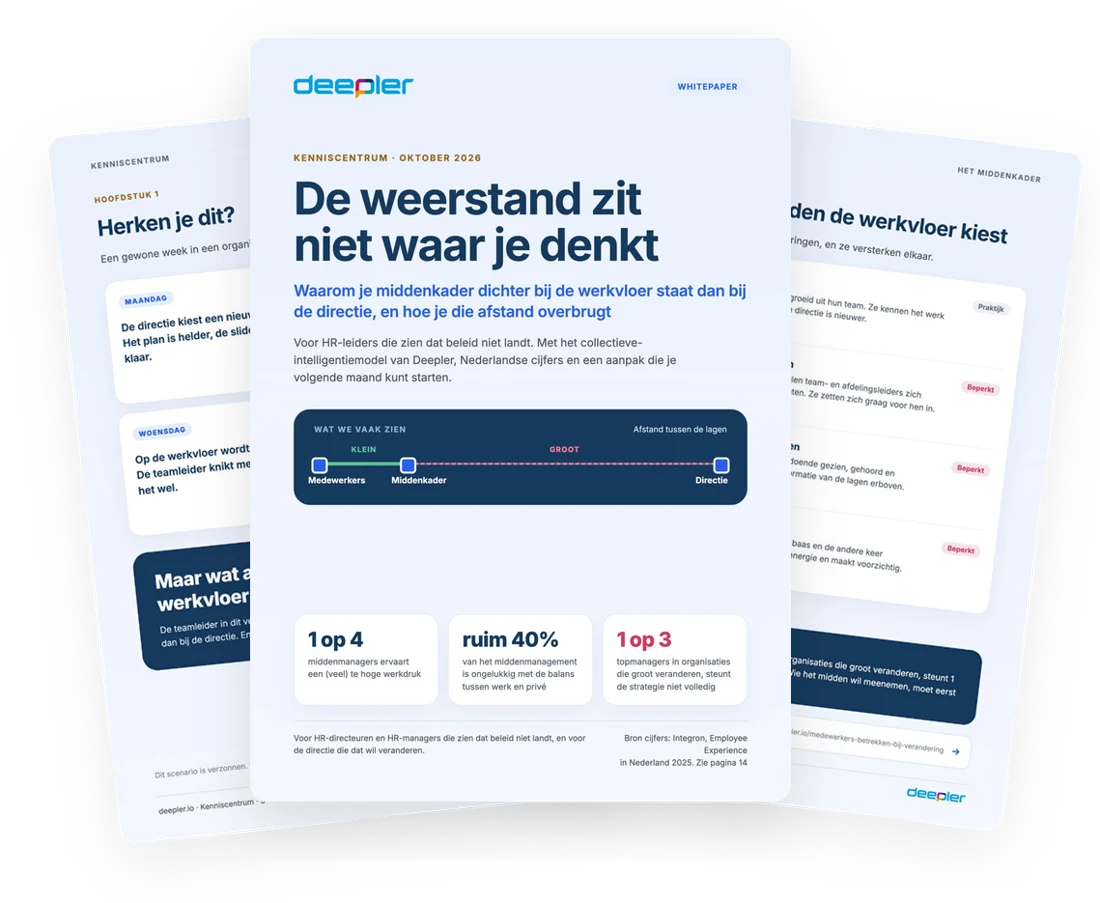
Gratis whitepaper
De weerstand zit niet waar je denkt
Waarom de grootste afstand vaak tussen middenkader en directie ligt, en wat het midden echt helpt.
- Het collectieve-intelligentiemodel van Deepler
- Zes maatregelen, gesorteerd op bewijs
- Zes uitspraken uit het MT, met antwoorden
Frequently asked questions
Frequently asked questions about 360-degree feedback
What is 360-degree feedback?
With 360-degree feedback, someone gets feedback from several sides: their own manager, peers, team members and a self-assessment. This creates a more complete picture than one conversation.
What does a 360-degree feedback look like?
An example: a team leader rates themselves on competencies such as giving direction and coaching, and the same questions go to their manager, peers and team. The report shows the differences per competency, with the biggest blind spots at the top.
Is 360-degree feedback anonymous?
Feedback from peers and team members is shown anonymously and at group level, so people can answer honestly.
How often do you do a 360-degree feedback?
Often once or twice a year, with a follow-up round after six to twelve months to make growth visible.
How do you use the outcomes in the development conversation?
Discuss the biggest differences between self-image and how others see you and choose one development goal together. The conversation questions in the report help to make the conversation concrete.