






Use cases / Technical service provider
Client case
Deepler Research · Continuous listening
Reorganisation with a grip: role clarity and insight into the undercurrent
A technical service provider brought two management roles together under one manager. The change affected a large part of the organisation, including several support departments. With one overview, short surveys among employees and managers and a monitored development programme for managers, the organisation got a grip on the reorganisation, including what was happening beneath the surface.
Sector
Technical services
Target group
Skilled professionals and managers
Solution
Deepler Research and Deepler 360
Application
Reorganisation and role clarity
In brief
The question
How do you keep a grip on a reorganisation that affects almost everyone?
The insight
The structure is in place quickly. The undercurrent determines whether it works.
The result
One overview, a fixed measurement rhythm and managers who know their role.
The question: how do you keep a grip when almost everyone gets a new role?
Technicians and service staff at this organisation reported to two managers. One focused on their craftsmanship and development, the other on day-to-day planning and supervision. In practice, this arrangement did not work optimally: who is the point of contact for what, and who decides what? The organisation therefore decided to bring both roles together under one manager.
The decision affected a large part of the organisation, including several support departments. The need for change was widely felt, and a lot of effort went into finding suitable positions. Even so, change is unsettling when it affects your own job.
For HR, a reorganisation like this is a major task on top of the regular work. Information is scattered across lists, meetings and signals from the organisation, and much is done on gut feeling. So how do you see in time where something is still missing in the preparation, what is going on in each department and how employees really experience the change?
The approach: four tracks that make the reorganisation manageable
The organisation did not treat the reorganisation as one big project, but as four tracks running side by side. Each track has its own question and a fixed moment when it comes back. You can set this up with simple tools. Software mainly makes it easier to keep it going.
1. One overview instead of separate lists. All parts of the preparation came together in one place: roles and placements, communication per department, systems and procedures, the support departments and the induction programme for managers. Each part has an owner, a status and a date. That way you can see at a glance what is done and where something is still missing, without chasing everything yourself.
2. Role clarity on paper and in practice. For the new manager role, the organisation described what it includes, what it does not, and where the role hands over to a support department. These agreements were discussed with managers and support departments before the new structure took effect, so everyone started with the same expectations.
3. Short surveys to see the undercurrent. Alongside the signals from meetings, employees and managers were asked a few short questions at fixed moments. Do I know what is changing for me? Do I know who to turn to? How secure do I feel about my position? What do I still need? The results per department show where uncertainty lies and where extra explanation or support is needed. With Deepler Research, inviting, sending reminders and viewing the results per department happen automatically, and answers remain anonymous.
4. Preparing and following managers. New managers start with an induction programme covering the basics, such as systems, procedures and absenteeism. This is followed by a longer development programme focusing on knowledge and on skills such as holding conversations and coaching skilled professionals in their development. A 360-degree feedback survey at the start and later in the programme shows where managers stand, what they still need and whether their development is noticeable in practice.
One overview
Each part with an owner, status and date
Short surveys
A few fixed questions, viewed per department
360 for managers
Seeing whether development lands in practice
The insight: the structure is in place quickly, the undercurrent sets the pace
A new organisation chart and suitable positions are an important step, but they do not complete a reorganisation. Whether the new structure works depends on what employees and managers experience. Do they know what is expected of them? Do they dare to say what they still miss?
You will not find that undercurrent in a planning and you only partly hear it in meetings. By asking the same short questions every time, it becomes discussable: per department, in time, and without HR having to sit at every table. That also makes the workload for HR easier to carry.
Measurement rhythm around the reorganisation
Plus the same short questions every quarter, so you can see what changes.
Illustrative representation
The result: a grip on the preparation and on what is going on
With one overview, HR could immediately see which parts of the preparation were still open. The short surveys showed per department where questions and uncertainty lay, so managers and HR could start targeted conversations instead of steering on gut feeling.
For the managers, there is a development programme that matches what they really need, with a measurement that shows whether development lands in practice. That way, attention does not stop on the day the new structure takes effect, but continues until the new roles are truly in place.
- One overview of the entire preparation
- Undercurrent visible per department
- Manager development measurable
Getting a grip on a reorganisation: three lessons
What this organisation learned about guiding a reorganisation:
Make the overview visible
One list with owners and status shows what is still missing.
Measure the undercurrent with fixed questions
Short, recurring questions make uncertainty discussable in time.
Follow managers after the transition
A new role is only in place when development is visible in practice.
Read more about Deepler Research and Deepler 360, or see how a municipality follows the development of its managers.
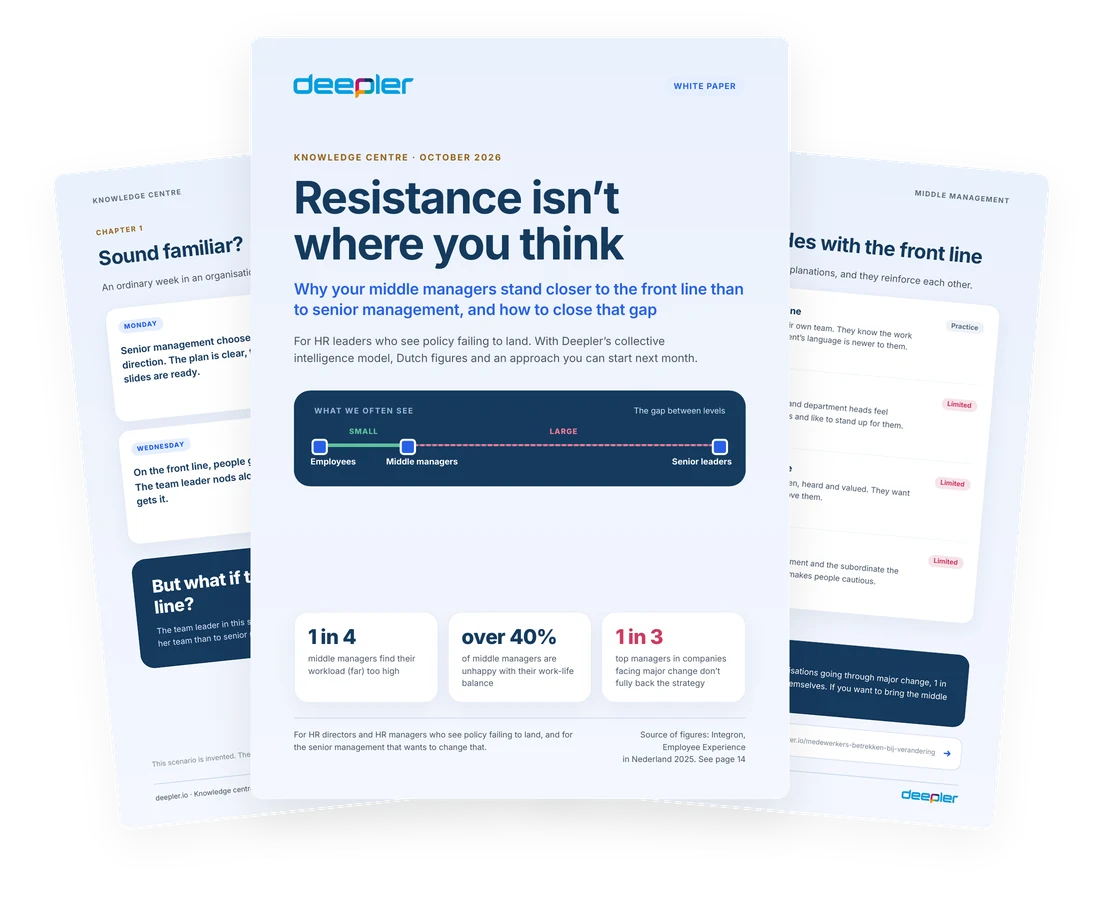
Free white paper
Resistance isn’t where you think
Why the biggest gap often lies between middle and senior management, and what really helps the middle.
- Deepler's collective intelligence model
- Six measures, ranked by evidence
- Six statements from the management team, with answers
Frequently asked questions
Frequently asked questions about getting a grip on a reorganisation
What is the undercurrent in a reorganisation?
The undercurrent is everything employees and managers experience but do not always say out loud: uncertainty about their position, unclear lines about who is the point of contact for what, and concerns about the new way of working. It is not in the plan, but it does determine whether a change lands.
How do you create role clarity during a reorganisation?
Describe for each role what it includes, what it does not, and where the role hands over to a support department. Discuss these agreements before the new structure takes effect, and then regularly ask whether employees know who to turn to.
How often should you measure during a reorganisation?
A baseline before the transition, a short survey around the transition and then, for example, every quarter works well. Keep the questions short and the same each time, so you can see what changes. Also share the results: measuring without feedback is counterproductive.
How do you measure whether managers' development becomes visible?
With a 360-degree feedback survey at the start and later in the development programme. Managers receive feedback from their employees, colleagues and own manager. That way you can see whether their development is also noticeable in daily practice.
Do you need software to keep a grip on a reorganisation?
No. You can also set up a good overview and short questionnaires with simple tools. Software such as Deepler does make it easier to keep it going: inviting, sending reminders and viewing the results per department happen automatically, and employees’ answers remain anonymous.