






Use cases / Staffing and secondment agency
Client case
Deepler Research · Continuous listening
Employee survey in secondment: over 70% response
A staffing and secondment agency wanted to know how its employees experience working through the organisation. Most employees work at client sites every day and rarely see their own employer. As a result, their connection with the organisation is low, which makes a high response rate difficult. With Deepler Research and a communication plan designed around that distance, over 70% of employees completed the questionnaire.
Sector
Staffing and secondment
Target group
Employees on site
Solution
Deepler Research
Application
Response and commitment
In brief
The question
How do you reach employees who never come to the office?
The insight
Response follows the relationship, not the inbox.
The result
Over 70% response and a plan for stronger commitment.
The question: how do you hear employees you rarely see?
This organisation’s employees work at client sites, in the client’s team, with their own manager on location. To them, their own employer is mainly the payslip and a consultant who gets in touch now and then. People who feel little connection with an organisation don’t open a survey invitation, or put it off. There is an extra concern as well: employees want to be sure that criticism has no consequences for their placement with the client.
At the same time, management wanted to hear from precisely this group how they like working through the organisation, what keeps them and what would make them leave. A standard email invitation would achieve little with this group. Low commitment calls for a more intensive approach.
The approach: a communication plan that bridges the distance
We built the communication around one principle: employees respond to people they know, not to a sender they hardly ever see. The plan ran in four steps.
1. Get the consultants on board first. Consultants and recruiters have the most contact with employees. Beforehand, they were briefed on the purpose of the survey, anonymity and what happens with the results, so they could answer questions themselves. They also checked that their employees’ contact details were correct, including an email address employees actually read.
2. An announcement with a face. A week before the start, management announced the survey with a short, personal message: why we are asking, what we will do with it, when employees will see the results and that the client sees none of the answers.
3. The call at moments of contact. The invitation coincided with moments when employees are in touch with the organisation anyway, such as submitting their hours and receiving their payslip. In addition, consultants sent a personal message through the channel they normally use to talk to their employees. The questionnaire was short and easy to complete on a phone, during a break or after a shift.
4. Steering on response. The survey was open for three weeks. Every week, the response rate per branch was shared, so consultants could contact groups that were lagging behind. Reminders went out on varying days and at varying times, to suit shift work and weekend work.
Consultants as sender
A familiar face instead of an anonymous email
Short and mobile
Easy to complete between shifts
Response per branch
Weekly adjustments where it lags behind
The insight: response follows the relationship
Response did not rise evenly. After the first invitation it lagged behind, as you would expect from a group with little commitment. The biggest step came after the consultant’s personal message, followed by the reminder around submitting hours. Where a consultant actively reached out, response was clearly higher.
This confirmed what also emerged from the answers: for employees working remotely, the consultant is the face of the organisation. The more frequent and personal that contact, the more connected employees feel and the more often they say they want to stay.
Response over time · three weeks of fieldwork
The biggest jump came after the consultant's personal message.
Illustrative view
The result: over 70% response and a plan for commitment
With over 70% response, the results were reliable, also per branch and separately for temporary workers and seconded employees. The organisation saw what employees are satisfied with and where commitment is under pressure. Based on this, it set a fixed rhythm of contact between consultant and employee, and organises return days where employees meet each other and the organisation.
The results were shared with all employees within the promised timeframe, together with the first actions. This shows employees that taking part makes a difference, which lays the foundation for the next survey.
- Over 70% response from employees on site
- Reliable results per branch and per group
- A fixed rhythm of contact between consultant and employee
High response from employees working remotely: three lessons
What this organisation learned about an employee survey in a group with low commitment:
Let familiar faces make the call
A message from their own consultant works better than a general email.
Tie in with existing moments
Ask for input when employees are in touch anyway, such as when submitting hours.
Promise feedback and deliver on it
People who see what happens with their answers take part again next time.
Read more about Deepler Research, or see how a healthcare organisation discusses its employee satisfaction survey per team.
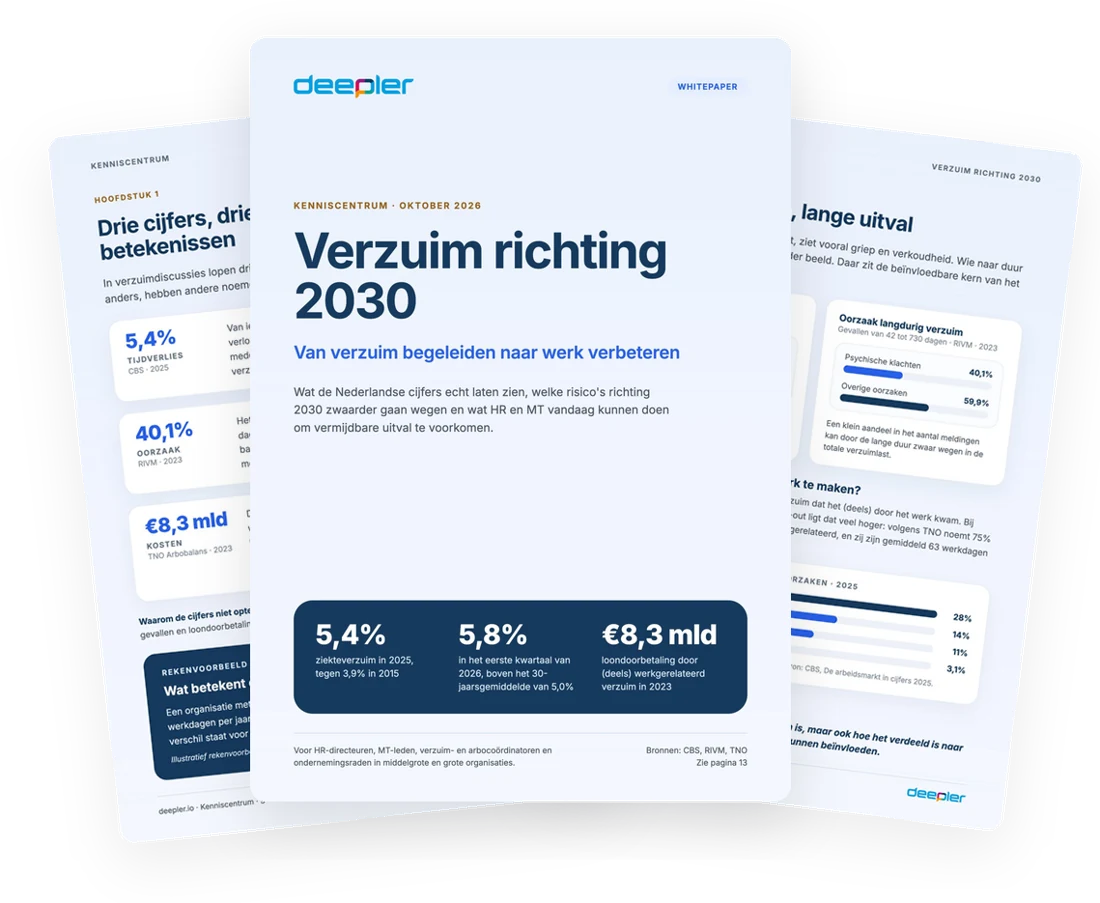
Free white paper
Absenteeism towards 2030
What the Dutch absenteeism figures really say, five risks towards 2030 and a plan for the first 90 days.
- The Dutch absenteeism figures clearly explained
- Five risks towards 2030
- Seven recommendations for HR and management
Frequently asked questions
Frequently asked questions about an employee survey in staffing and secondment
What is a good response rate for an employee survey?
The higher the response, the better the results represent the whole group. Many organisations aim for 60% or more. Among employees who work on site at clients, response without an extra approach often stays well below that. Over 70% is a strong result in that context.
How do you increase response among employees who work remotely?
Let the invitation come from people employees know, such as their consultant. Choose channels and moments when employees are already in touch with the organisation, keep the questionnaire short and mobile-friendly, and steer on response per group during the survey.
Does the client see employees' answers?
No. The survey belongs to the employer, not the client. The results are only visible to the organisation itself, and only from a minimum number of respondents, so answers cannot be traced back to individuals.
How long should an employee survey stay open?
For employees with varying shifts, a period of about three weeks works well. That way, people with night shifts, weekend work or leave can also take part, and there is room to make adjustments along the way.
Can you include temporary workers and seconded employees in one survey?
Yes. You survey both groups in the same survey and view the results per group. That way, you see where their experiences match and where they differ.