


Absence does not fall through better recording. It falls through better work.
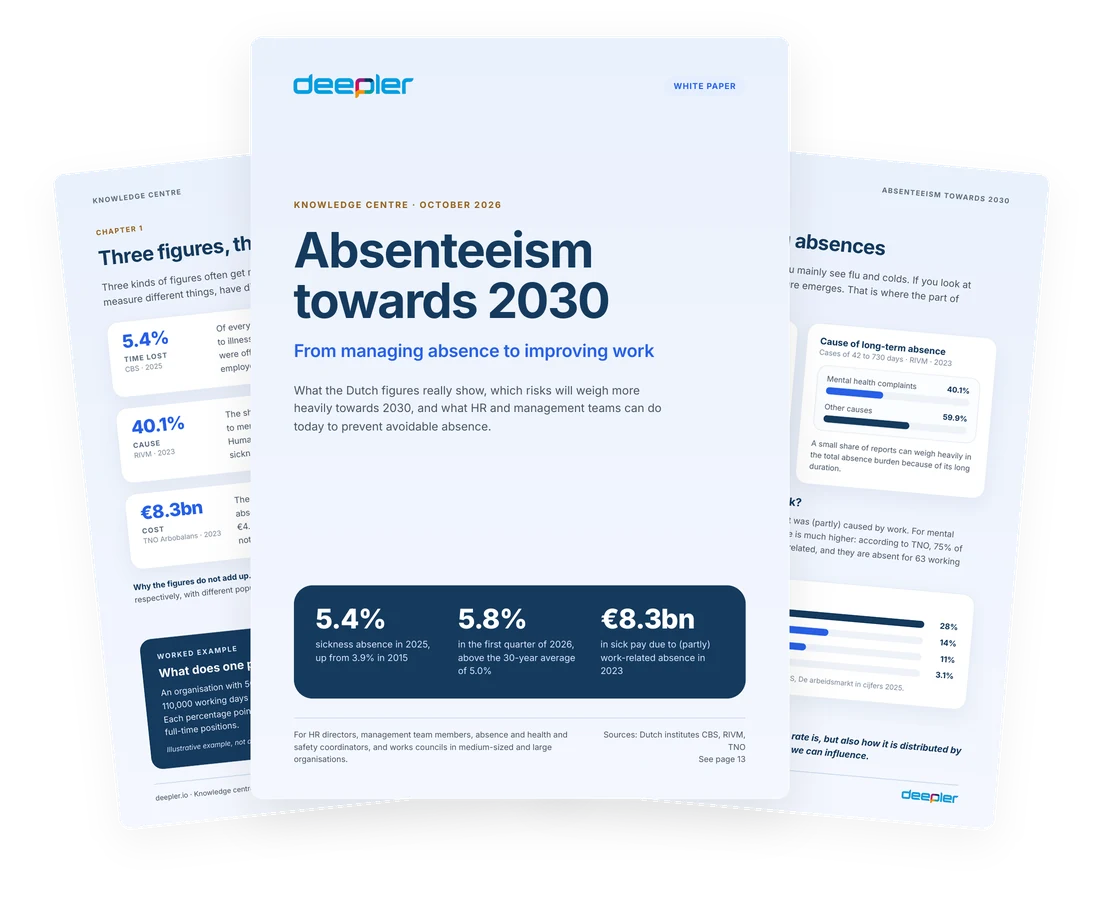
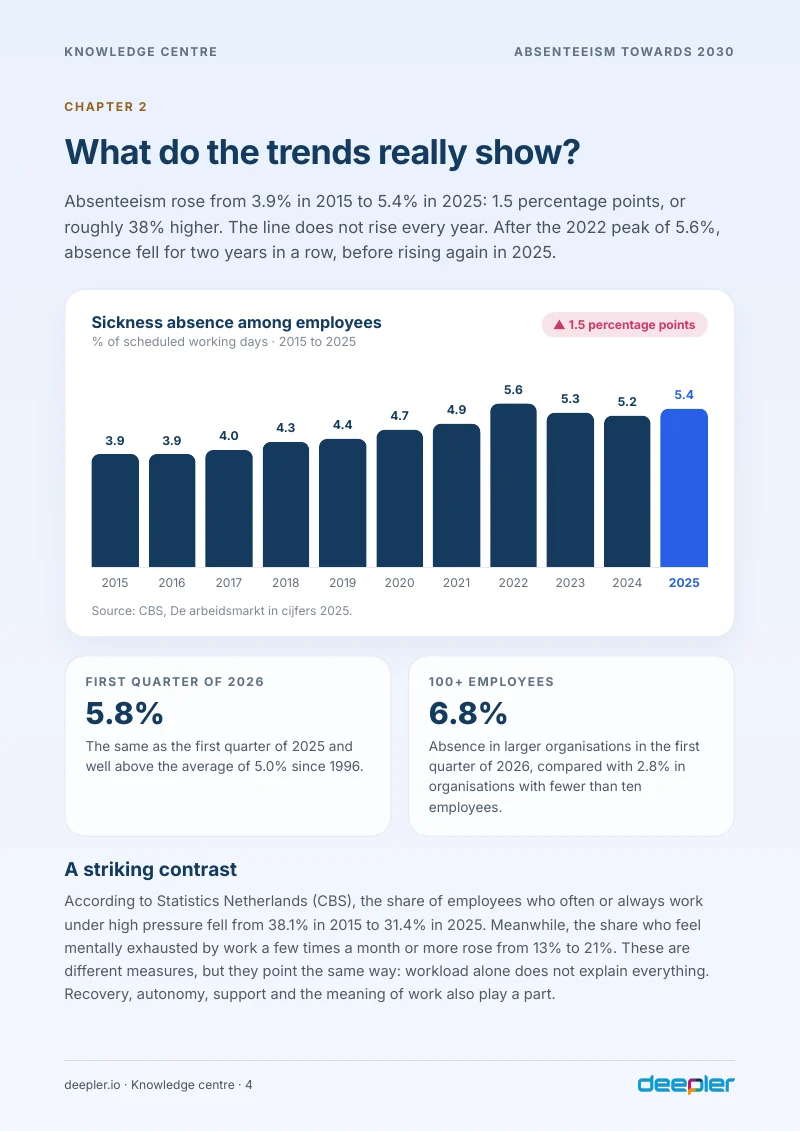
Sickness absence in the Netherlands rose from 3.9% in 2015 to 5.4% in 2025. The biggest burden lies in long-term absence: more often psychological, more often work-related. This white paper shows what the figures really mean and how HR and management teams can move from managing absence to improving work.
- The three absence figures that often get mixed up
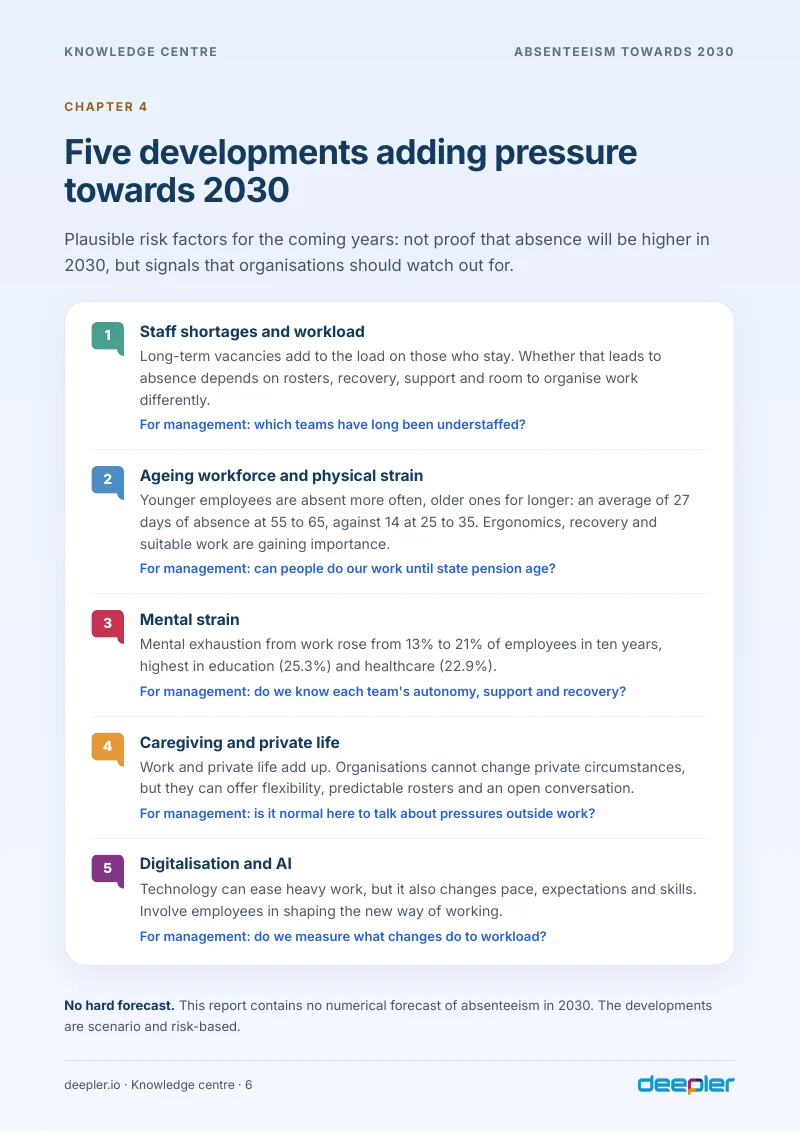
- Five developments adding pressure towards 2030
- Seven recommendations for HR and senior management
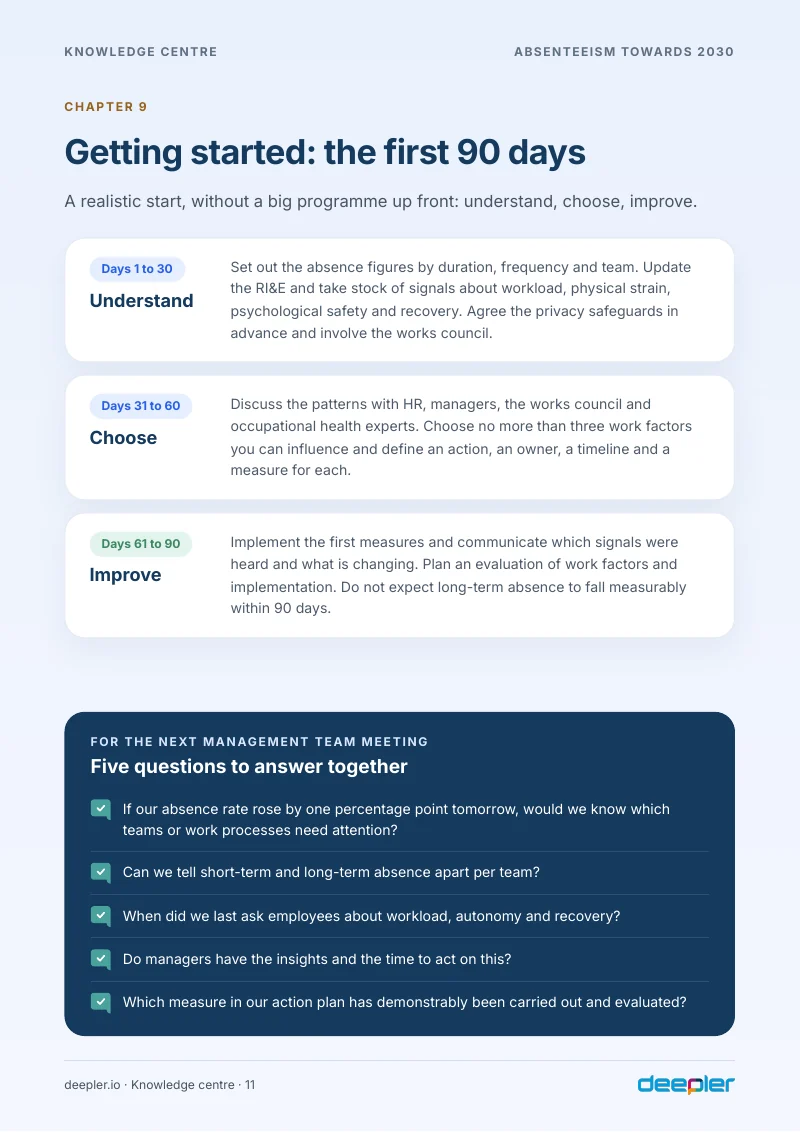
- A concrete plan for the first 90 days
Sources: Dutch institutes CBS, RIVM and TNO
Trusted by 400+ employers
4.9/5 reviews
Download the free white paper
Straight to your inbox. No spam. No obligations.
You get right away:
What the figures mean, the risks per sector, the four-step model for preventive employer practice and five questions for your next management team meeting.
Absence figures tell you how much. Not why.
Many organisations steer by a single percentage. Then you only see something once someone has already dropped out.
Step 1.
The percentage rises
The management team is alarmed by the quarterly figure. But which teams are behind it?
Step 2.
Everyone looks at the short sickness reports
Flu and colds dominate the reports. The heavy burden lies in long absences.
Step 3.
A wellbeing campaign follows
Well meant, but the work itself stays the same.
Step 4.
The next figure is high again
Because the causes in workload, recovery and support never came into view.
What is in the white paper
Three figures, three meanings
Time lost, cause and cost: what they measure and why you do not add them up.
The trends up to 2026
From 3.9% to 5.8% in the first quarter of 2026, and what lies behind it.
Five risks towards 2030
Staff shortages, an ageing workforce, mental strain, caregiving and AI, with a question for management per risk.
Differences by sector
Healthcare, government, education, industry and transport side by side.
From reactive to preventive
What the Dutch Working Conditions Act already requires and a practical four-step model.
The 90-day plan
Understand, choose, improve, plus five questions for your management team.
White paper: Absenteeism towards 2030
- The Dutch absence figures clearly explained
- Five risks towards 2030
- Seven recommendations for HR and senior management
- A plan for the first 90 days
- 13 pages, with sources
A look inside the white paper
This is what it looks like


From the white paper
Workload tops the list by far.
And that is exactly where you have influence as an organisation. The white paper shows which causes you can influence and how to map them per team, before anyone drops out.
Download the white paperMost cited work-related causes (2025)
Share of employees with work-related absence. Source: CBS, De arbeidsmarkt in cijfers 2025
If you want prevention, you need to know what is going on in your teams.
Absence records show how many days are lost. Employee research shows which work factors are involved. With Deepler you see per team where demands and resources fall out of balance, anonymously and at group level.
- Workload, recovery and support per team
- No medical questions, no individual profiles
- From insight to improvement action
Trusted by small and large
Experiences of customers who make a difference with us.
-
Larren
Recruitment Lead,
De Selectie
“Recently, I used Deepler to arrive at an EVP. Great what they were able to achieve in a short time! In a period of two weeks, we collected information and were able to continue with our AMC plan. In any other situation, it takes weeks, if not months, to get this done. Contact is good, friendly and constructive. Very nice club to work with.”
-

Douwe
Recruiter,
Securitas
“Ideal tool and company to gain more and better insight into the organization and employees as an organization! And especially with speed! For us, it was also the need to get tools for the topics of retention, to prevent future absenteeism or turnover. I also have experience with other parties and I sincerely value the speed of switching, follow-up and personal contact with Deepler. Absolutely recommended.”
-

Jolanda
HR Business Partner,
Nedcargo
“Deepler is a great tool for continuously collecting feedback from our employees. This input is then centrally available for us as management, but also for managers who benefit from it.”
-

Jonathan
Manager,
UWV
“What makes Deepler special is that it doesn’t get stuck in numbers. It helps you immediately understand where it is and what teams need. For us, this ensured that employees themselves came up with areas for improvement and took responsibility for them. The insights were sharp and useful, but most importantly: the conversation that started afterwards made the difference. Thanks to Deepler, we didn’t get a paper plan, but change that was supported by the people themselves.”
-
Amadeus
COO,
OSRE
“The software has a positive impact on us as a rapidly growing organization. By better understanding what is going on in the workplace and what people offer as solutions for improvements, we can make more effective decisions. The platform helps us to gain real-time insight and to respond directly to it via the tool.”
From managing absence to improving work.
Download the white paper and discover which risks will weigh more heavily towards 2030, and what you can already do today.
- Understand what the absence figures really say
- See which five developments add pressure
- Compare your sector with the average
- Work preventively, within what Dutch law already requires
- Start with a realistic 90-day plan
Download the free white paper
Straight to your inbox. No spam. No obligations.