


Welfare meeting: what to ask an employee off sick
Monday, 8:15. A team leader at one of the sites gets a call: an employee has reported sick. What can...
Verder lezen


Absence in winter is flu, and there is little an organisation can do about it. That is the common assumption, and in part it holds. Flu fills the sick reports. But the damage sits in long-term absence, and that more often has to do with the work. Winter blues in your team are then a first signal. What matters is the winter load of the work: light, recovery and staffing.
Sickness absence per quarter in 2025
Source: CBS, Ziekteverzuimpercentage per kwartaal (2026), the Netherlands
Absence follows a fixed pattern. In the Netherlands in 2025, it stood at 5.8% in the first quarter and 5.1% in the third quarter. That is a difference of 0.7 percentage points (CBS, 2026a). The fourth quarter came in at 5.6%.
Statistics Netherlands (CBS) speaks of a seasonal effect: more people are off sick in winter than in summer. That is why it always compares a quarter with the same quarter of earlier years (CBS, 2026b).
A large part of the explanation is the flu season. The RIVM, the Dutch National Institute for Public Health and the Environment, runs the respiratory season from week 40 to week 20. That is roughly from early October to mid-May (RIVM, 2026). In 2025, 55% of employees on sick leave named flu, a cold or another viral infection as their main complaint (CBS, 2026b).
So the season is long. The epidemic itself is shorter. In 2026 it started at the end of January and lasted six weeks. A year earlier it lasted nine weeks (Nivel, 2026). It is hard to predict when the peak will fall. You can prepare, though, because a team often runs with little reserve in the dark months.
In terms of the number of sick reports, largely yes. Flu and colds account for 55.2% of absence. They last 3 working days on average. Only 11% is attributed to the work (Van den Heuvel et al., 2025, figures for 2023).
Absence due to mental health complaints, overstrain and burnout is 7.9% of the total. It lasts 63 working days on average. In 75% of cases it is partly or mainly attributed to the work (Van den Heuvel et al., 2025). So the short reports fill the statistics. The long-term absence determines the damage. Also read what causes burnout and what an employer can do about it.
Note what this does not say. There is no evidence that absence due to mental health complaints is higher in winter than in summer. The reasoning is simple, though. When short reports thin out a team, colleagues share out the work. The pressure lands on whoever stays. A team with little reserve notices that first.
The figures on workload point the same way. High workload and infection at work are among the most frequently cited causes of work-related absence (Arboportaal, 2026). Both can partly be influenced. The share of employees with burnout complaints rose to 21% in 2025, against 19% in 2023 (Arboportaal, 2026).
For the board, the cost counts too. In 2023, employers paid € 8.3 billion in wages during work-related absence. Of that, € 4.9 billion came from psychosocial workload (Van den Heuvel et al., 2025).
Winter blues is the everyday name for low energy in winter. You get tired more quickly and feel less motivated. You also hear the terms winter dip and autumn dip. Winter blues is not a diagnosis and not an illness.
Seasonal depression, also known as seasonal affective disorder (SAD), is. According to Thuisarts, the Dutch GP information site, you then have a depression in autumn or winter two years in a row. It goes away again in spring. The cause is probably less daylight. People then have no energy, feel very tired and want to sleep a lot (Thuisarts, n.d.). The NHS describes it in the same way. Light therapy is not routinely available there, because the evidence is too limited (NHS, n.d.).
For HR, that means: do not diagnose, and do not ask about it. A team leader sees behaviour, not the cause. Anyone who has felt low for more than a few weeks belongs with their GP or occupational physician. The conversation with the employee is about the work and what they need. A dip in energy can be discussed; a depression belongs with a professional. As HR, you make sure the route to the GP or occupational physician is short.
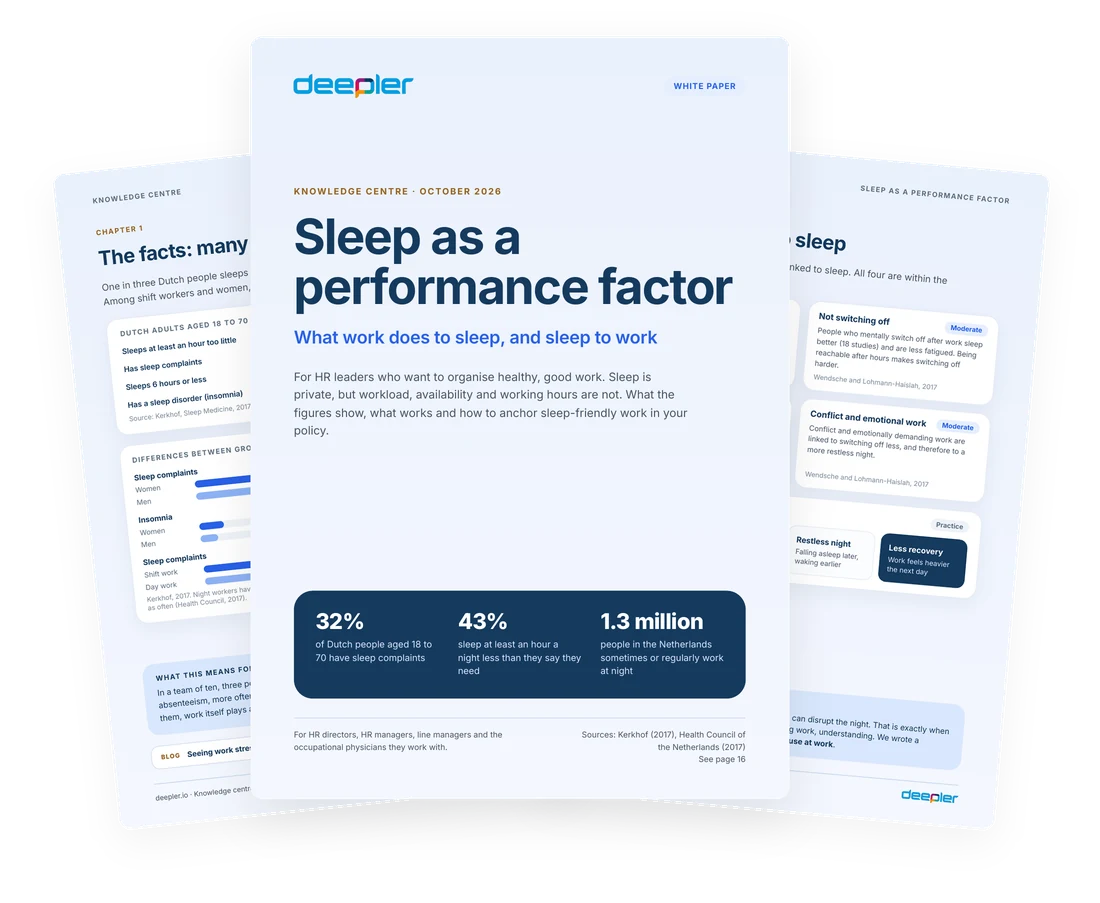
Free white paper
Sleep as a performance factor
How sleep, energy and work influence each other, and what HR can do about it.
According to the KNMI table, around 21 December the sun rises at about 8:45 am and sets at 4:30 pm in the Netherlands (KNMI, n.d.). That is less than eight hours of daylight. Anyone working nine to five travels there and back in the dark.
The Arboportaal, the Dutch occupational health portal, writes that the positive effects of light apply mainly to daylight. It advises exposing employees to daylight as much as possible (Arboportaal, n.d.). Artificial light has a lower intensity.
How much absence this saves is not known. The measures are small and cheap, though:
The team leader who makes the rota does their best with the staff they have. Light is rarely in that rota. It can be, if someone raises it.
That applies to healthcare, where shifts change, and to production, where teams work fixed hours. A team that starts at 6:00 am and finishes at 2:30 pm sees little daylight in December. The question is not who is to blame, but where a quarter of an hour outside fits.
You do not need to wait until spring. You arrange this in November:
Winter blues are no reason to panic, but they are a reason to pay attention. It is about what you can plan into the work, not about what happens to your employees in private. Whoever builds winter into the planning as a season has more room in January. Whoever waits for the first absence does not.
If you ask employees, keep it short and anonymous. Do not split out the results for small groups. Say beforehand what will happen with the answers. Discuss the absence policy and what is recorded with the works council.
Think of the employee who fills it in, too. Why would they answer honestly? Only if they know the answer cannot be traced back to them. And that something happens with it afterwards. An example question: how was your energy over the past weeks, on a scale of 1 to 5?
The dark months in your team
Sources: Arboportaal; RIVM; own compilation by Deepler
What can you do tomorrow? In the next team leaders’ meeting, go through the winter weeks with the checklist above. That is all the first time needs to be.
With the Reduce absenteeism module in Deepler Research, you ask employees anonymously which work factors influence absenteeism in their team. Want to read more about recovery first? Then read How to switch off from work when always reachable.

Stijn van der Vat
Founder / CEO
Stijn founded Deepler in 2021 together with three other change managers, driven by a shared conviction: organizations only truly change when employees are taken seriously. As CEO, he shapes Deepler’s strategic direction and builds lasting partnerships with clients and partners. Stijn is often the first point of contact for organizations looking to get more out of their employees' voices.