It is 22:10 and the shift leader’s app lights up: tomorrow’s rota has changed. Or it is Sunday evening and the director has sent an email nobody has to answer, but everyone reads. Nobody forces you to reply. Still, it gets much harder to switch off from work. Anyone who is always reachable keeps their mind on the job. That is called technostress: stress caused by technology in and around work.
Five sources of technostress
Techno-overloadTechnology makes you work faster and more.
Techno-invasionWork intrudes on your private time. This is what this blog is about.
Techno-complexitySystems feel too complicated to use well.
Techno-insecurityYou fear technology will make your job redundant.
Techno-uncertaintySystems keep changing, so learning never stops.
Source: Tarafdar et al. (2007)
The message is not the problem
One quick message takes you ten seconds. What matters is what it does to the rest of your evening. You know it is there, and you wonder whether a reply is expected.
Researchers call this telepressure: the urge to respond immediately to work messages (Barber and Santuzzi, 2015). That urge often comes from an unspoken expectation, not from an agreement. That is exactly why it is hard to discuss.
Why it is so hard to switch off
Recovery after work begins with mentally letting go of the job. Psychologists call this psychological detachment (Sonnentag, 2012). Anyone who cannot detach keeps brooding over work, even at dinner or on the sofa.
In a diary study, researchers saw that using a smartphone for work in the evening was linked to more conflict between work and home. That went together with less recovery and more burnout symptoms (Derks and Bakker, 2014).
Recovery is more than doing nothing. Sonnentag and Fritz (2007) distinguish four experiences that help.
Four experiences that help you recover
1. Mental detachmentYou stop thinking about work for a while.
→
2. RelaxationYou wind down, physically and mentally.
→
3. MasteryYou learn or do something new outside work.
→
4. ControlYou decide how to spend your free time.
Source: Sonnentag and Fritz (2007)
A message at 22:10 affects three of them. You detach less, your rest is shorter and your time is no longer entirely your own.
Nobody is the villain
The manager who emails in the evening often does so to keep the day free for the team. The colleague who replies straight away wants to help. Both act with good intentions.
Still, you feel the effect, even when the message is not urgent. The mere expectation that you read email outside working hours affects wellbeing. Not only the employee’s, but also that of the partner at home (Becker et al., 2021).
So the pattern is shared. That also means you can change it together, without anyone having to feel guilty.
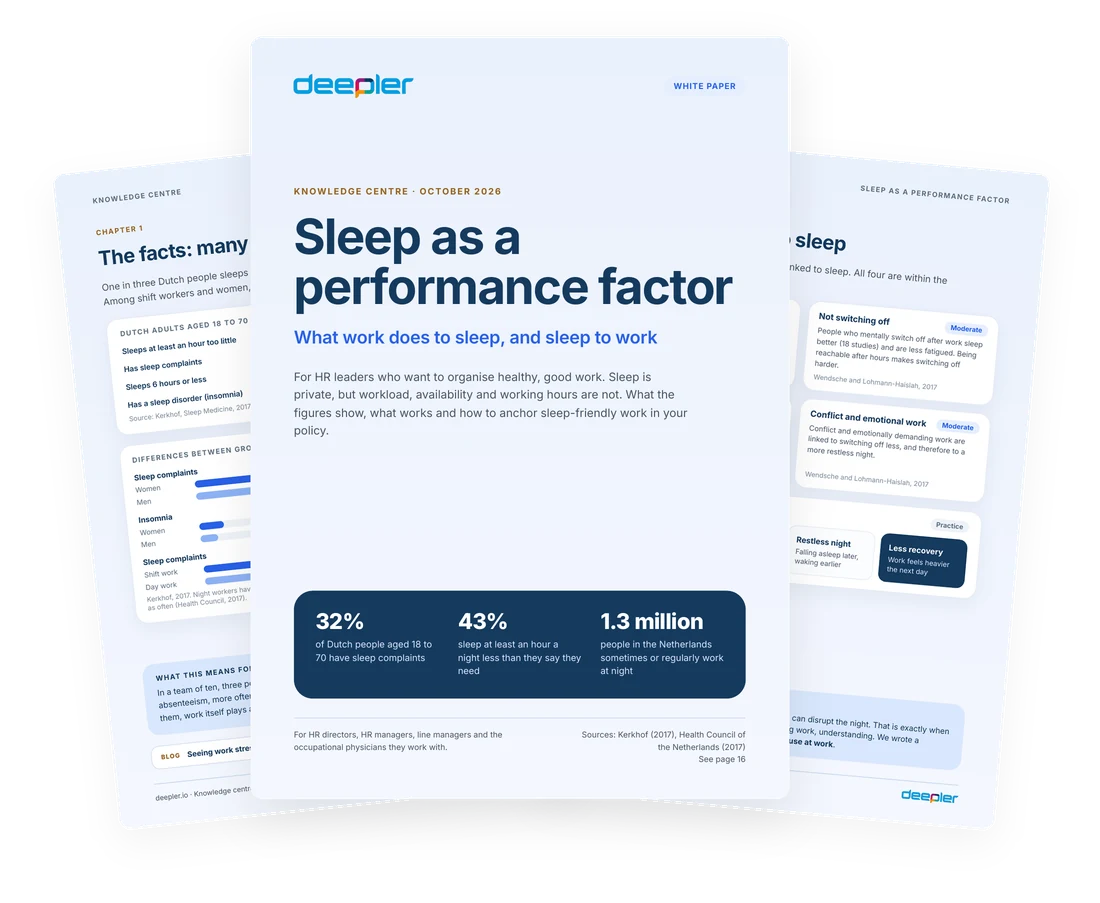
Free white paper
Sleep as a performance factor
With an explanation of sleep and recovery, and a worksheet for team agreements.
Download the white paper
Five agreements for the team meeting
Agreements help more than good intentions. Discuss them in the team meeting, including people without a desk or a work email address. Think of shift workers, the shop floor, the phone and WhatsApp groups.
- Channel. Agree which channel you use for what: the app for rotas, email for the rest.
- Urgent. Decide what is urgent and who calls then. Everything else waits until the next working day.
- Response time. Make clear that nobody has to reply outside working hours. That way, being unreachable for a while is simply allowed.
- Scheduling. Schedule messages so they arrive on a working day.
- Leading by example. Managers show what they agree. A leader who sends nothing at 22:10 says more than a rule.
Want to know what is going on? Ask your team. Say beforehand what happens with the answers and keep them anonymous. Involve the works council in agreements about availability. The employee who fills it in wants to know that something really changes afterwards. Also read how to spot work stress earlier.
Start tomorrow with one question in the team meeting: when do we actually expect an answer?
Getting started
With the Workload module in Deepler Research, you see per team where workload is squeezing people, including outside working hours. Want to find out first where your own energy goes? Then take the work stress test.
Knowledge centre
What does your team agree about being unavailable for a while?
Download the worksheet and discuss the first point in your next team meeting.
Download for free
Sources
- Barber, L. K., & Santuzzi, A. M. (2015). Please respond ASAP: Workplace telepressure and employee recovery. Journal of Occupational Health Psychology, 20(2), 172-189.
- Becker, W. J., Belkin, L. Y., Tuskey, S. E., & Conroy, S. A. (2021). Killing me softly: Organizational e-mail monitoring expectations’ impact on employee and significant other well-being. Journal of Management, 47(4), 1024-1052.
- Derks, D., & Bakker, A. B. (2014). Smartphone use, work-home interference, and burnout: A diary study on the role of recovery. Applied Psychology, 63(3), 411-440.
- Sonnentag, S. (2012). Psychological detachment from work during leisure time: The benefits of mentally disengaging from work. Current Directions in Psychological Science, 21(2), 114-118.
- Sonnentag, S., & Fritz, C. (2007). The Recovery Experience Questionnaire: Development and validation of a measure for assessing recuperation and unwinding from work. Journal of Occupational Health Psychology, 12(3), 204-221.
- Tarafdar, M., Tu, Q., Ragu-Nathan, B. S., & Ragu-Nathan, T. S. (2007). The impact of technostress on role stress and productivity. Journal of Management Information Systems, 24(1), 301-328.