


Slaap en werk: waarom slaap een HR-onderwerp is
Een op de drie Nederlanders heeft slaapklachten, en ruim vier op de tien slapen structureel te kort....
Verder lezen



When do you see that a team is becoming overloaded? Many organisations only see it when absence rises. But by then you are actually too late. Work stress doesn’t start with a sick note. It starts with small signs of stress at work that you can hear in conversations, often weeks or months earlier.
Around the Dutch Week of Work Stress (Week van de Werkstress), we like to take a moment to reflect on this.
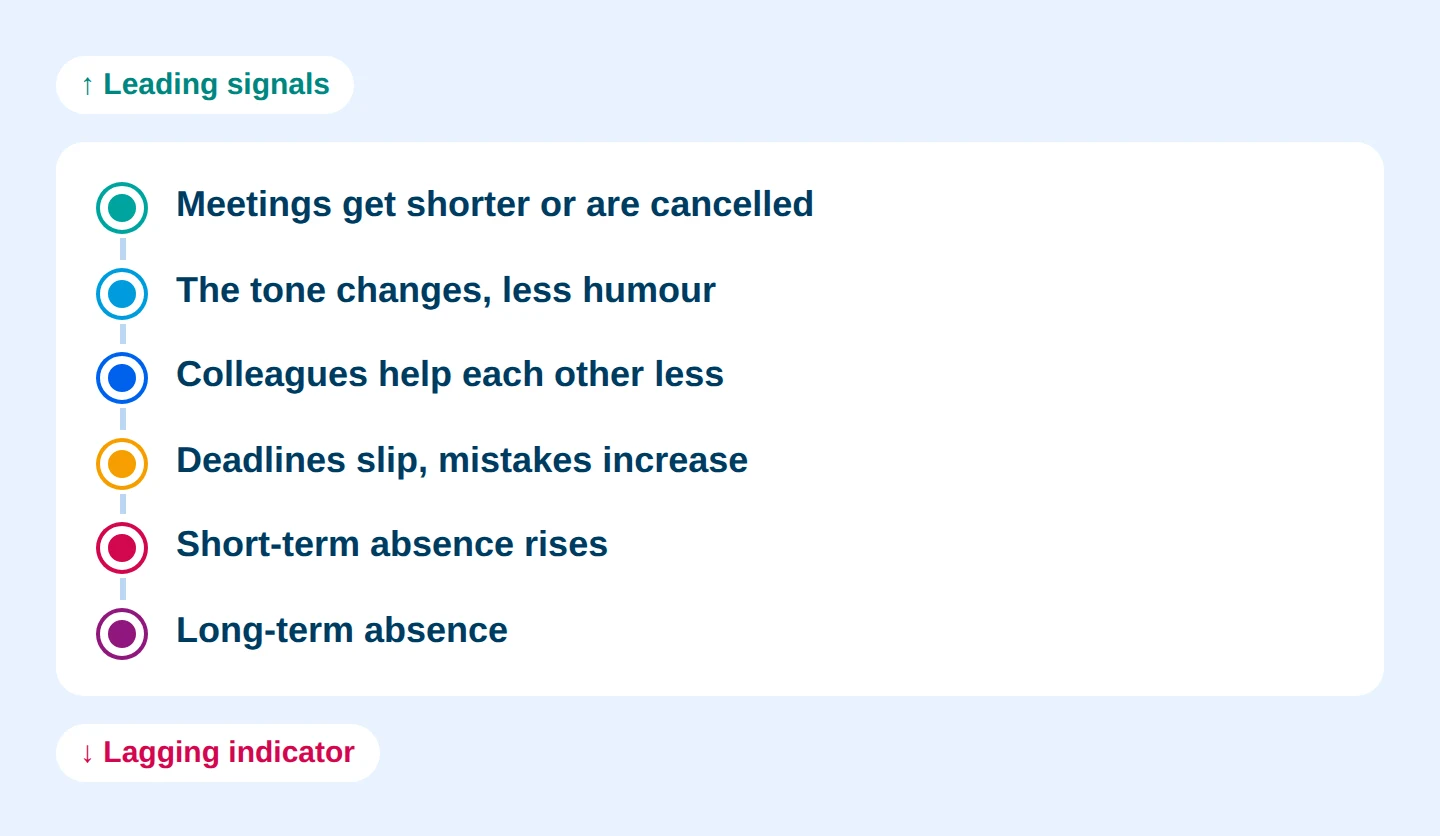
An absence figure tells you what has already happened. It is like the warning light on the dashboard that only comes on when the engine is already damaged. Useful, but not for prevention.
If you want to spot work stress sooner, you look at leading signals: how people experience their work, how much room they feel they have and how collaboration is going. Those signals are usually there long before someone drops out.
Every year, the Netherlands Working Conditions Survey (NEA) by TNO and CBS gives a picture of how employees in the Netherlands experience their work. According to the NEA 2025, 21 percent of employees had burnout complaints. Ten years earlier, that was 13 percent. More than a third of employees (37 percent) think (additional) measures are needed to tackle work pressure and work stress. High work pressure is also the most frequently cited cause of work-related absence.
Important to know: burnout complaints in the NEA are self-reported complaints of mental fatigue caused by work. So they are not medical diagnoses, but what people experience themselves. That is exactly why they are valuable: they show what is going on before things go wrong.
None of these signals proves anything. Together, however, they are a reason to start a conversation.
Recognising signals is one thing. Doing something with them is another. A few simple agreements help:

The manager is often the first to notice something. That doesn’t mean they have to become a counsellor. The role is simpler, and at the same time harder.
Noticing. Pay attention to changes in behaviour, not just performance.
Asking. An open question works better than a judgement. “I notice you’ve often been working late lately. How are you doing?” is a good start. Listen, and don’t try to solve things straight away.
Looking at the work. Ask what would help in the work. Tasks, priorities, planning and support are within the manager’s influence.
Referring. Do complaints persist, or are you worried about someone’s health? Then refer them to the occupational physician, HR or a confidential adviser. That is not failure, but good employership. Questions about health belong with the occupational physician, not with the manager.
As a manager, also keep an eye on yourself. If you are overloaded yourself, you are slower to see signals in others.
One conversation gives a snapshot. Listening regularly, briefly and anonymously shows how things develop. Has experienced work pressure in a team risen three months in a row? Then you know something is going on, long before absence shows it.
Anonymity matters here. Not everyone tells their manager that things are tough. And it is about trends per team, not about tracking individuals.
Bakker and Demerouti’s Job Demands-Resources model shows that it is not only about the demands of the work, but also about resources: autonomy, support from colleagues and the manager, feedback. If you have both in view, you know where you can adjust.
Work stress is not only a matter of good employership. Under the Dutch Working Conditions Act, employers must have a policy to prevent or limit psychosocial workload, such as work pressure. Psychosocial workload should therefore have a place in the risk inventory and evaluation (RI&E), with an action plan. Many other countries have comparable obligations.
Listening regularly helps keep that risk assessment up to date. It shows where the risks are and whether measures are having an effect. The Dutch Arboportaal offers practical information and tools for this.
Involve employees in coming up with measures as well. They often know best where the work pressure comes from and what would help in practice. A measure devised together with the team usually fits the work better than one imposed from above.
Work stress is a serious topic, but no reason to panic. Most signals can be recognised in time and made discussable. What it takes is attention: regularly asking how things are going, and taking the answers seriously.
Read at deepler.io how we help organisations spot signs of work pressure sooner.

Sanne Huisman
Knowledge center Deepler
Sanne is the heart of Deepler’s Knowledge Center. She translates research, data, and practical experience into real-world applications for organizations. Whether it involves an employee survey, a whitepaper, or hands-on support, Sanne ensures that knowledge doesn’t go to waste but is instead used to improve both our work and our products.