Monday, 8:15. A team leader at one of the locations gets a call: an employee has called in sick. What is he allowed to ask? Should he call back or not? This conversation happens every week, at every location. Hardly anyone has ever taught the team leader anything about it. The first welfare meeting is not about the illness, but about the work and staying in touch.
What research says about absence due to mental health complaints and work
75%of absence periods due to mental health complaints and burnout are, according to TNO, partly or mainly attributed to work
63 daysaverage duration of absence due to mental health complaints, overstrain and burnout
€8.3 billionin continued pay by employers for work-related absence in 2023
Source: TNO, Arbobalans 2024 (figures for 2023)
Why does the first conversation after someone calls in sick so often feel awkward?
The team leader is unsure. He wants to be caring, but does not know what is and is not allowed. So he asks too much, or he does not call for fear of saying the wrong thing. He is doing his best. He has just never learned how to do it.
The employee is on the other end of the line, at their most vulnerable. Especially when it comes to mental health complaints, every question can feel like a judgement. That first conversation sets the tone for the rest of the absence.
There is another tricky point. The team leader is not the company doctor and does not need to be. His role is the work: what is on the agenda, what needs to be covered and when you will speak again. As soon as he is clear about this, much of the tension disappears.
It also weighs heavily financially. TNO calculated that employers spent €8.3 billion on continued pay for work-related absence in 2023. More than half, €4.9 billion, was due to psychosocial workload. This is mainly because of the long duration of this type of absence (Van den Heuvel et al., 2025). Also read what causes burnout and what an employer can do.
What can you ask when someone calls in sick, and what not?
The Dutch Data Protection Authority is clear: when someone calls in sick, you may only ask and record what is necessary. These are the following points (Autoriteit Persoonsgegevens, n.d.):
- Contact details. The phone number where the employee can be reached and the (care) address.
- Expected duration. How long the employee expects the illness to last.
- Ongoing work. What the ongoing tasks and appointments are.
- Accidents. Whether the illness is related to an accident at work, or to a traffic accident with a right of recourse.
- Safety net scheme. Whether the employee falls under one of the four safety net schemes of the Dutch Sickness Benefits Act. They do not always have to say which scheme it is.
What is not allowed is asking what someone has and what caused it. Health data are special categories of personal data. Even the employee’s consent does not change that. They depend on their employer and may feel obliged. Consent can therefore never be entirely free.
Does an employee tell you on their own initiative what is going on? Then you can simply listen. Listening is allowed. You do not ask about it, and you do not record or share it. So the list of what you may ask is short. That is not a disadvantage, because the rest of the conversation is about the work.
Conducting a welfare meeting in four steps
Take a team leader at a location who gets a sick report on Monday morning. A welfare meeting does not have to take long. Four steps, in this order, keep the conversation safe and useful.
- Tone. Start with: how are you? Do not probe. The answer may be short, and they do not need to explain anything.
- Practical. What needs to be taken over? Think of ongoing shifts, appointments and what cannot wait. That way the employee does not have to worry about it.
- Contact. Ask how and when the employee wants to stay in touch, and with whom. The British NICE guideline NG146 advises asking how someone wants to be contacted, how often and by whom. If the manager is not the right person, offer an alternative (NICE, 2019).
- Work. Does the work play a role? Ask about the work, not the illness. That makes sense. With mental health complaints and burnout, work often plays a role. That applies to 75% of absence periods, partly or mainly (Van den Heuvel et al., 2025).
The answer to the last question does not have to come in the first conversation. Just say that the question remains open. The employee can decide when to bring it up. It can help to agree on a fixed moment, for example a call in a week’s time. Then they do not have to take the first step themselves.
The first welfare meeting on one card
Do askWhere can you be reached? How long do you think it will take? What should I take over from you? How and by whom would you like us to stay in touch?
Do not askWhat do you have? What is causing it? What medication are you taking? Anything about a diagnosis.
Discuss if the employee raises it themselvesDoes the work play a role? What do you need? Listen, do not probe and do not record the illness.
Sources: Dutch Data Protection Authority; NICE NG146
Free whitepaper
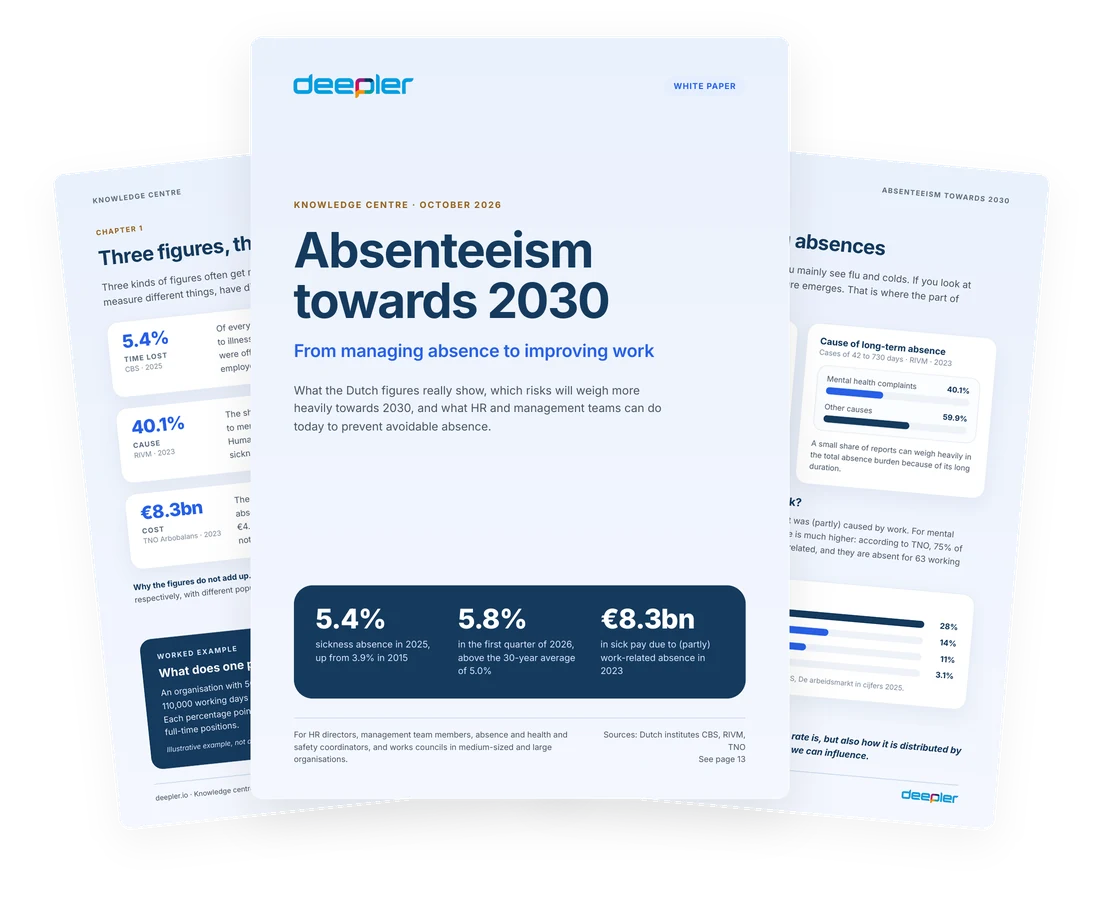
Absenteeism towards 2030
If you see now where workload arises, you will keep the absence challenge of the coming years better under control.
Download the whitepaper
How do you stay in touch with a sick employee?
After that first conversation the real work begins. Staying in touch with a sick employee is not a courtesy, but a legal obligation. Under the Dutch Gatekeeper Improvement Act, your responsibility starts with the sick report. The UWV puts it like this: in the first weeks you make regular contact. You ask how things are going and what the expectations are (UWV, n.d.-a). The timeline after that:
- First weeks. Regular contact. Intended to stay involved.
- After 6 weeks. The company doctor draws up a problem analysis.
- By week 8 at the latest. You and the employee draw up a plan of action together, within 2 weeks of the problem analysis.
- After that. At least once every 6 weeks you discuss progress (UWV, n.d.-b).
- After 52 weeks. A mandatory first-year evaluation.
NICE also advises making contact within 4 weeks. Make it clear that the aim is support, not control. The division of roles also helps. The company doctor discusses the medical side. The manager discusses the work. Keep that separate, and the conversation stays within what is allowed.
Earlier TNO research indicated that active absence policy by the manager goes hand in hand with less absence (Ybema & Jettinghoff, 2009). Job satisfaction also increased. Read this as a cautious indication, because the research dates from 2009.
What does the employee hear in that conversation?
Look at the conversation from the other side for a moment. An employee calls in sick. They hear: “When will you be back?” That feels like pressure, even if it is not meant that way. The conversation is about the planning, not about them. Many employees are already unsure whether they are allowed to be ill. That question confirms that doubt.
If they hear this: “What do you need, and what can I take over?” Then they notice that someone is thinking along with them. The subject is the same, the tone is different. One question feels like control, the other like care.
That difference matters for what happens next. Someone who feels heard stays in touch and talks more openly about what is going on at work. Someone who feels controlled would rather stay silent. Then you miss exactly the information you need to help.
What can HR do so that team leaders can do this themselves?
The answer to “we are not ready yet” is: start small. You do not need to launch a big programme. Three small steps are enough to get started:
- One conversation card. Put the card above on one page and send it to all team leaders.
- One practice moment. Go through the conversation once in the team leaders’ meeting, using a recognisable situation.
- Clear agreements. Record in the absence protocol who does what and what is recorded.
Discuss that protocol with the works council. That is not a formality. This way everyone knows what is and is not recorded, and who may see it. It also gives team leaders something to hold on to when an employee asks about it.
Want to know which work factors play a role per team? Then ask the employees themselves. Do this anonymously and do not break down the results for small groups. Say in advance what will happen with the answers. Also read how to spot work stress earlier.
What can you do tomorrow? Forward the conversation card to the team leaders. And at the next sick report, ask one question about the work instead of about the illness. That first conversation does not need to be more than that.
Get started
With the Reducing absenteeism module in Deepler Research you ask employees anonymously which work factors influence absence in your teams. Want to know more first about what lies ahead for absenteeism in the coming years? Then read the whitepaper Absenteeism towards 2030.
Sources
- Autoriteit Persoonsgegevens. (n.d.). Regels voor werkgevers bij zieke werknemers. https://www.autoriteitpersoonsgegevens.nl/themas/werk-en-uitkering/ziekteverzuim-en-privacy
- National Institute for Health and Care Excellence. (2019). Workplace health: Long-term sickness absence and capability to work (NICE guideline NG146). https://www.nice.org.uk/guidance/ng146/chapter/Recommendations
- UWV. (n.d.-a). Quick start bij de Werkwijzer Poortwachter [Brochure]. UWV. https://www.uwv.nl/assets-kai/files/8c607801-a55b-40d6-9bd3-523911a688a6/quick-start-werkwijzer-poortwachter.pdf
- UWV. (n.d.-b). Plan van aanpak als een werknemer ziek is. https://www.uwv.nl/nl/ziek/loondoorbetaling/plan-van-aanpak
- Van den Heuvel, S. G., Bouwens, L., & De Vroome, E. M. M. (2025). Arbobalans 2024 (TNO 2025 R11108). TNO. https://monitorarbeid.tno.nl/wp-content/uploads/sites/16/2025/05/TNO-Arbobalans-2024.pdf
- Ybema, J. F., & Jettinghoff, K. (2009). Effecten van verzuimbeleid en verzuimcultuur op ziekteverzuim en arbeidstevredenheid. Tijdschrift voor Arbeidsvraagstukken, 25(2), 156-169.