Tuesday, 9:00: a sick report with a story behind it. At 11:00 a bad-news conversation about a reorganisation. At 14:00 a colleague walks in in tears. At 17:00 the board asks whether the absence figures are ready yet. You walk back to your desk and carry on. Anyone who works like this risks emotional labour turning into compassion fatigue: running empty from absorbing other people’s emotions.
What research says about emotional strain and HR
20%of Dutch employees have burnout symptoms
9.1%of Dutch employees experience high emotional strain
75%of HR professionals in the US find working in HR emotionally exhausting (American research)
Sources: TNO and CBS, NEA 2024, the Dutch national working conditions survey (first two figures, all employees); SHRM (2024), American HR professionals
Who looks after you when HR absorbs everything?
HR is often the department where everything lands. The manager who passes on a conflict. The employee who can no longer cope at home. The director who wants someone else to deliver a difficult message. It comes with the job, and most of the time you are glad to do it.
The problem is that it is rarely visible. You absorb it, and then you move on to the next conversation or the next report. An hour-long conversation appears in no report. So the director does not see it either. That is not ill will: what is recorded nowhere, nobody notices.
Frost and Robinson (1999) called people who absorb the pain in an organisation toxic handlers. They saw them as heroes and casualties at the same time. The term fits the position HR often takes.
What is compassion fatigue?
Figley (1995) describes compassion fatigue as the negative effect of caring for people in distress over a long period. It erodes your ability to empathise with others (cited in Bentley, 2022). In healthcare the term has been familiar for a long time. In HR you rarely hear it, even though the work is much alike.
It rests on emotional labour. Hochschild (1983) used that term for work in which you manage your own feelings because your role demands it. You stay calm with an angry employee. You sound understanding about a decision you find difficult yourself.
HR does this every day, and also sits between employer and employee. You have to take everyone seriously, even when interests clash. That costs energy you never see reflected on a form. In the long run you notice you have less patience, or less desire to empathise. That is not a character flaw. It is a known consequence of this kind of work.
How common is emotional labour in HR?
For HR in the Netherlands we have no figure of our own. We do know how things stand on average. According to TNO and CBS, 20% of Dutch employees have burnout symptoms (Nationale Enquête Arbeidsomstandigheden 2024, the Dutch national working conditions survey). That is 1.7 million people. In addition, 9.1% experience high emotional strain (TNO, 2025). Both figures concern Dutch employees.
In the United States, SHRM (2024) asked HR professionals how they experience their work. A majority, 75%, find it emotionally exhausting. That is American research, so read it as a signal and not as a Dutch fact. Whether it is the same here, nobody knows exactly. If you recognise it, that is reason enough to take a look.
Also read how burnout develops and what an employer can do about it.
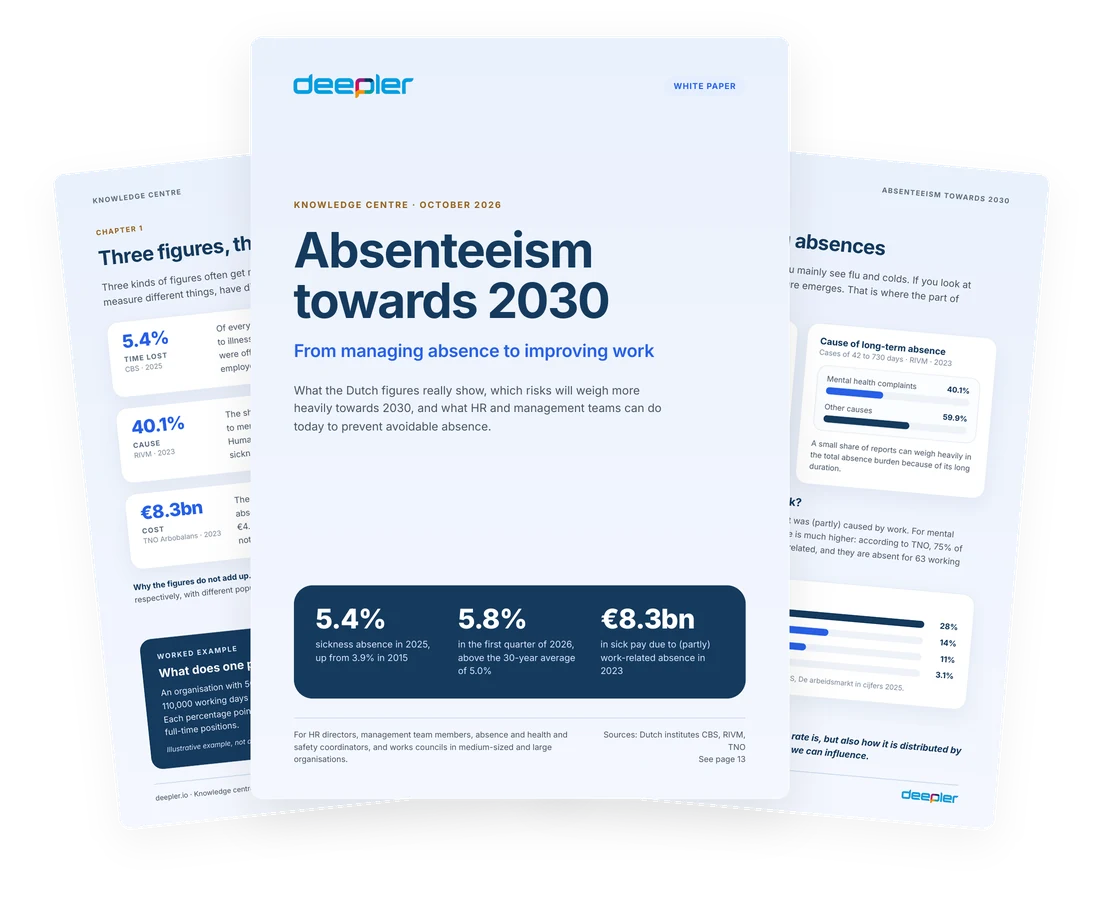
Free white paper
Absenteeism towards 2030
If you can see where workload builds up today, you will be better placed to manage absenteeism in the years ahead.
Download the white paper
Why does HR measure everything except itself?
The cobbler’s children have the worst shoes. HR measures and improves the wellbeing of the whole organisation, but rarely its own. It is nobody’s fault. It is a blind spot that you can remove together.
The Job Demands-Resources model by Bakker and Demerouti (2017) helps to see it. Work has demands and resources. It goes wrong when demands grow and resources do not keep pace. Resources can dampen the effect of high demands on burnout.
Workload in HR as a balance between demands and resources
Job demandsEmotional conversations, role conflict and peaks around reorganisations and absence.
→
ResourcesSupport from colleagues, peer consultation, recovery after heavy conversations and autonomy.
→
OutcomeIf demands grow faster than resources, the risk of burnout symptoms increases.
Source: Bakker and Demerouti (2017), Job Demands-Resources model
How do you ask your own HR team how they are doing?
It is tempting to give your own team a questionnaire too. Do it with care. An HR team is often small, so anonymity is difficult.
- Group size. Do not break results down for a group of a few people. Then everyone knows who filled in what.
- Explanation beforehand. Before anyone starts, say what happens with the answers and who sees them.
- Conversation instead of a list. For your own department, choose a conversation with an external person or a peer consultation group. An overview with names attached backfires.
- The works council. Involve the works council if you make agreements that also apply to HR.
Also look through the eyes of the HR employee who fills in the questions. They wonder what it means that a direct colleague reads the outcome. Answer that question before you begin.
What can you do tomorrow?
Save these five questions for the next team meeting. You do not need to start a survey for them. One conversation is enough to see whether something is going on.
- Conversations. How many heavy conversations did you have this week?
- Talking it through. Who do you discuss those conversations with?
- Recovery. When do you recover after a conversation like that?
- Passing on. What gets passed on to HR that belongs with the manager?
- Visibility. Who in the organisation knows how HR is doing?
Start tomorrow with the last question. The answer often shows where emotional labour in HR goes unnoticed, and with whom you can make it open for discussion.
Getting started
With the Workload module in Deepler Research, you see per team where workload is squeezing people. That includes the HR team itself. Want to know first how to spot work stress earlier? Then read signs of stress at work.
Knowledge centre
Who in your organisation knows how HR is doing?
Download the white paper and discuss with your team what workload will soon mean for absenteeism.
Download for free
Sources
- Bakker, A. B., & Demerouti, E. (2017). Job demands-resources theory: Taking stock and looking forward. Journal of Occupational Health Psychology, 22(3), 273-285.
- Bentley, P. G. (2022). Compassion practice as an antidote for compassion fatigue in the era of COVID-19. The Journal of Humanistic Counseling, 61(1), 58-73.
- Frost, P. J., & Robinson, S. L. (1999, July-August). The toxic handler: Organizational hero and casualty. Harvard Business Review.
- Hochschild, A. R. (1983). The managed heart: Commercialization of human feeling. University of California Press.
- Stanchak, J. (2024, 1 May). Worker mental health challenges are a productivity risk for HR. SHRM Executive Network.
- TNO. (2025). Factsheet week van de werkstress 2025. TNO (cijfers uit de Nationale Enquête Arbeidsomstandigheden 2024, TNO en CBS).