


Winter blues at work: what to do before January
Absence in winter is flu, and there is little an organisation can do about it. That is the common as...
Verder lezen




Sickness absence in the Netherlands stood at 5.4% in 2025. Ten years earlier it was still 3.9%. In the first quarter of 2026 it came out at 5.8%, well above the average of 5.0% since 1996. Many organisations respond with tighter absence management. That is necessary, but it does not explain why people drop out. If you really want to reduce sickness absence, you have to look at the work itself.
Sickness absence in the Netherlands
Sources: CBS (2026), RIVM (2025), TNO Arbobalans (2025)
In absence discussions, three kinds of figures are often lumped together. They measure different things and cannot be added up.
What does one percentage point mean for your organisation? An organisation with 500 FTE has around 110,000 working days a year. Each percentage point of absence then represents about 1,100 working days: roughly five full-time positions.
If you look at sick reports, you mainly see flu and colds: 55% of the most recent reports. Mental health complaints account for 9%. But if you look at duration, you see a different picture. In long-term absence, from 42 days to two years, 40.1% of cases involve mental health complaints. And of the employees who are absent for that reason, 75% call the absence (partly) work-related. They are absent for an average of 63 working days.
Most frequently cited work-related causes (2025)
Workload is by far the top cause, and that is something you can influence as an organisation.
Share of employees with work-related absence. Source: CBS, De arbeidsmarkt in cijfers 2025
Notably, according to CBS, the share of employees who often work under high pressure fell from 38.1% in 2015 to 31.4% in 2025. At the same time, the share who regularly feel mentally exhausted by work rose from 13% to 21%. So workload alone does not explain everything. Recovery, autonomy, support and the meaning of the work all play a part.
Nobody can predict how high absence will be in 2030. But there are developments that organisations need to be alert to:
Free whitepaper
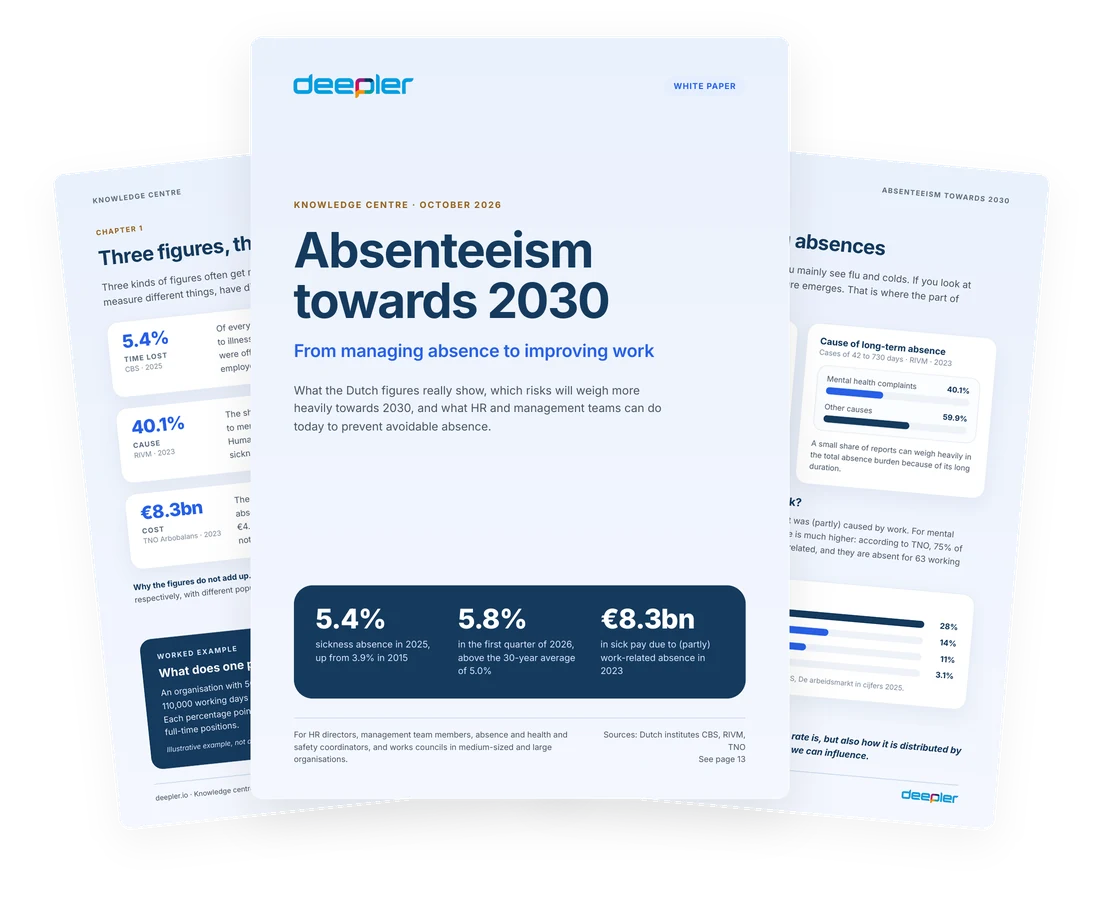
Absence towards 2030
The Dutch figures, five risks, differences per sector, seven recommendations and a plan for the first 90 days.
Good absence management remains essential. But if you only take action after someone calls in sick, you miss the chance to limit risks earlier. The Dutch Working Conditions Act already requires this: an up-to-date risk inventory and evaluation (RI&E) with an action plan, including psychosocial risks, and a policy to prevent work pressure and undesirable behaviour. Preventive employership is therefore not an extra. It is the way to give those obligations meaning.
A practical four-step model
→
→
→
The Job Demands-Resources model shows that high demands mainly become a problem when resources fall short: autonomy, support from the manager and colleagues, appreciation and moments of recovery. So the task is not just to make employees more resilient, but above all to organise the work better. Also read how to spot work stress earlier, before it turns into absence.
Absence records show how many days are lost. They do not explain whether workload, leadership, rosters or lack of recovery play a role. For that you need employee research, at group level. Ask about the work, not about health or diagnoses. Never use results to profile individuals, and involve the works council in advance: it has the right of consent on health, safety and absence policy.
With the Absence reduction module and the Workload module in Deepler Research you see per team where demands and resources get out of balance. Anonymously, at group level and without medical questions. In the whitepaper you will find a 90-day plan to get started right away.
Knowledge Centre
Ready for the first 90 days?
Download the whitepaper with the complete plan: understand, choose, improve.

Sanne Huisman
Knowledge center Deepler
Sanne is the heart of Deepler’s Knowledge Center. She translates research, data, and practical experience into real-world applications for organizations. Whether it involves an employee survey, a whitepaper, or hands-on support, Sanne ensures that knowledge doesn’t go to waste but is instead used to improve both our work and our products.