



Ready to listen? Why you build readiness by starting
“We want to, just not yet.” We hear that sentence a lot. The organisation is in the middle of a reor...
Verder lezen



In many organisations, development revolves around one moment: the annual review. A year of work, summed up in one hour. It is logical that this moment falls short. A performance management cycle with fixed moments throughout the year turns development into an ongoing conversation, instead of a yearly reckoning.
The annual review gives a picture of one moment, from one perspective. What happened recently weighs more heavily than what went well months ago. And the manager mainly looks from their own observation, while much of the work happens where they are not present.
Research by Gallup shows how big that problem is. It is American research, published in May 2024, among 135 CHROs of Fortune 500 companies and 18,665 employees. The fieldwork took place in 2023.
Figures in other countries will differ, but the pattern is recognisable. Anyone who discusses goals only once a year often no longer knows exactly what they are working towards by mid-year.
Gallup makes three recommendations to improve performance management:
The last point in particular deserves attention. As soon as a conversation is also about pay, the tone shifts. The employee then mainly wants to show what went well, and talks less freely about what was difficult. By discussing development and pay separately, you keep room for an honest conversation.
Together, these three points form the basis of a performance management cycle.
A quarterly rhythm sounds like more work. It does not have to be. The trick is to keep the conversations short and the admin light. An example:
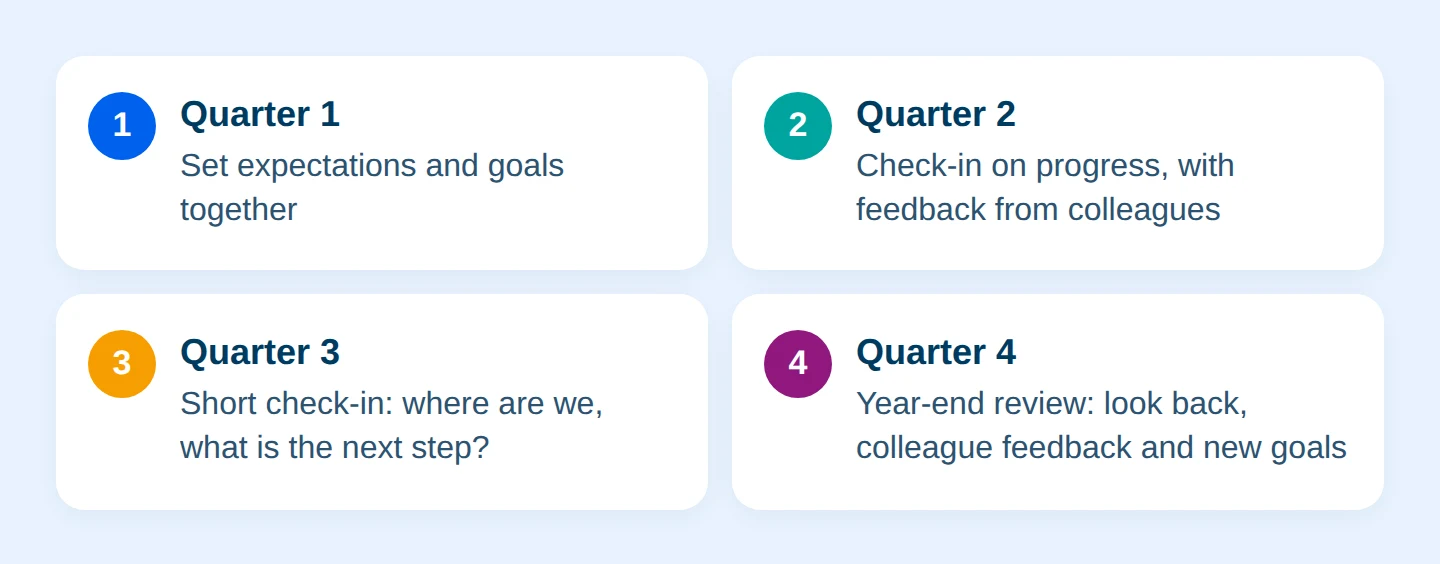
A check-in does not have to be complicated. Three questions are often enough: what is going well, where are you getting stuck, and what do you need? That keeps the conversation focused on progress, not on filling in a form.
Each conversation takes twenty to thirty minutes. The notes consist of one or two sentences: where are we, and what is the next step? The year-end review is then no longer a surprise, but a summary of conversations that have already taken place. For that last conversation, you will find practical questions in 10 questions that open the year-end review.
An ongoing conversation only works if everyone speaks the same language. For that you need a shared competency profile: a short set of competencies, described in concrete behaviour, that is the same for a role or team.
That way the employee knows what they are working on, the manager knows what to look for and colleagues know what to give feedback on. It also prevents every conversation from being about something different. Better to choose five competencies that really matter than fifteen that nobody remembers.
Describe each competency in behaviour you can see. Not “customer-focused”, but for example “thinks along with the question behind the customer’s question”. The more concrete the description, the easier it is to say something meaningful about it in a short conversation, and the better you can track growth over time.

The big advantage of a cycle: you can see growth. Anyone who gathers a picture once a year has a snapshot. Anyone who does it every few months sees a line.
Put the results per competency side by side. Is it improving on the point someone is working on? Do self-image and colleague feedback stay close together, or do they drift apart? That makes development visible, for the employee and for the manager. And it makes a conversation about progress much more concrete than “it’s going well”.
For input from colleagues you can use 360 degree feedback, for example twice a year. In between, short check-ins between employee and manager are enough.
A performance management cycle stands or falls with the manager. They do not need to be a coach, but they do need a few things. A short explanation of the purpose of the conversations. A simple format, so that not everyone reinvents the wheel. And time in the calendar, blocked in advance for the whole year.
HR plays a supporting role. Not by chasing managers for their forms, but by helping them have good conversations. For example with a few sample questions, or by asking after the first round what worked and what did not.
You do not have to introduce a new cycle for the whole organisation at once. In fact, that usually works worse. Start small:
After the first cycle, take time to look back. Ask managers and employees what the rhythm gave them, and what could be better. Perhaps a quarter is too often for some roles, or not often enough. Adjust the approach before you expand.
A pilot also shows what an ongoing conversation delivers, for example that you hear sooner when someone gets stuck or has doubts.
With Deepler 360 you start with a pilot team. Managers get a 30-minute briefing and then run the cycle independently. Plan an introductory meeting to see how that works for your organisation.

Sanne Huisman
Knowledge center Deepler
Sanne is the heart of Deepler’s Knowledge Center. She translates research, data, and practical experience into real-world applications for organizations. Whether it involves an employee survey, a whitepaper, or hands-on support, Sanne ensures that knowledge doesn’t go to waste but is instead used to improve both our work and our products.