




From annual review to ongoing conversation: how to make development a cycle
In many organisations, development revolves around one moment: the annual review. A year of work, su...
Verder lezen



“We want to, just not yet.” We hear that sentence a lot. The organisation is in the middle of a reorganisation, the management team is busy, or there are doubts about whether everyone is ready. So people wait for the right moment to start continuous listening, for example with a first pulse survey.
Our honest answer: that moment rarely arrives on its own. Readiness is not a precondition for starting. It is something you build by starting.
That is often true. There is already plenty on the plate. But listening doesn’t have to take a lot of time, especially if you keep it small. And it is precisely in busy periods that it helps to know where things are pinching.
First step: ask one question to one team, about one topic that matters right now. Plan half an hour to discuss the results.
Understandable. Nobody wants to discover that things are worse than they thought. But the problems already exist, whether you measure them or not. The only question is whether you hear them before they grow.
First step: agree in the management team beforehand how you will deal with unwelcome results. If you arrange that in advance, you’ll be less shocked afterwards.
This is the most valid reason to wait. Asking without following up costs trust, as research into feedback after employee surveys shows (Church et al.).
First step: arrange the follow-up for that one team: who shares the results, when, and who takes the first action. That is enough to start.
Employee surveys involve personal data, and therefore data protection law and, where there is one, the works council. That is no reason to skip it, but it is a reason to do it carefully.
First step: talk to the works council before you commit anything to paper. More on that below.

Anyone who waits until everything is arranged runs into a paradox. The things you need to listen well, such as trust, experienced managers and follow-up that works, come about precisely by listening. You don’t learn to ride a bike by reading about it.
What’s more, the organisation doesn’t stand still in the meantime. Bottlenecks grow, good people leave and ideas are left lying around. Not listening is also a choice, just a less visible one.
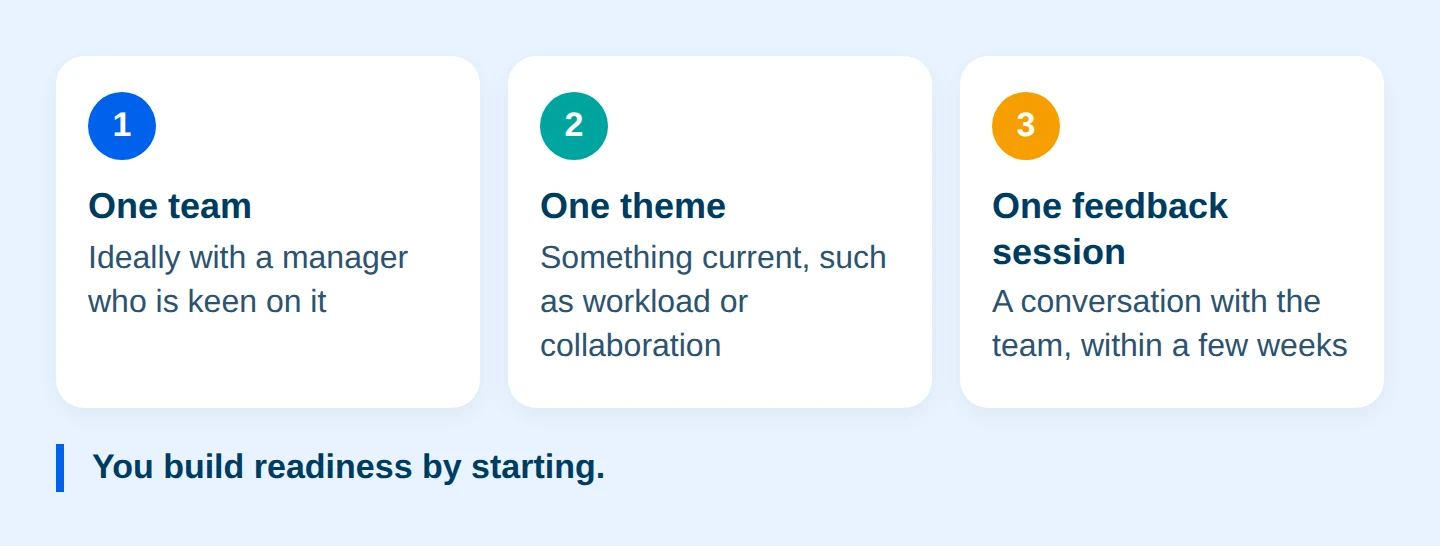
A pilot makes it small enough to start and big enough to learn from. We use three times one:
After the pilot you know how employees respond, what managers need and what could be better. That is more valuable than any implementation plan.
Share the lessons from the pilot, too. Tell other teams what happened, what worked and what you will do differently. That way the pilot becomes an invitation rather than an experiment behind closed doors, and interest from other teams grows by itself.
Don’t choose a team for the pilot where things have been chafing badly for months. The pressure to show results immediately is high there. Start instead with a team where there is trust, and learn there how it works.
In the Netherlands, under article 27 of the Works Councils Act (WOR), the works council has a right of consent over arrangements for processing employees’ personal data and over systems that can monitor their attendance, behaviour or performance. Similar rules apply in many other countries. Whether this applies to your survey depends on its set-up. That is exactly why it pays to involve the works council early.
Don’t see the works council as a hurdle, but as an ally. The works council often knows well what is going on and can help convince employees that taking part is safe.
Explain clearly how anonymity is arranged:
If you can answer these questions simply, you make it easier for employees to be honest. Edmondson showed that psychological safety, the shared sense that you can say something without risk, is related to how much a team learns.
Don’t forget the managers either. They get the questions from their team about anonymity and about what happens with the results. Give them the same explanation as the works council beforehand, in plain language, so that they can answer those questions with confidence.
Recognise three or more? Then you are probably further along than you thought.
Which of the four reasons to wait do you recognise most in your own organisation? Often it is not one reason, but a combination. Pick the reason that weighs most heavily and link it to the first step described above. That way, the question of whether you are ready becomes the question of where you start.
No organisation is ever completely ready. But you can take a first step today that makes the next one easier. One team, one theme, one conversation.
Read more at deepler.io about how we help organisations start small and grow step by step.

Sanne Huisman
Knowledge center Deepler
Sanne is the heart of Deepler’s Knowledge Center. She translates research, data, and practical experience into real-world applications for organizations. Whether it involves an employee survey, a whitepaper, or hands-on support, Sanne ensures that knowledge doesn’t go to waste but is instead used to improve both our work and our products.