




Implementing a skills-based performance review system
Setting up a skills-based assessment system The traditional way of assessing, where we primarily loo...
Verder lezen



The year-end review often feels like filling in a form. Ticking boxes, giving a score, signing at the bottom. Yet it is one of the few moments in the year when you really take time for each other. The difference often lies in the questions you ask. Good performance review questions open the conversation. They invite reflection instead of defence.
Below you will find ten questions for your review conversation, divided into three phases: looking back, discussing blind spots and looking ahead. You do not have to ask them all. Choose a few per phase that suit the person in front of you.
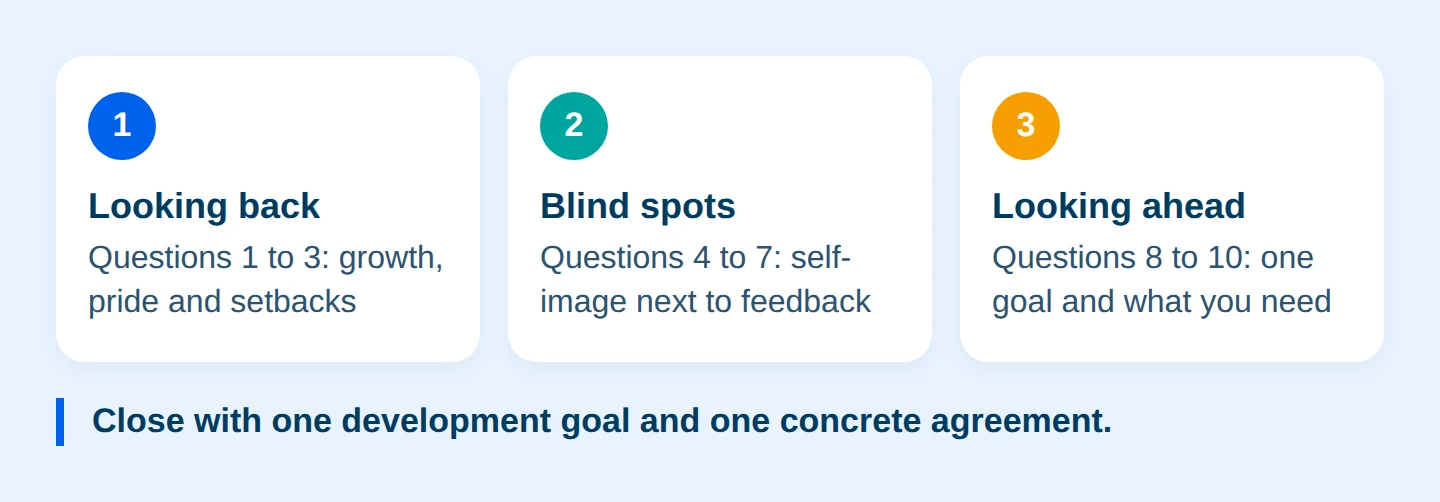
A good conversation starts before you sit down together. Send the questions you want to ask to the employee a week in advance. That gives them time to think, and the conversation feels less like an exam.
Plan enough time and choose a quiet place. A year-end review squeezed between two other meetings rarely works. If you gathered feedback in advance, make sure the employee has already been able to read it. And resolve to listen above all. It is the employee’s conversation, not your presentation.
Start with what happened this year. Not to settle scores, but to build a shared picture of the year together. Whoever gets to speak first listens better afterwards.
An open start, focused on development rather than results. The employee decides where the conversation begins, and that builds trust.
A concrete moment says more than a general judgement. You hear what gives someone energy, and that is valuable information for next year.
This question makes room for setbacks without turning them into blame. You often hear things here that you had not seen as a manager.
In this phase you put self-image next to what others see. That calls for a safe tone. The goal is not to be proven right, but to discover something together.
If you gathered feedback in advance, for example with 360 degree feedback, this is the best opening question. What someone recognises confirms. What surprises is where the conversation gets interesting.
The gap between self-image and feedback is not a problem, but information. By looking at it together, you avoid a discussion about who is right.
An invitation to look from another perspective. It makes feedback concrete and focuses on behaviour, not character.
A year-end review works both ways. By also asking about your own role, you show that feedback is not a one-way street.
The last part of the conversation is about next year. Keep it small and concrete. One well-chosen step achieves more than a long list of resolutions.
One is enough. Anyone who picks five development points gets round to none of them. A shared competency also gives you a common language to discuss progress.
This question makes an intention concrete. It forces you to name behaviour you can see, and it already puts the next moment in the calendar.
A good closing question. Development is a shared responsibility. With this question, you make clear what you contribute as a manager.

Starting with the score. If you open the conversation with a final verdict, little else gets heard. The employee is busy with the score, not the content. Save any rating for later in the conversation, or discuss it separately.
Becoming defensive. Sometimes criticism comes back, also about you as a manager. It is tempting to explain how things were. Try to understand what the other person means first. A follow-up question such as “can you give an example?” works better than an explanation.
Not making a concrete agreement. A good conversation without an agreement is quickly forgotten. Always close with something you can both look back on, and a moment to return to it.
Keep the notes short. Two things are enough:
Let the employee write the notes, and then complete them together. That way they are in the employee’s own words, and you know for sure you heard the same thing.
That way the year-end review is not the end of the year, but the start of the next one. Want to make that a regular rhythm? Read how to turn the annual review into an ongoing conversation.
Want to start the conversation with a broader picture? With Deepler 360 you gather feedback in advance, so you can ask question 4 with real input.

Leon zu Salm-Salm
Founder / CIO
Leon is a co-founder of Deepler and is responsible for product development, compliance, and the ongoing evolution of the Deepler platform. He translates organizational needs into effective tools—ranging from surveys and 360-degree feedback to onboarding. Leon works in Dutch, English, German, and French, and easily switches between strategy, technology, and practical client applications.