


Winter blues at work: what to do before January
Absence in winter is flu, and there is little an organisation can do about it. That is the common as...
Verder lezen




In the Netherlands, around 1.8 million women are in the menopausal transition. Many of them notice little of it, but for a sizeable group it affects their work. Yet in the workplace it often stays unspoken. And because almost no one calls in sick, you do not see it in the absence figures. How do you make menopause and work an ordinary conversation instead of a taboo?
Menopause is a normal stage of life, not an illness. But the figures show that the impact on work is considerable:
Female employees in menopause, aged 40 to 75
The impact is in the work, not in absence. Anyone who looks only at absence misses most of the story.
Source: CBS and TNO, Netherlands Working Conditions Survey 2021 (published 2022)
Symptoms are more than hot flushes. Around 60% of women with menopausal symptoms experience memory or concentration problems. Poor sleep, concentration and self-confidence affect work directly. These are often employees with twenty or thirty years of experience, with knowledge, a network and a role-model function. With some room and understanding, they keep using that experience to the full.
Around half of working women with menopausal symptoms do not discuss them at work. Five barriers we hear again and again:
Meanwhile, 57% of women who experience inconvenience actually want more support or understanding at work.
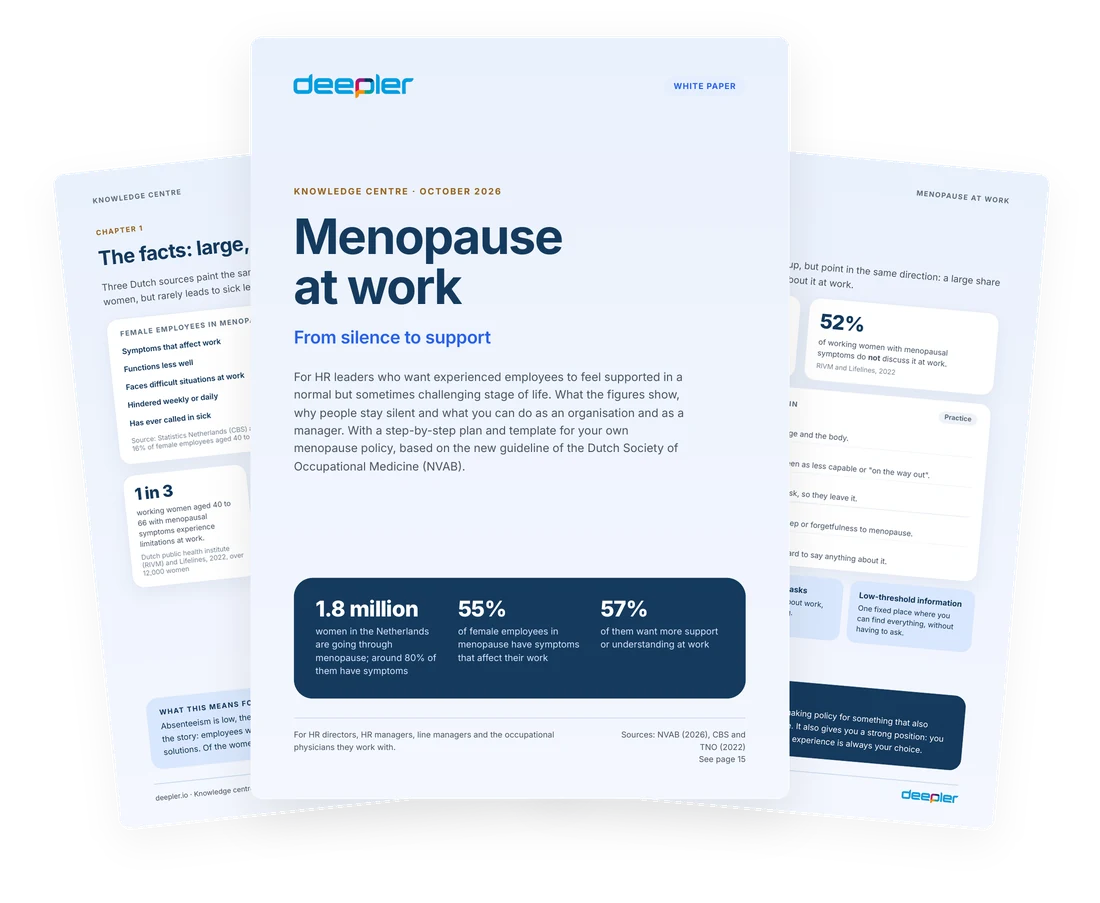
Free whitepaper
Menopause in the workplace
The figures, what works, five building blocks for policy, a step-by-step plan, a template and a conversation card for managers.
Since March 2026, the NVAB (the Dutch association of occupational physicians) has had a guideline on menopause and work. Together with the guidance from the Labour Foundation, it provides a clear framework. To be honest: there is no workplace measure with strong evidence yet. Self-help with cognitive behavioural therapy has been researched best. Most workplace measures rest on consensus, but they cost little and do no harm.
Menopause policy in five building blocks
The most important tool is a good conversation. Start with the work, not with a guess about the cause. For example: “How are you, and how is your work going?” or “Is there anything in your work or workplace that would make things easier for you?” The employee decides what she shares. Do not raise menopause yourself on the basis of age, do not ask about symptoms or medication, and leave out jokes, even well-meant ones.
The golden rule: discuss work and adjustments with the manager, and health with the occupational physician or GP. HR makes sure both routes are clear and safe.
Health data is special category personal data. As an employer, you do not ask about symptoms or diagnoses. In anonymous questionnaires too, you ask about work experience, support and openness, and you only look at results at group level. Menopause policy falls under the works council’s right of consent.
With Deepler Research you measure what different age groups need: anonymously, at group level and without questions about health. See also how an organisation mapped the needs per generation. In the whitepaper you will find a step-by-step plan and a template for your own menopause policy.
Knowledge Centre
Do your managers know how to have this conversation?
Download the whitepaper with the conversation card and the policy template.

Sanne Huisman
Knowledge center Deepler
Sanne is the heart of Deepler’s Knowledge Center. She translates research, data, and practical experience into real-world applications for organizations. Whether it involves an employee survey, a whitepaper, or hands-on support, Sanne ensures that knowledge doesn’t go to waste but is instead used to improve both our work and our products.