































4,9/5 reviews
Absence survey: get control over absence and prevention
Absence rarely begins on the day someone calls in sick. Often there are earlier signals: increasing work pressure, unclear expectations, reduced energy, tensions in the team or a manager who notices too late that someone is struggling.
With an absence survey, you make those patterns discussable before short absence becomes frequent or long-term absence develops. Deepler helps organizations not only register absence, but understand it better. This way you see where risks arise, which teams need support and which preventive measures can really make a difference.
- Recognize early where absence risks emerge
- Investigate causes behind short, frequent and long-term absence
- Translate signals into targeted prevention and team conversations
Absence: what does it mean and how can you prevent it?
Organizations often only look at absence when the figures rise. Then the focus quickly shifts to absence percentages, reporting frequency and reintegration.
Those figures are important, but they don’t always tell you why people are absent. A good absence survey therefore looks at the circumstances behind sick leave: work pressure, energy, recovery, leadership, team dynamics and the extent to which employees seek help in time. This shifts the approach from reacting to preventing.
In this article we explain:
- What absence means and what types of absence there are
- Why frequent absence is often an important warning signal
- How you can prevent, reduce and decrease absence
- What role managers, HR and occupational health services have
- How Deepler helps you take control of absence
Table of contents
What is absence?
Absence means that an employee cannot work at times when this would normally be expected according to their employment contract. In practice, it usually refers to sick leave: absence due to physical or mental complaints.
Yet absence is more than an administrative notification. It is often a signal that workload, capacity, work agreements or support are not properly aligned.
Sometimes it’s just the flu that passes after a few days. Sometimes repeated short absence indicates something more structural. And sometimes a situation develops into long-term absence, with major impact on the employee, team and organization.
The main types of absence
Absence often distinguishes between short absence, medium-term absence and long-term absence. Short absence usually lasts a few days.
Medium-term absence lasts longer, but is not yet structurally long-term. Long-term absence requires more intensive guidance and reintegration.
Organizations also sometimes speak of frequent absence when someone calls in sick notably often. Terms like grey absence or pink absence are also used, but require caution: the goal is not to judge employees, but to understand patterns and establish healthy work agreements.
Why is absence important?
Absence affects almost everything in an organization. For the employee, it means that health, energy or work capacity are under pressure.
For colleagues, it often means extra work, shifting priorities and sometimes frustration. For managers, pressure builds to get the schedule right.
And for HR or management, costs, risks and complexity increase. Those who see absence only as a number miss the opportunity to intervene earlier. Those who understand absence as an organizational issue can work on prevention, better support and sustainable deployment.
An absence survey provides organizations with various advantages
Absence doesn’t always arise from work, but work can contribute to workload, recovery and deployment. An absence survey makes visible which circumstances help or make employees vulnerable. This way you can make your absence policy less reactive and more preventive.
1. Earlier visibility of risks
An absence survey shows where employees experience stress, pressure or reduced energy. This means you don’t have to wait until the absence percentage rises. You see earlier where teams are vulnerable and where conversations are needed.
2. Less dependent on isolated signals
Without research, absence prevention is often dependent on what a manager happens to hear or notice. Structured feedback creates a more complete picture. This helps to recognize patterns that are easily hidden in individual conversations.
3. Better control of absence
Controlling absence requires more than a protocol. You need to know where causes lie, who takes on which role and which interventions are logical. Deepler makes visible where the conversation should begin and which topics deserve priority.
4. More targeted absence reduction
Reducing absence works better when you know what problem you’re solving. For one team it’s about work pressure, for another about schedules, leadership, safety or collaboration. An absence survey prevents you from applying the same measure everywhere.
5. Stronger absence policy
A good absence policy aligns with practice. By surveying employees periodically, you see if policy works, where rules are unclear and where preventive measures need to be better organized.
Conduct your absence survey with Deepler’s software
With Deepler, you don’t just investigate how much absence there is, but especially which factors increase the risk of absence. Employees answer short, targeted questions about work pressure, energy, recovery, support, clarity and psychological safety.
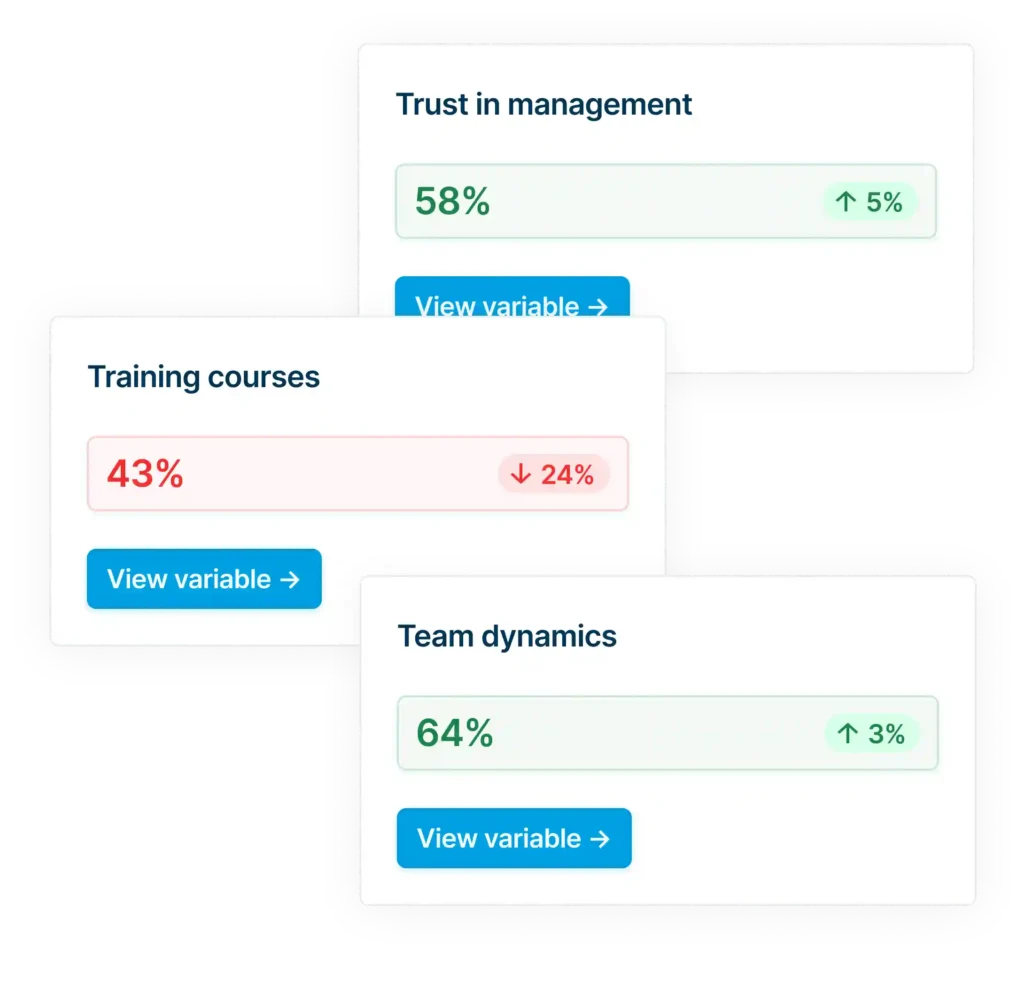
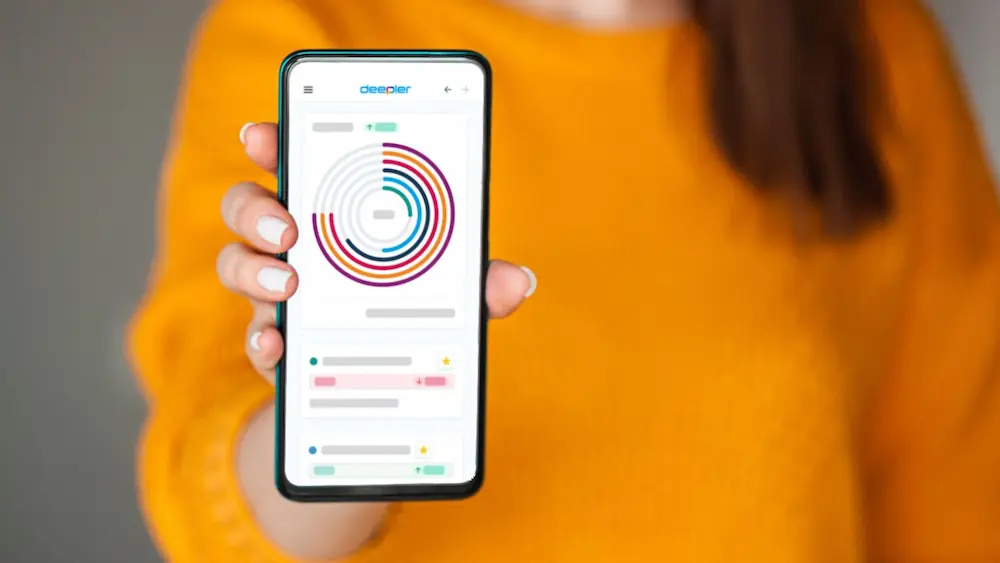
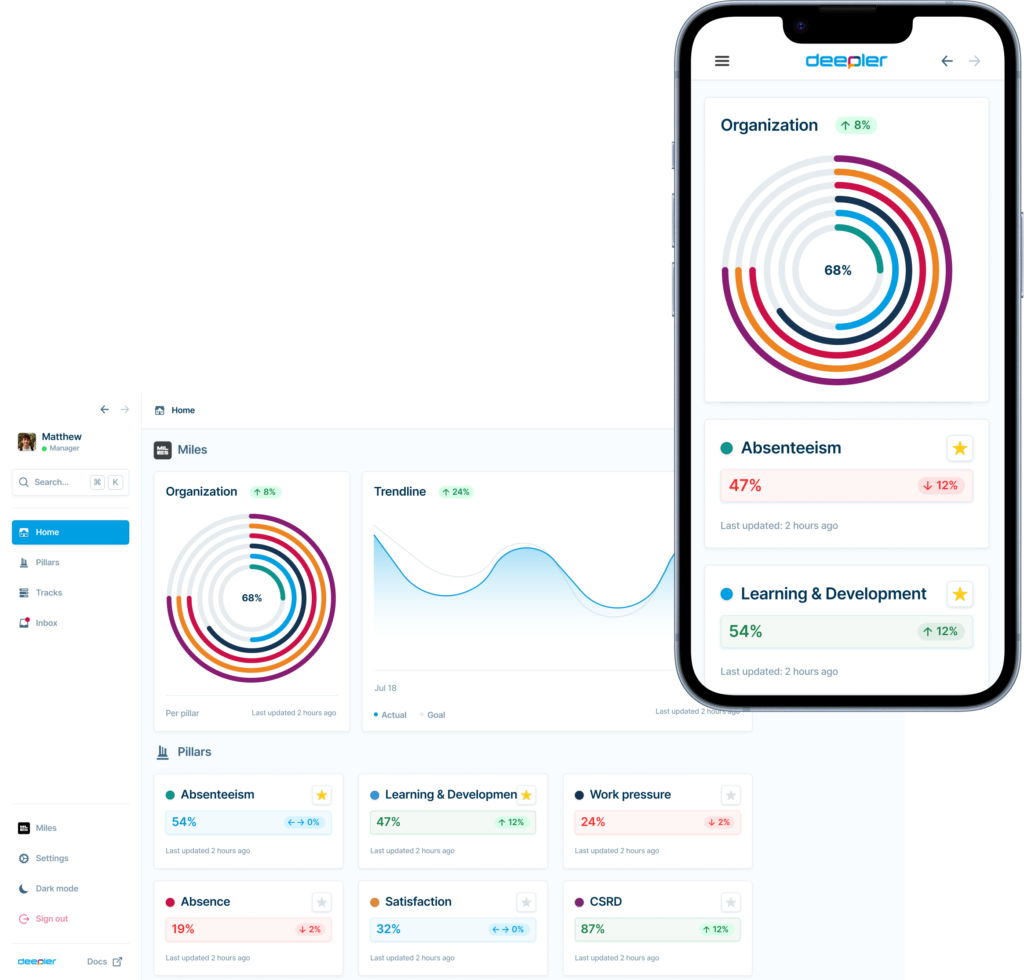
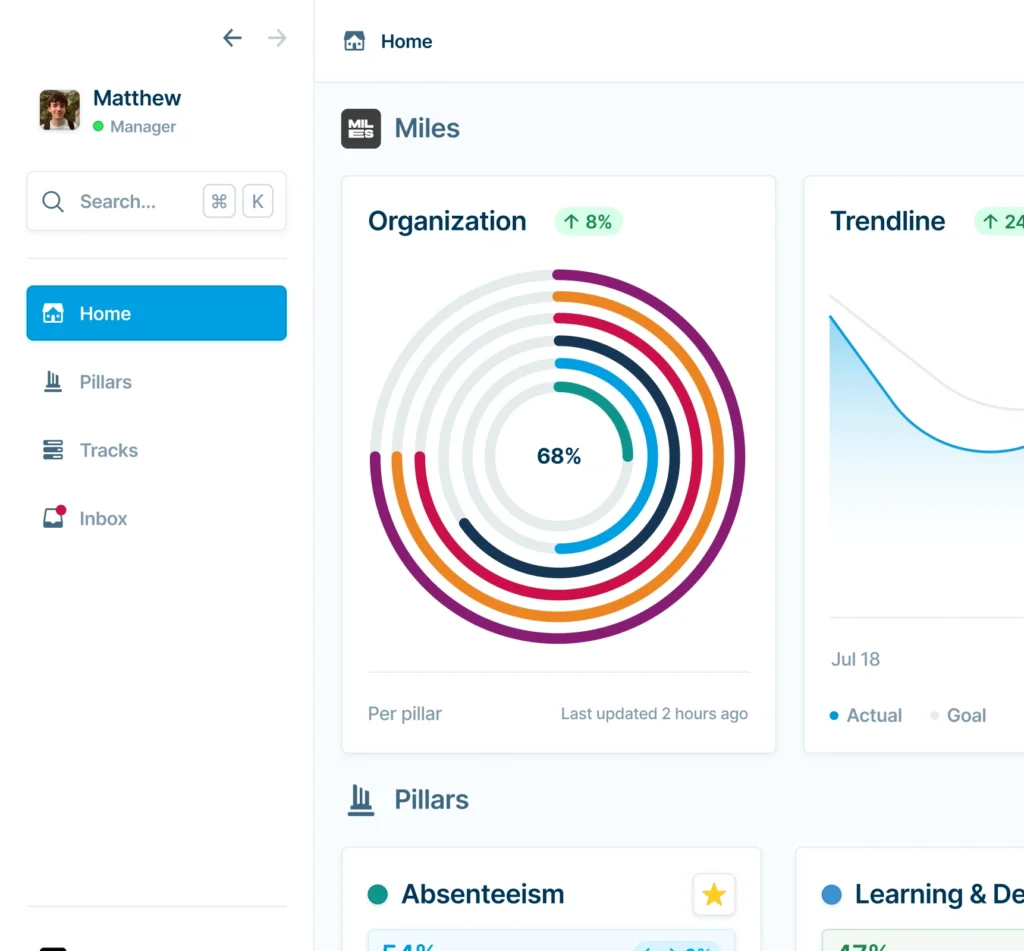
The results are displayed clearly in dashboards, so HR, management and managers immediately see where action is needed. You can view differences between teams, locations or functions without exposing individual employees. This creates a practical basis for prevention, team conversations and better control of absence.
Our satisfied customers
What are the benefits of an absence survey?
An absence survey gives organizations language for a topic that is often sensitive. Illness is personal, but work can contribute to workload, recovery or absence.
By asking the right questions, you make it possible to discuss which working conditions increase the risk of absence. This helps you steer more effectively, without collecting medical information or evaluating employees individually.
From absence registration to absence prevention
Absence registration tells you what happened. Absence prevention requires insight into what preceded it.
That’s where the value of an absence survey lies. You look at signals such as recovery opportunities, autonomy, role clarity, work pressure, manager support and psychological safety.
That information helps you have the conversation before absence becomes long-term. This makes the approach less reactive and creates more control over sustainable deployment.
What are the benefits of an absence survey?
An absence survey gives organizations language for a topic that is often sensitive. Illness is personal, but work can contribute to workload, recovery or absence.
By asking the right questions, you make it possible to discuss which working conditions increase the risk of absence. This helps you steer more effectively, without collecting medical information or evaluating employees individually.
Better manage absence costs
The costs of absence don’t just lie in continued salary payments. Replacement, productivity loss, extra pressure on colleagues, quality loss and management time also factor in.
An absence survey helps influence those costs earlier. Not by putting pressure on employees, but by improving the circumstances in which absence arises or recurs.
Reduce absence more effectively
Reducing absence requires focus. A general wellness campaign helps little when the real problem lies in unclear priorities, poor schedules or a manager who picks up signals too late.
With Deepler you see which topics weigh most heavily per team or segment. This allows you to choose interventions that fit the cause.
More confidence in the absence approach
Employees sometimes experience absence policy as control. A good survey shows instead that the organization wants to understand what people need to work healthily.
When results are shared and followed up, confidence grows. This makes it easier to speak up early and prevents problems from staying hidden.
Trusted by small and large organizations
Ervaringen van klanten die met ons het verschil maken.
-
Larren
Recruitment Lead,
De Selectie
“Recently, I used Deepler to arrive at an EVP. Great what they were able to achieve in a short time! In a period of two weeks, we collected information and were able to continue with our AMC plan. In any other situation, it takes weeks, if not months, to get this done. Contact is good, friendly and constructive. Very nice club to work with.”
-

Douwe
Recruiter,
Securitas
“Ideal tool and company to gain more and better insight into the organization and employees as an organization! And especially with speed! For us, it was also the need to get tools for the topics of retention, to prevent future absenteeism or turnover. I also have experience with other parties and I sincerely value the speed of switching, follow-up and personal contact with Deepler. Absolutely recommended.”
-

Jolanda
HR Business Partner,
Nedcargo
“Deepler is a great tool for continuously collecting feedback from our employees. This input is then centrally available for us as management, but also for managers who benefit from it.”
-

Jonathan
Manager,
UWV
“What makes Deepler special is that it doesn’t get stuck in numbers. It helps you immediately understand where it is and what teams need. For us, this ensured that employees themselves came up with areas for improvement and took responsibility for them. The insights were sharp and useful, but most importantly: the conversation that started afterwards made the difference. Thanks to Deepler, we didn’t get a paper plan, but change that was supported by the people themselves.”
-
Amadeus
COO,
OSRE
“The software has a positive impact on us as a rapidly growing organization. By better understanding what is going on in the workplace and what people offer as solutions for improvements, we can make more effective decisions. The platform helps us to gain real-time insight and to respond directly to it via the tool.”

Is an absence survey mandatory?
An absence survey as Deepler conducts it is not mandatory as a separate measurement. Employers do have a duty to ensure healthy and safe working conditions and to establish sick leave policy that suits the organization.
Clear obligations also apply to illness and reintegration for both employer and employee. An absence survey helps fulfill that broader responsibility, because you better understand where risks arise and which preventive measures are needed. So see it not as a legal checklist, but as a practical tool to better manage healthy work.
Is an absence survey anonymous?
An absence survey should be designed so that employees can answer safely and fairly. Especially on topics such as work pressure, energy, management support and psychological safety, anonymity is important.
Deepler reports results at group level and prevents individual responses from being traceable. This is essential because absence and health are sensitive topics. Employees should know that the survey is intended to improve working conditions, not to monitor individual sick leave.
What about GDPR and privacy in absence?
Strict privacy rules apply to absence. An employer cannot ask for the medical reason for sick leave and cannot record medical data.
Only the occupational health physician or occupational health service may process medical information. An absence survey must therefore not ask about diagnoses, treatments or personal medical situations.
The focus is on work-related factors that affect availability, such as work pressure, recovery, clarity, social support and collaboration. This keeps the survey useful for prevention without crossing the privacy boundary.
What is the role of HR, managers and works council?
HR usually monitors the approach, communication and translation of results into policy. Managers play an important role in conducting team discussions and following up on signals.
The works council or staff representation may be involved in occupational health policy, absence policy and the way employees are surveyed. The occupational health service or occupational health physician remains responsible for medical guidance during illness. An absence survey works best when these roles are clearly defined in advance so employees understand who does what with the results.
Why do many organizations still conduct an absence survey?
Many organizations start an absence survey when absence is already high. Smarter is to measure earlier.
Frequent absence, rising work pressure or signals of reduced energy can indicate that employees are becoming more vulnerable. By examining this systematically, you can prevent absence rather than only manage it. This makes the survey valuable for HR, management and managers who want to gain control over availability, staffing and team health.
How to get more out of your absence survey
Link the survey to concrete absence behavior
Don’t just look at general satisfaction, but make the connection with signals such as short absence, frequent absence, work pressure and recovery. This makes it clear which factors may contribute to absence.
Make it safe to answer honestly
Absence is sensitive. Therefore, clearly communicate that the survey is not a medical check and that results are used at group level. Without trust, you get socially desirable answers.
Turn results into preventive actions
Don’t just use the results for a report. Discuss per team which causes are influenceable and what actions are needed to prevent, reduce or lower absence.
Do’s of an absence survey
A good absence survey requires care. You are not examining medical files, but work factors that affect energy, recovery and availability.
- Explain in advance why you are conducting the survey
- Ask about work factors, not medical causes
- Combine absence data with employee feedback at group level
- Involve managers in follow-up and team discussions
- Choose a few clear priorities rather than too many actions
Don’ts of an absence survey
- Don’t use the survey to assess individual sick leave
- Don’t ask about diagnoses, treatments or private health
- Don’t draw conclusions based on groups that are too small
- Don’t share results without explanation or follow-up
- Don’t make absence prevention a one-time campaign
What do you do with the results of an absence survey?
The value of an absence survey only emerges after measurement. Results show where risks lie, but improvement requires conversation, choices and follow-up. So don’t start with a long list of actions.
First, look at which themes are most strongly associated with absence risks. Is it high work pressure? Insufficient recovery?
Unclear priorities? Lack of management support? By translating the analysis into concrete conversations and actions, the survey becomes a starting point for prevention.
From insight to preventive action
After you have analyzed the results and identified the key risk factors, it is time to convert these insights into targeted measures. This requires a systematic approach in which you set priorities, assign responsibilities and monitor progress. By not treating the findings as a one-time project, but as a basis for structural improvements, you create the conditions for sustainable prevention.
Deepler helps you better understand absence and at the same time take concrete steps to combat it. We have defined six follow-up steps that you can follow after completing the survey. These steps ensure that your survey results lead to actual change and less absence:
Wil je nog meer tips over hoe je een medewerkerstevredenheidsonderzoek (MTO) effectief op kan volgen? Lees dan ons artikel:
MTO Effectief Opvolgen: Waarom Is Dat Belangrijk?
Analyze patterns in absence and perception
Combine group results with existing absence data, such as notification frequency, short absence and long-term absence. Look for patterns, but avoid explaining individual situations without context.
Determine where the risk is greatest
Not every team needs the same approach. Some teams need better planning, others need leadership, role clarity or recovery time. Focus on places where signals and impact come together.
Share the key insights
Make results understandable for managers and employees. Show what is strong, where risks lie, and which topics are a priority. Transparency prevents the research from feeling like a black box.
Have the right conversation in teams
Use the results as a basis for dialogue. Ask teams what resonates, what is missing, and which solutions are realistic. This creates ownership instead of an HR plan imposed from above.
Create a preventive action plan
Choose actions that match the root cause. Think about better prioritization, schedule adjustments, clearer work agreements, additional support for managers, or interventions on workload and recovery.
Keep measuring and adjust
Absence prevention is not a one-time action. By measuring periodically, you see whether measures are effective and where new risks emerge. This keeps absence policy current and practical.
Have the right conversation about absence risks
With Deepler, signals around workload, recovery, leadership, and employability are translated into clear dashboards and team insights. This allows you to have conversations based on patterns instead of assumptions. That helps HR and managers determine faster where prevention is needed.
Organizational research without high costs
Stem je wensen af met ons Basic- of Plus-pakket. Wil je meerdere landen of organisaties vergelijken? Dan is het Enterprise-pakket de beste keuze.
Basic
€2.99
Per user/per month
The best for your team or smaller organizations that want to gain insights quickly.
- Maximum of 1 module
- Score segmentation
- In-depth analysis for Managers
- Unlimited number of languages
- Personal dashboard for employees
Plus
€3.49
Per user/per month
The best option if you want to survey multiple teams and SMEs.
- Everything from Basic
- 2 additional research modules
- Personal success manager
- Non-desk employees
- Custom questions
Most popular
Enterprise
On request
Per user/per month
The best for large organizations and custom modules.
- Everything from Plus
- Single Sign-On
- Custom modules
- Advanced Security
- Personal onboarding
Basic
€36
Per user/per year
The best for your team or smaller organizations that want to gain insights quickly.
- Maximum of 1 module
- Score segmentation
- In-depth analysis for Managers
- Unlimited number of languages
- Personal dashboard for employees
- Suitable for employees company email address
Plus
€42
Per user/per year
The best option if you want to survey multiple teams and SMEs.
- Basic
- 2 additional research modules
- Personal support from a Deepler expert
- Suitable for all employees
- Add your own questions
- Option to conduct surveys using QR codes
Most popular
Enterprise
On request
Per user/per year
The best for large organizations and custom modules.
- Plus
- Unlimited research modules
- Custom modules
- Unlimited number of languages
- Personal dashboard for employees
- Suitable for employees company email address
Frequently asked questions
What is absence?
Absence means that an employee is not working at a time when this would normally be expected. Usually this concerns sick leave: absence due to physical or mental complaints. For organizations, it is especially important not only to record the absence report, but also to understand which work factors can contribute to downtime or recovery.
What does sick leave mean?
Sickness absence is absence due to illness or health complaints. The medical cause is private and belongs to the employee and the occupational health physician. As an employer, you can look at work-related circumstances that affect availability, such as work pressure, recovery, schedules, support from managers, and collaboration.
What types of absence are there?
Commonly used categories are short-term absence, medium-term absence, and long-term absence. Additionally, frequent absence is often considered: employees who report sick relatively often.
Terms such as gray absence, pink absence, and composite absence also occur, but use them carefully. The goal should always be to understand patterns, not to label.
What is frequent absence?
Frequent absence means that an employee reports sick multiple times within a certain period. It can be a signal of recurring health problems, work pressure, personal stress, loss of motivation, or insufficient recovery.
Therefore, discuss frequent absence carefully and without judgment. Focus especially on what support or adjustment is needed.
How can you prevent absence?
Preventing absence starts with early detection. Regularly examine how employees experience work pressure, energy, recovery, clarity, and support.
Also ensure a clear absence policy, good conversations between manager and employee, realistic work agreements, and attention to sustainable availability. Prevention works especially well when signals are followed up on seriously.
How can you reduce or decrease absence?
Reducing absence works better when you know the causes. Analyze where short, frequent, or long-term absence occurs and combine this with feedback on work factors. Then choose targeted measures, such as better prioritization, schedule adjustments, manager support, or interventions around work pressure and recovery.
What is control over absence?
Control over absence means that it is clear who has what responsibility in prevention, sick reporting, guidance, and return to work. HR, managers, employee, occupational health service, and occupational health physician all have a role. Good control prevents isolated actions and ensures that signals, agreements, and follow-up come together.
What should be included in an absence policy?
An absence policy describes how the organization handles sick reporting, guidance, privacy, re-integration, prevention, and responsibilities. It must fit the organization and be clear to employees and managers. An absence survey helps to check whether policy works in practice and where improvement is needed.
What is an action plan for absence?
For longer-term illness, employer and employee, usually based on advice from the occupational health physician, make agreements about re-integration. These agreements are documented in an action plan. An absence survey does not replace this, but does help to see more broadly which working conditions increase absence risks.
Can an employer ask why someone is sick?
No. An employer may not ask for the medical cause of illness and may not record medical information.
However, you may ask practical information needed for planning and absence management, such as expected duration of absence or ongoing agreements. Medical information belongs with the occupational health physician or occupational health service.
What questions do you ask in an absence survey?
Good questions are about influenceable work factors. Examples are: I can recover from busy periods; My work pressure is manageable; I know which priorities are important; My manager notices signs of overload; Within my team it is safe to ask for help on time.
How often should you conduct an absence survey?
It depends on the situation. With high or rising absenteeism, it is wise to measure more frequently in short intervals, so you can adjust quickly.
In stable organizations, periodic measurement can be part of broader research into work pressure, engagement, or sustainable employability. What is important is that you follow up on results before measuring again.
How do you ensure that employees answer honestly about absenteeism risks?
Honest answers arise when employees understand that the survey is not intended to control illness. Clearly explain that the questions are about work factors and that results are used at group level. Then also share what happens with the feedback, otherwise trust will disappear at the next measurement.
Schedule a consultation
Klaar om stappen te zetten? Laat van je horen, dan kijken we samen naar de beste aanpak. Of je nu een vraag hebt of gewoon even wilt sparren, we zijn er voor je.
- Een inkijkje in het dashboard van Deepler
- Persoonlijk advies en start met eerlijk inzicht
- Een vrijblijvend gesprek voor al jouw vragen