Software · One platform
From employee surveys to customer satisfaction, with built-in follow-up.

360-degree feedback that makes growth visible and demonstrable.

An employee journey that measures itself, from onboarding to exit.

Measure your culture and see the gap with your ambition.
Services
Smart software, combined with human service.
Train yourself in effective team and organisational development.
4.9/5 reviews
The Korn Ferry Leadership Architect model is one of the best-known competency models in the world. It describes 38 competencies, divided into four factors: thought, results, people and self. Here you can read how the model is structured, where the Lominger competencies come from and how to measure competencies in practice.
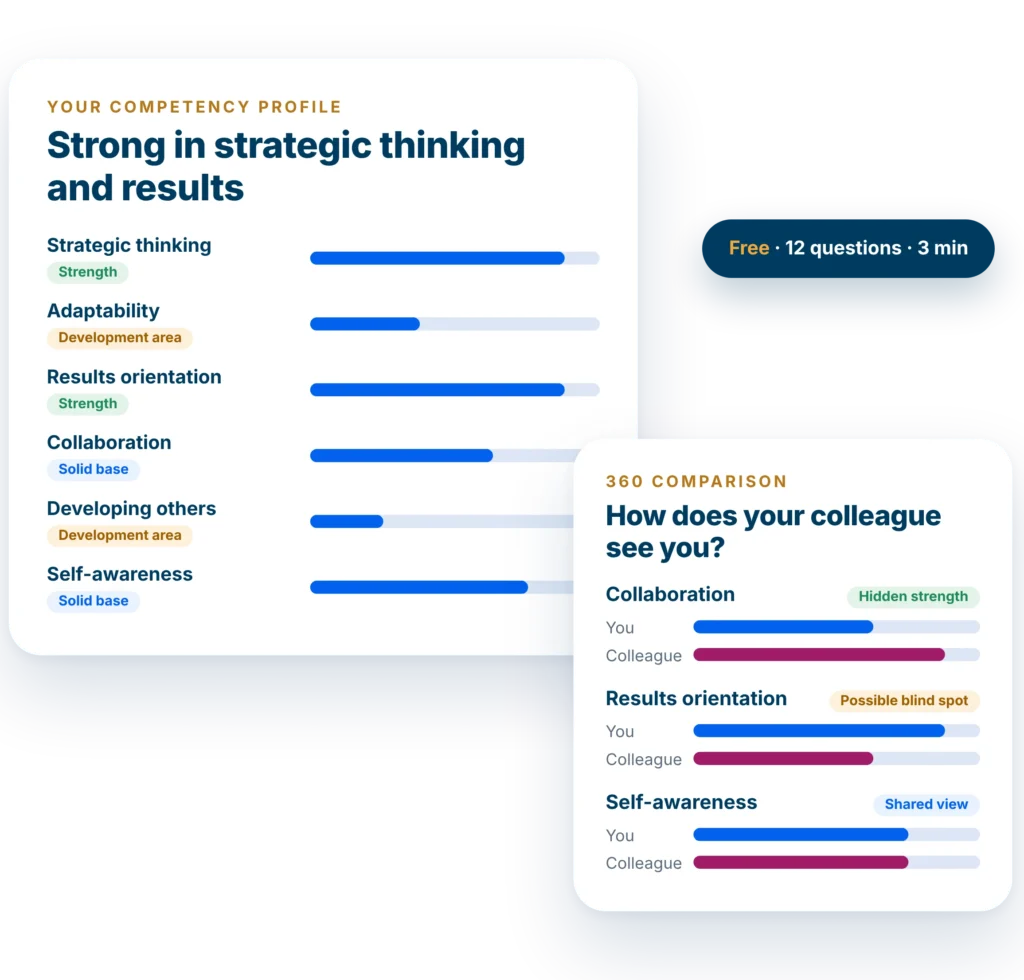
Want to know straight away where you stand? Take the free competency test: your own profile in 3 minutes, then compare it with how a colleague sees you.
A competency model describes the behaviour needed to succeed in a role. It gives organisations a common language for recruitment, appraisal and development. The Korn Ferry Leadership Architect model is one of the most widely used examples.
In this article you will read:
The Leadership Architect model is a competency model from the international consultancy Korn Ferry. It describes the behaviour that makes managers and employees successful, divided into 38 competencies. These competencies are grouped into twelve clusters and four factors.
Each competency is described in concrete, observable behaviour, with different levels of proficiency. This means you can use the model to profile roles, select candidates, appraise employees and guide development. The model is based on years of research into what sets successful leaders apart.
The model has its roots in Lominger, founded in 1991 by Michael Lombardo and Robert Eichinger. They developed a library of 67 competencies, which became known as the Lominger competencies. Many organisations still use that term.
In 2006 Korn Ferry acquired Lominger. The model was then developed further and simplified into the current version with 38 competencies. The principle has remained the same: success in a role comes down to behaviour that you can name, observe and develop.
The 38 competencies are divided into four factors. Together they give a complete picture of how someone performs.
How you process information, see connections and set direction. Think of strategic thinking, making good decisions and dealing with complexity.
How you turn plans into results: setting goals, taking responsibility and persevering when things get tough.
How you work with others and bring them along: communicating, collaborating across boundaries, managing conflict and developing others.
How you manage yourself: self-awareness, ability to learn, resilience and dealing with ambiguity.
Curious where you stand? Deepler’s free 360 mini-analysis is inspired by the four factors of the model. You answer twelve short questions about your behaviour in recognisable work situations and immediately get your profile with strengths, development areas and tips. You then invite a colleague to answer the same questions about you, so you experience how 360-degree feedback works.
A competency model only adds value when you use it. Organisations use competencies for, among other things:
Do not measure every competency at once. Choose the five to eight competencies that really matter for your organisation or role.
A competency test that you fill in on your own measures your self-image. That is valuable, but self-image and how others see you often differ. People overestimate themselves on some points and underestimate themselves on others.
That is why 360-degree feedback works so well: managers, colleagues and team members assess the same competencies. Where their view differs from your self-image, you find your blind spots and hidden strengths. With Deepler 360 you can easily set up such a feedback round, with the competencies that suit your organisation. Also read how to prepare 360-degree feedback.
Korn Ferry and Leadership Architect are trademarks of Korn Ferry. Deepler is not affiliated with Korn Ferry. This page describes the model based on publicly available information.
The Lominger competencies are the 67 competencies that Michael Lombardo and Robert Eichinger described in their competency library. After Korn Ferry’s acquisition in 2006, the model was developed into the current Korn Ferry Leadership Architect model with 38 competencies.
The current version of the Korn Ferry Leadership Architect model contains 38 competencies, grouped into twelve clusters and four factors: thought, results, people and self.
No. The mini-analysis is inspired by the four factors of the model, but uses its own questions and its own scoring method. Deepler is not affiliated with Korn Ferry.
The 360 mini-analysis is free. You receive your profile by email and can invite a colleague to give feedback at no cost.
A competency test usually measures your self-image. With 360-degree feedback, others such as your manager, colleagues and team members also assess the same competencies. That way you see where your view matches that of others and where it does not.
Yes. In Deepler 360 you decide which competencies and competency models you use, so the feedback fits your organisation and roles.
Ready to take the next step? Get in touch and we will look at the best approach together. Whether you have a question or just want to talk things through, we are here for you.