


Preparing 360 degree feedback: how to gather feedback you can actually use
The year-end review is coming up. For many managers, that means thinking back over a whole year and ...
Verder lezen



On Monday the board chooses a new course. On Tuesday the team leader explains it to her team, but she has doubts herself: why, actually? On Wednesday there is grumbling on the shop floor, and the team leader nods along. On Friday the word resistance comes up in the management team. The conclusion: employees do not want it. But what if the problem is not on the shop floor, but in middle management?
Deepler works with a collective intelligence model: how does an organisation think and decide together, from passive to active and from individual to collective? If you plot your employees, middle management and board on that model, we see the same pattern again and again in practice. Employees and middle management are close together. The board is further away.
Example: “I understand why we are choosing this course” (% agree)
The board thinks the course is clear. The middle sees it differently, and the shop floor follows the middle.
Example with fictitious figures, as you would see it in a measurement per layer
The team leader in the story above is not against the course. She is simply closer to her team than to the board. And nobody took her along in the why.
It is not unwillingness. There are four explanations, and they reinforce each other:
And the top? In organisations undergoing major change, 1 in 3 top managers does not fully support the strategy themselves. If you want to take the middle along, you first need to be clear yourself.
How the middle and the top are doing
Source: Integron, Employee Experience in Nederland 2025 (poll)
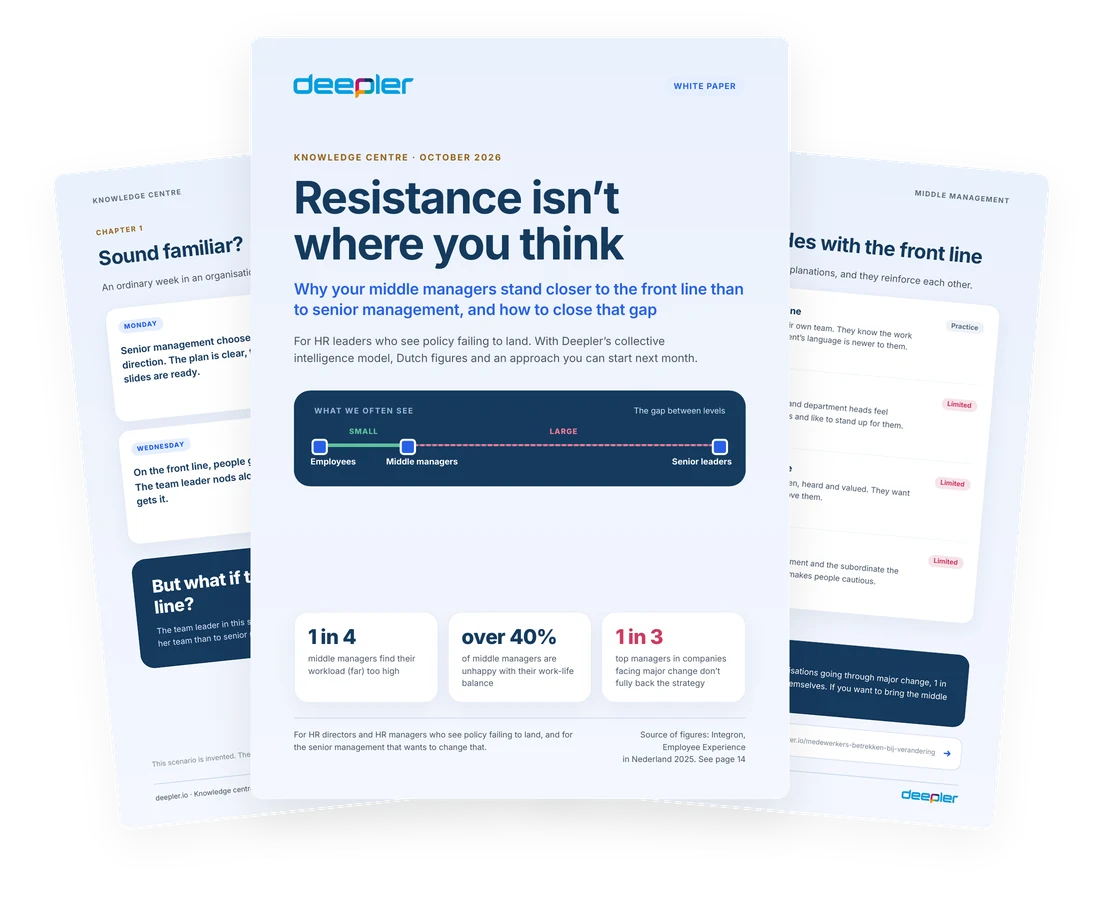
Free whitepaper
Resistance is not where you think
The collective intelligence model, six measures sorted by evidence, a worksheet for the board and middle management, and a baseline measurement.
Not every measure is equally well supported. Sorted by strength of evidence:
Four steps to close the gap
→
→
→
Let team leaders help write the approach. An approach for the middle, made without the middle, widens exactly the gap you want to close. Read how a healthcare organisation developed its team leaders in a targeted way in the case on 360 feedback for team leaders.
You are in the middle yourself too. Convincing the board today, reassuring a team tomorrow. Loyal to two sides, and sometimes understood by neither. What you wish for your team leaders, you should allow yourself too: a fixed place to spar and an honest limit to what you solve for others.
The Team leadership module in Deepler Research measures, among other things, shared strategy, communication and role clarity, per layer and anonymously. With Deepler 360 you develop managers based on their competency profile.
Knowledge Centre
How far apart are your board and middle management?
Download the whitepaper with the worksheet for a one-hour session.
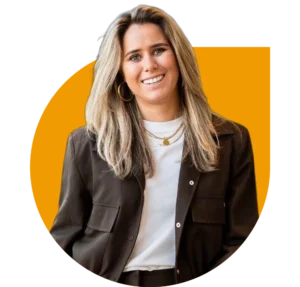
Sanne Huisman
Knowledge center Deepler
Sanne is the heart of Deepler’s Knowledge Center. She translates research, data, and practical experience into real-world applications for organizations. Whether it involves an employee survey, a whitepaper, or hands-on support, Sanne ensures that knowledge doesn’t go to waste but is instead used to improve both our work and our products.