


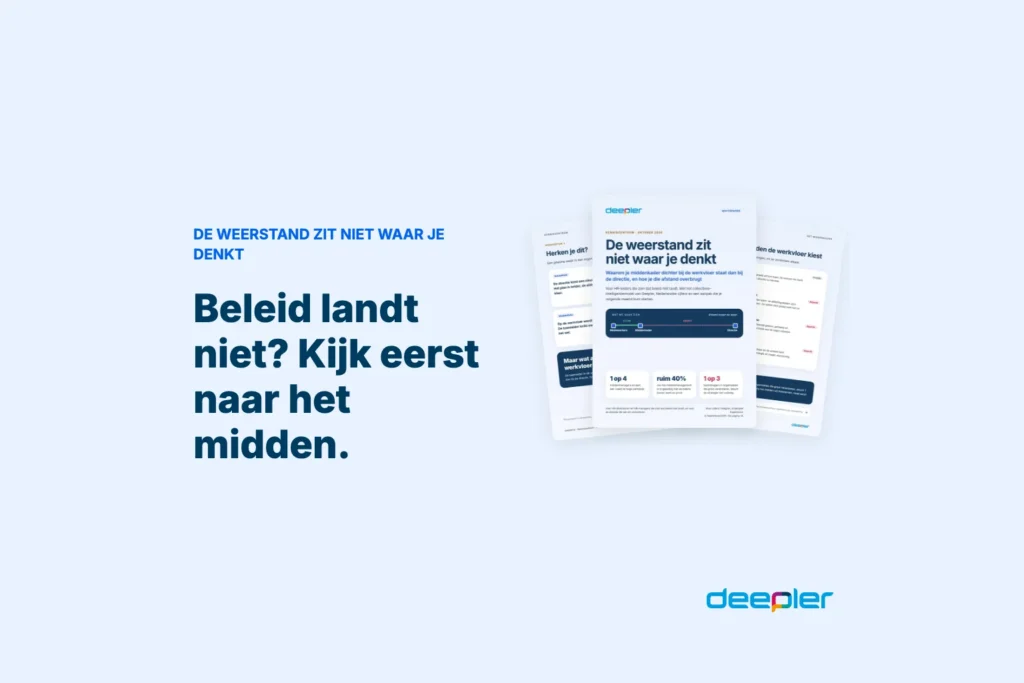
Weerstand bij verandering: waarom het middenkader de sleutel is
Maandag kiest de directie een nieuwe koers. Dinsdag legt de teamleider het uit aan haar team, maar z...
Verder lezen



Psychological safety means that team members feel free to share their views, ask questions, and admit mistakes without fear of negative consequences. This concept, popularized by Harvard professor Amy Edmondson, is essential for creating an open and innovative work environment [“].
Companies with a high level of psychological safety perform better because employees are free to express their ideas, try new things, and provide feedback without fear of rejection. In teams where psychological safety is lacking, people are often afraid to speak, leading to stagnation and reduced cooperation [“].

At work, psychological safety is about feeling that employees feel safe to speak up, especially when they want to provide feedback or raise an issue. This is not only good for the well-being of employees, but also for the team dynamics and operating results.
Employees feel safer to speak their mind, which leads to greater transparency.
Teams that feel safe are often more productive and creative because they’re not afraid to make mistakes or introduce new ideas.
Psychological safety fosters a culture that focuses on innovation and learning.
Teams that excel in psychological safety often have five key characteristics in common. Here are the building blocks that enable teams to thrive:
Everyone feels heard and valued, regardless of rank or experience. This creates a culture where people feel safe to participate in conversations. It is one of the most important pillars of psychosocial safety.
In a safe working environment, there is a willingness to learn from mistakes and to continuously improve. Can people express their mistakes or is there a checkout culture. This hampers the sense of social safety at work.
Employees dare to propose new ideas without fear of rejection. Both mistakes and ideas must be able to be expressed and shared.
Each team member feels free to share his or her opinion without fear of negative consequences. That does not mean that there should not be a hierarchy between employees and managers. It does mean that within this hierarchy, both parties dare to be open and transparent.
Team members actively help each other and create a culture of collaboration. Do employees seek each other out and actively ask each other for feedback? Is the answer to this: Yes! , then you are well on your way to a psychologically safe situation.
Leadership plays a crucial role in creating a safe work environment. Managers and team leaders must foster a culture where team members feel free to share ideas, ask questions, and admit mistakes without fear of repercussions. A leader who is open to feedback, dares to admit mistakes himself, and offers space for dialogue sets the tone for the entire team.
It’s not just about showing empathy, but also about actively listening and showing conscious leadership. Leaders must actively lead by example, by showing vulnerability themselves and encouraging employees to share new ideas or challenge the status quo. Psychological safety cannot be imposed top-down; it must be lived up to by leaders who clearly communicate that making mistakes is part of learning and growth.
Creating psychological safety requires more than just an open culture. It requires conscious leadership and continued commitment. Here are some practical steps to promote psychological safety within your team or organization:
Leaders must actively listen and set an example by communicating openly and admitting mistakes.
Create an environment where employees can provide feedback safely without fear of repercussions. Tools like Deepler’s AI-driven feedback systems can help with this by allowing employees to provide anonymous feedback and insight into the work culture.
Make sure that all team members feel equal and are able to speak their mind. This can be done by facilitating regular team discussions and organizing feedback sessions.
The rise of working from home and hybrid working methods poses new challenges in the field of psychological safety. In a physical office environment, colleagues can meet informally and there is more room for spontaneous conversations, which promotes trust. However, working remotely can create a sense of isolation, which puts psychological safety under pressure.
To ensure psychological safety in remote teams, leaders must make conscious efforts to keep communication open. This can be done through regular check-ins, virtual meetings where there is room for questions and feedback, and creating safe digital spaces where employees feel heard. Stimulating inclusiveness and active engagement is critical for teams that are not physically together. Tools such as anonymous feedback systems or virtual team building can help create a sense of belonging, even from a distance.
Deepler offers science-based tools that go beyond traditional approaches to psychological safety. Our AI-driven surveys not only measure the degree of psychological safety, but also provide immediately useful insights to make improvements. As a result, teams can not only identify problems, but also take actions to make their work environment safer and more productive.
Get instant feedback on the current state of psychological safety within your organization. In this way, a manager can have a good conversation with employees and give employees a safe platform to address psychological safety issues.
Our AI tools analyse the data and provide targeted recommendations for improvement. This way, you can centrally monitor whether employees feel psychologically safe and what is happening to improve it.
Creating a culture where employees feel safe to speak up, make mistakes, and come up with new ideas is essential to the growth of any company. Psychological safety isn’t just an HR theme, it’s the basis for innovation, productivity, and long-term success.
Do you want to know how your organization can improve psychological safety? Learn how Deepler’s AI solutions can help your team become a safer, more engaged, and more productive team.

Sanne Huisman
Knowledge center Deepler
Sanne is the heart of Deepler’s Knowledge Center. She translates research, data, and practical experience into real-world applications for organizations. Whether it involves an employee survey, a whitepaper, or hands-on support, Sanne ensures that knowledge doesn’t go to waste but is instead used to improve both our work and our products.