



Preparing 360 degree feedback: how to gather feedback you can actually use
The year-end review is coming up. For many managers, that means thinking back over a whole year and ...
Verder lezen



In 2021, four change managers founded Deepler. Not because the world needed another questionnaire, but because they kept seeing the same thing go wrong. Founders Stijn van der Vat and Leon zu Salm-Salm on stalled change programmes, reports in a drawer and why involving employees in change pays off.
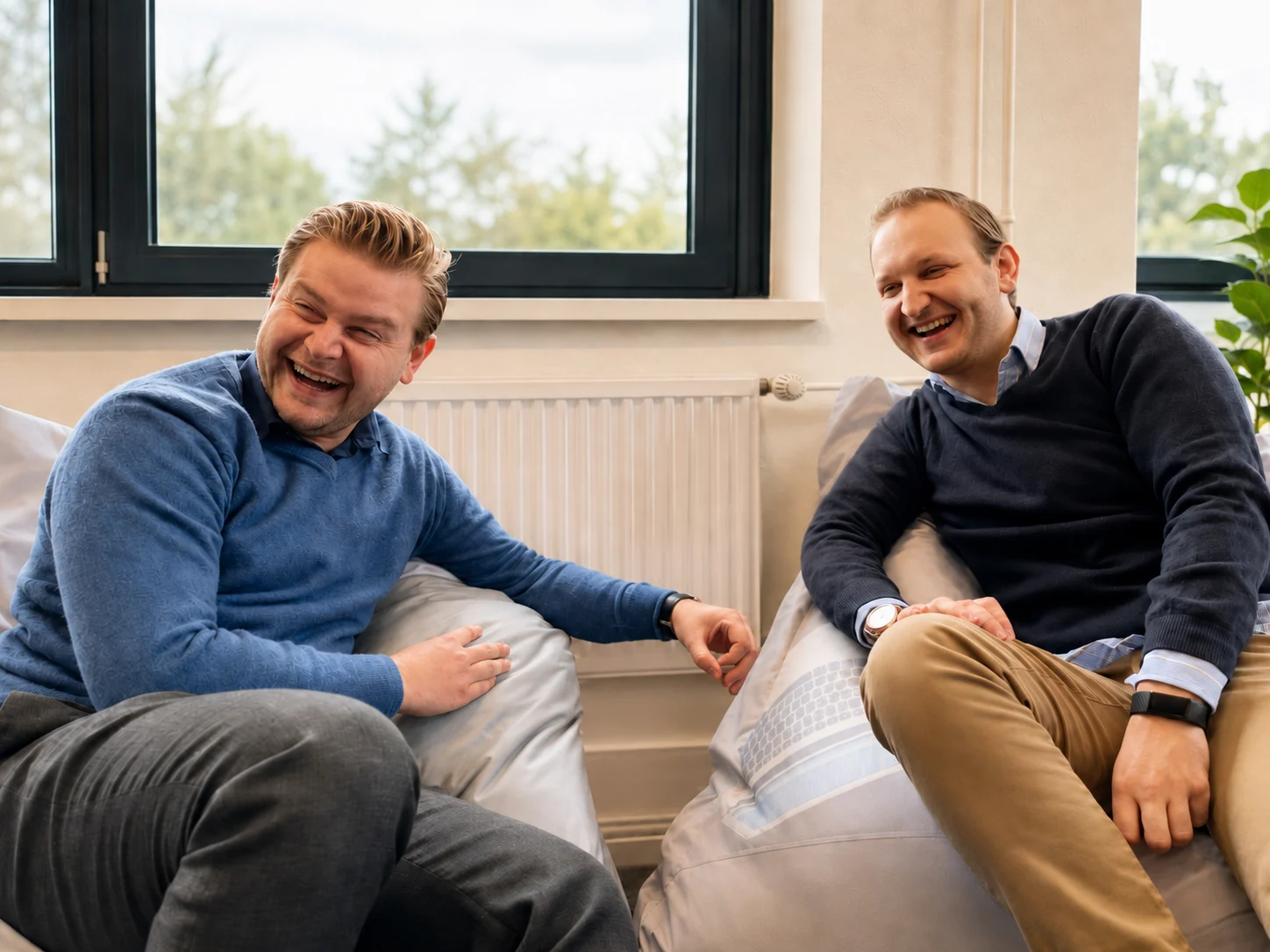
You both come from change management. What did you see there?
Stijn: The same scene, over and over. A steering group in the project room, the roadmap on the wall, green ticks next to the first phases. Budget in order, planning in order. And yet almost nobody was using the new way of working.
Leon: While two floors down they knew exactly why. Team leaders had raised it, in a meeting, in an email, in an evaluation. That evaluation ended up in a report, and the report ended up in a drawer.
Can you name a moment when that really hit home?
Stijn: I was supporting a reorganisation at a logistics company. After nine months the steering group met because the new rosters weren’t working. Someone pulled out an evaluation from six months earlier. The problem was described in it word for word, by the planners themselves. It had been there all along. Nobody had read it.
The usual explanation is resistance. Do you recognise that?
Leon: Hardly. Employees were actually the first to see where things chafed. Which process didn’t fit, which schedule was unrealistic, which customer got caught in the middle. The problem wasn’t the will, it was the route. That knowledge reached the decision-makers too late, too filtered or not at all.
Stijn: That has been well researched, too. Milliken, Morrison and Hewlin showed that employees often don’t raise concerns upwards, partly because they think it won’t make a difference anyway. And Detert and Burris found that the openness of the manager makes a big difference.
Leon: So silence on the shop floor rarely means there’s nothing to report. Often it means that reporting hasn’t led anywhere before.
So why not build a questionnaire? That seems the obvious thing to do.
Leon: Because the questionnaire was never the problem. The problem was what happened afterwards. We wanted to build something that gets what employees know to the place where decisions are made, quickly, and makes sure something is done with it. That rested on three beliefs.
Which ones?
Stijn: The first: listening without action costs trust. An employee survey is a promise. If you ask how things are going, you create the expectation that something will change. Church and colleagues found in large organisations that employees who saw something being done with the results were more positive on almost every topic than employees for whom it stopped at measuring. Measuring alone doesn’t do it. Following up does.
Leon: The second: the shop floor often already knows. That’s not a romantic idea, it’s a practical fact. The Dutch government’s occupational health portal, Arboportaal, advises employers to involve employees in tackling work pressure for good reason. The question is rarely whether that knowledge exists, but how quickly it reaches the decision-makers.
Stijn: And the third: change needs to be carried. A plan that works on paper is not yet change. Oreg, Vakola and Armenakis brought together sixty years of research, and a recurring finding is that people who are informed and involved respond more positively to change. Support isn’t a communications job after the fact. It starts with who gets to think along before the plan is finished.
In your very first year you were at Web Summit in Lisbon. What was that like?
Leon: Exciting, because we had little more than a conviction and a prototype. What stayed with me: almost everyone who stopped at our stand started talking about a programme of their own that had stalled. We hardly had to explain the problem. People recognised it straight away.
That same year the first assignment came, at a large multinational. What did you learn there?
Stijn: That speed changes everything. When teams saw within a few weeks that their input led to a concrete change, response went up and the feedback got sharper. People started thinking along more seriously, because they noticed it mattered. That confirmed exactly why we had started.
If you sum it up in one sentence: what does Deepler stand for?
Leon: Organisations perform better when they listen better, and act on it straight away.
Stijn: And our mission is even shorter: turning listening into movement.
What can an organisation do tomorrow, without a new system?
Stijn: Have an honest conversation in the management team. With three questions.
Leon: Anyone who answers those questions honestly has already taken the first step from listening to movement.
Curious how Deepler helps organisations take that step? Feel free to have a look around at deepler.io.

Sanne Huisman
Knowledge center Deepler
Sanne is the heart of Deepler’s Knowledge Center. She translates research, data, and practical experience into real-world applications for organizations. Whether it involves an employee survey, a whitepaper, or hands-on support, Sanne ensures that knowledge doesn’t go to waste but is instead used to improve both our work and our products.