Home » Blogs » The manager as amplifier: what an engagement survey taught us about leadership
Leadership & Management
The manager as amplifier: what an engagement survey taught us about leadership
Two teams, similar workplaces, a completely different verdict. What an engagement survey at VolkerWessels showed about the influence of managers, and how feedback reveals blind spots.
Stijn van der Vat
5 min read
In this article
How do colleagues see you?
Compare your self-image with a colleague’s view in the free 360 mini-analysis.
What determines whether employees enjoy going to work? Salary, the content of the work, colleagues: all important. But one factor keeps coming back in research into employee engagement: the direct manager. That role became very concretely visible in an engagement survey at VolkerWessels.
The insight: same workplace, different verdict
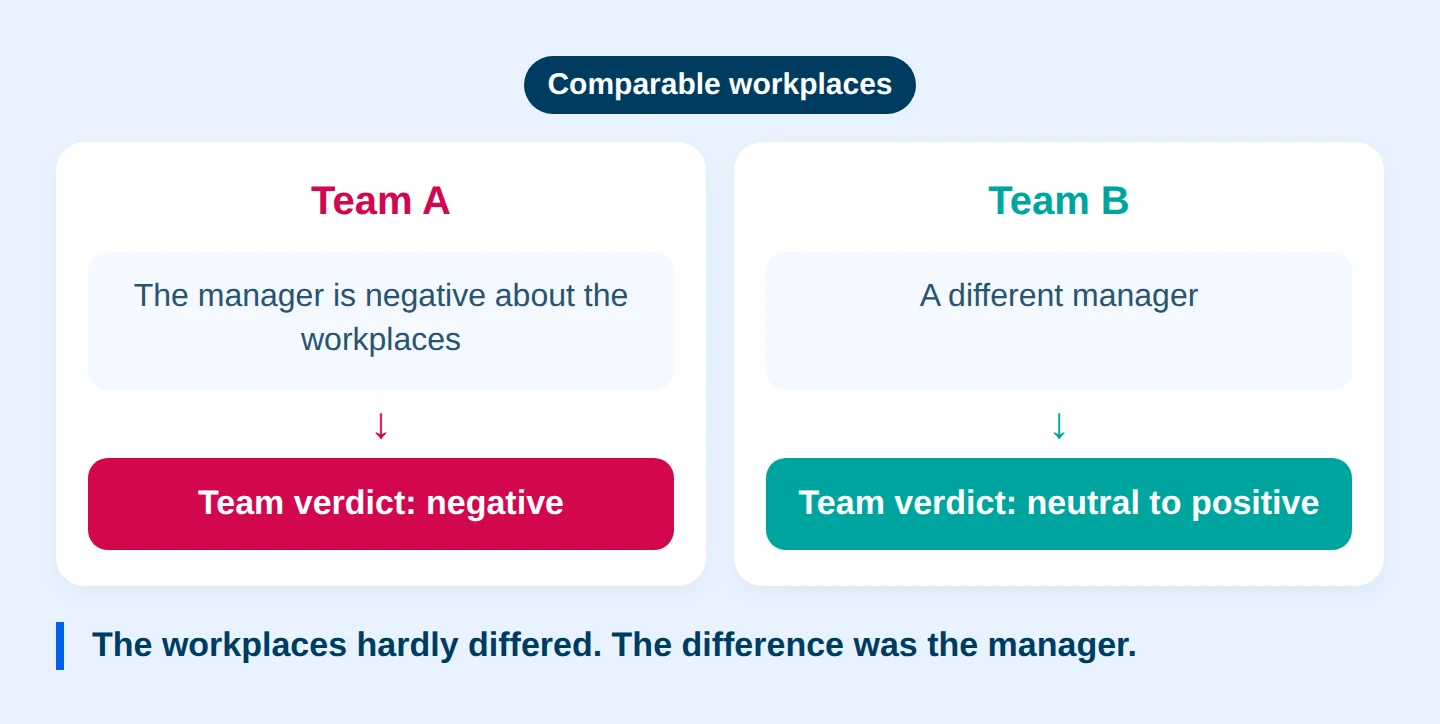
One of the most useful insights from that survey was, in the end, not about engagement itself, but about workplaces. Two teams worked in comparable workplaces and yet came to a very different verdict. In the team of one manager, who was negative about the workplaces himself, the verdict was negative. In the other manager’s team it was neutral to positive.
The workplaces hardly differed. The difference was in the manager: in attitude, in the conversations that were held and in the behaviour the team saw every day. That coloured how the whole team experienced things.
For VolkerWessels HR adviser Lola den Daas, the survey thus gave insight into the influence of managers on how employees experience their work. The organisation still regularly uses the example to make managers aware of their impact. According to her, the survey also provided valuable pointers for leadership development (translated from Dutch).
What research says about managers and employee engagement
The manager as amplifier is not a new idea. In a large meta-analysis, Harter, Schmidt and Hayes found that engagement at business-unit level is related to outcomes such as customer satisfaction, productivity and turnover. So engagement differs per team, and those differences matter.
Gerstner and Day brought together research on the quality of the relationship between manager and employee. A good relationship is associated with greater satisfaction, better performance and fewer intentions to leave. The relationship with the manager also emerges in the meta-analysis by Griffeth, Hom and Gaertner on the causes of turnover, although it is certainly not the only factor.
So the manager amplifies what is already there. Good policy becomes even better in a good team. A negative tone can undermine even a perfectly good workplace.
What you don’t see yourself as a manager
The tricky thing about influence is that it is hard to see in yourself. A manager who occasionally lets slip what he thinks of the workplaces usually doesn’t notice that this colours the verdict of the whole team. It is a blind spot: behaviour that others see, but you don’t.
Feedback from several sides helps make such blind spots visible: from your own team, from colleagues and from your own manager, alongside a self-assessment. The difference between how you see yourself and how others see you is often the most instructive part.
In their meta-analysis, Smither, London and Reilly found that performance improves slightly on average after such feedback, and more strongly when people link concrete goals to it and really act on it. So a result is not an end point, but the start of a development conversation. Use such feedback for development, not for appraisal. As soon as it becomes part of a performance judgement, the answers become more cautious and the value disappears.
Discussing team differences without blame
As soon as results per team are visible, a league table is lurking. Understandable, but rarely helpful. A manager who feels judged will defend rather than learn. What does work:
Start with the context. A team in the middle of a reorganisation scores differently from a team that has just finished a project.
Look at development, not just level. A team that is improving is doing something right, even if it isn’t at the top.
Learn from the strongest teams. Often it comes down to small, transferable habits.
Discuss one-to-one first. Give managers the chance to process their own results before they are discussed in a group.
From insight to development: three steps for HR
1. Make results personal and understandable. Give every manager an overview of their own team, in plain language, with two or three points for attention.
2. Link them to development. Use the results, possibly supplemented with feedback from several sides, as a starting point for coaching, peer consultation or a leadership programme. Have each manager choose one concrete development goal.
3. Measure again and celebrate progress. Come back to the same theme after a few months and show what has changed. Seeing progress is the best motivation to keep going.
Five questions for managers
When did I last ask what my team needs from me?
Which of my own opinions does my team echo in how it talks about the work?
Does everyone in my team feel free to disagree with me?
What do I do with the feedback I get, and do my employees see that too?
Which of my habits would my team most like to see changed?
An amplifier works in both directions
An amplifier makes sound louder, whatever that sound is. The same goes for managers. That is why it pays to invest in their development, and to give them honest information about how their team experiences the work and how others see them.
Want to know how we help organisations give managers insight into their own influence? Take a look at deepler.io.
Sources
Gerstner, C. R., & Day, D. V. (1997). Meta-analytic review of leader-member exchange theory: Correlates and construct issues. Journal of Applied Psychology, 82(6), 827-844.
Griffeth, R. W., Hom, P. W., & Gaertner, S. (2000). A meta-analysis of antecedents and correlates of employee turnover. Journal of Management, 26(3), 463-488.
Harter, J. K., Schmidt, F. L., & Hayes, T. L. (2002). Business-unit-level relationship between employee satisfaction, employee engagement, and business outcomes: A meta-analysis. Journal of Applied Psychology, 87(2), 268-279.
Smither, J. W., London, M., & Reilly, R. R. (2005). Does performance improve following multisource feedback? A theoretical model, meta-analysis, and review of empirical findings. Personnel Psychology, 58(1), 33-66.
Deepler (2026). Use case VolkerWessels: two teams, the same workplaces, a completely different verdict. deepler.io
How do colleagues see you?
Compare your self-image with a colleague’s view in the free 360 mini-analysis.
Stijn founded Deepler in 2021 together with three other change managers, driven by a shared conviction: organizations only truly change when employees are taken seriously. As CEO, he shapes Deepler’s strategic direction and builds lasting partnerships with clients and partners. Stijn is often the first point of contact for organizations looking to get more out of their employees' voices.
Deepler 360
Organising feedback structurally in your teams?
Discover how Deepler 360 gathers feedback from colleagues in a structured way and makes it easy to discuss.