



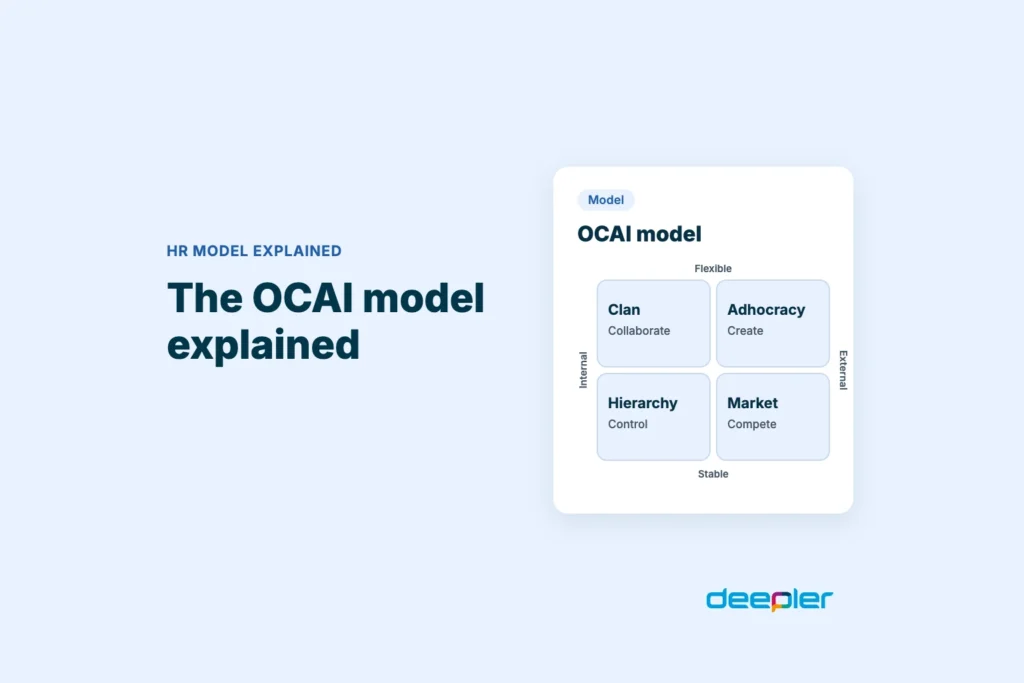
OCAI model: Competing Values Framework and 4 culture types
The OCAI model (Organizational Culture Assessment Instrument) is a questionnaire developed by Kim Ca...
Verder lezen




A new course in January. A new system in March. A reorganisation in June. The employee survey in October, while nothing was ever said about last year’s. And in November, when a merger is announced, the management team says: “There is a lot of resistance.” But is it resistance to the merger? Or is it change fatigue, among people who no longer believe anything happens with their input?
The Netherlands is reorganising more than it has in years. In 2025, 355 companies reported a major reorganisation to the UWV, the highest number in ten years. Almost 25,000 employees were affected. And employees are making it clear what that does to them.
In organisations undergoing major change
Source: Integron, Employee Experience in Nederland 2025 (poll among 5,000 working people)
If you lose people during the change, you pay the bill afterwards in turnover and absence.
A useful image: every change makes a withdrawal from the same trust. Explaining, involving people, giving feedback and finishing what you start deposits something back. If you only withdraw, one day you will be overdrawn.
Illustrative statement of the trust account
The merger is not the problem. It is just the withdrawal that puts the account in the red.
Illustrative, not a measurement. Based on research into trust and participation and on Deepler’s practice
A review of 79 studies over sixty years (Oreg, Vakola and Armenakis, 2011) shows what determines how people receive a change. Two things help, three cause fatigue:
So resistance rarely lies in the change itself. It lies in the trust that is left, in the stacking of changes and in whether people are heard. As HR, you have influence on all five.
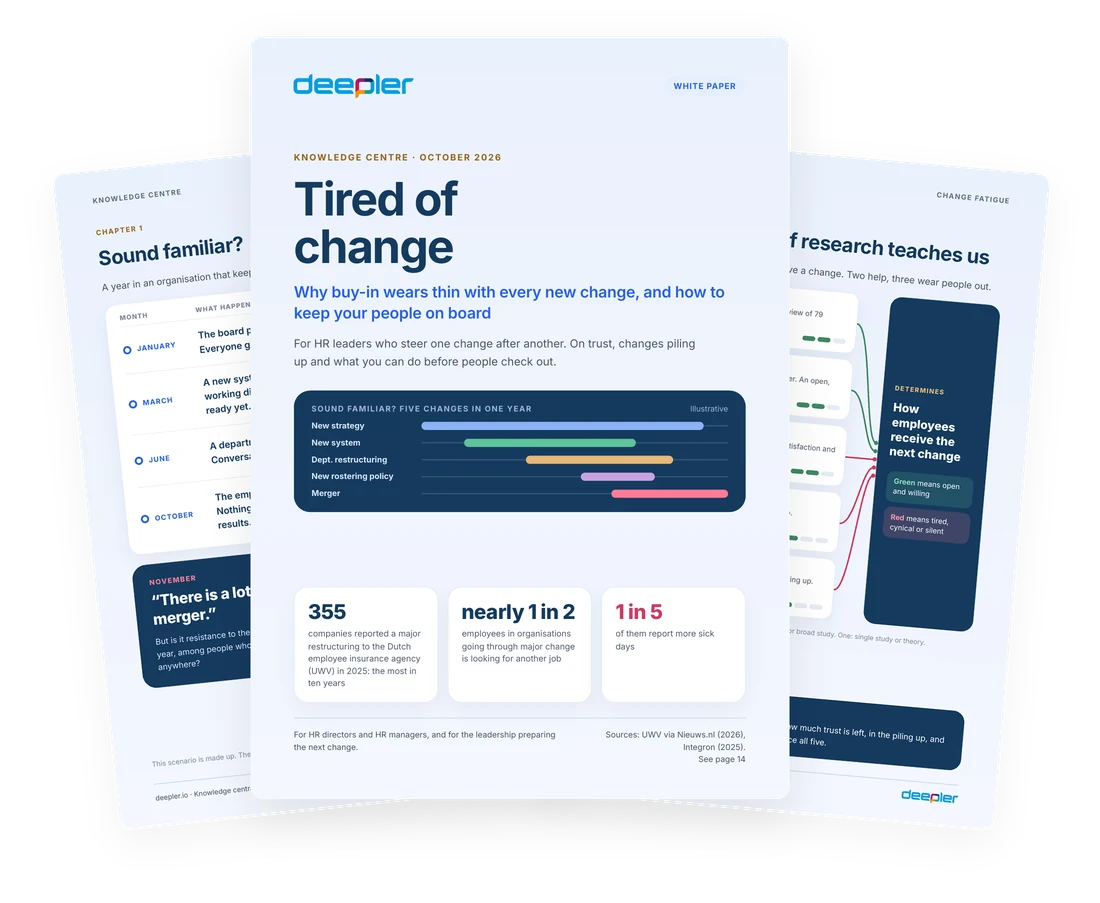
Free whitepaper
Tired of change
The trust account model, six deposits sorted by evidence, answers to six management team statements and a baseline measurement.
You hear firm statements about change. Three we come across often:
The simplest rule: set at least one deposit against every new change. A completion, a piece of feedback, or a change that stops.
Four steps to win back support
→
→
→
Give every change one owner who also arranges the feedback. Otherwise everyone is responsible, and nobody does it. And celebrate what is finished: visibly close off what has been achieved. Read why it pays to involve people early in involving employees in change.
Start small. Count with the management team how many changes are running at the same time, and sort the stack: what do we stop, what do we finish first, what can wait six months? The height of the stack alone is often an eye-opener. Want to know how two merging organisations compared their cultures before they started? Read the case on culture in a merger.
With Deepler Research you anonymously put statements such as “I can see what happens with my input” to all teams, and see per team where things chafe. The whitepaper includes a baseline measurement with ten statements that you fill in with your management team in five minutes.
Knowledge Centre
How is your account looking?
Download the whitepaper with the baseline measurement and the worksheet for your management team.

Sanne Huisman
Knowledge center Deepler
Sanne is the heart of Deepler’s Knowledge Center. She translates research, data, and practical experience into real-world applications for organizations. Whether it involves an employee survey, a whitepaper, or hands-on support, Sanne ensures that knowledge doesn’t go to waste but is instead used to improve both our work and our products.