




Role of HR in promoting a data-driven culture
The role of HR in promoting a data-driven culture HR professionals are increasingly being asked: “Ca...
Verder lezen


The OCAI model (Organizational Culture Assessment Instrument) is a questionnaire developed by Kim Cameron and Robert Quinn to map the culture of an organisation. It is based on the Competing Values Framework and distinguishes four culture types: clan culture, adhocracy culture, market culture and hierarchy culture. For each question, respondents divide 100 points across four descriptions, once for the current culture and once for the preferred culture.
Culture shapes how people work together, make decisions and respond to change. Yet it is hard to put your finger on. The OCAI model, often simply called the Cameron and Quinn model, makes culture discussable with a clear vocabulary and a simple measurement. In this article you will learn what the OCAI model is, how the questionnaire works, how to calculate and interpret the scores, where its limitations lie and which related models you can use.
OCAI stands for Organizational Culture Assessment Instrument. It was developed by Kim Cameron and Robert Quinn at the University of Michigan and described in their book Diagnosing and Changing Organizational Culture. It is one of the most widely used instruments for measuring organisational culture worldwide.
The OCAI model is built on the Competing Values Framework. That framework emerged in the early 1980s from research by Quinn and Rohrbaugh into what makes organisations effective. They found that effectiveness runs along two tensions. Together those tensions form four quadrants, and each quadrant represents a culture type.
The terms are often used interchangeably, but they mean slightly different things:
The OCAI model places organisations on two axes. There is no right or wrong position: every position has benefits and a price.
Combining the two axes gives four quadrants. Flexible and internally focused is the clan culture. Flexible and externally focused is the adhocracy culture. Stable and externally focused is the market culture. Stable and internally focused is the hierarchy culture. The types that sit diagonally opposite each other clash the most: clan versus market and adhocracy versus hierarchy. That is where the name competing values comes from.
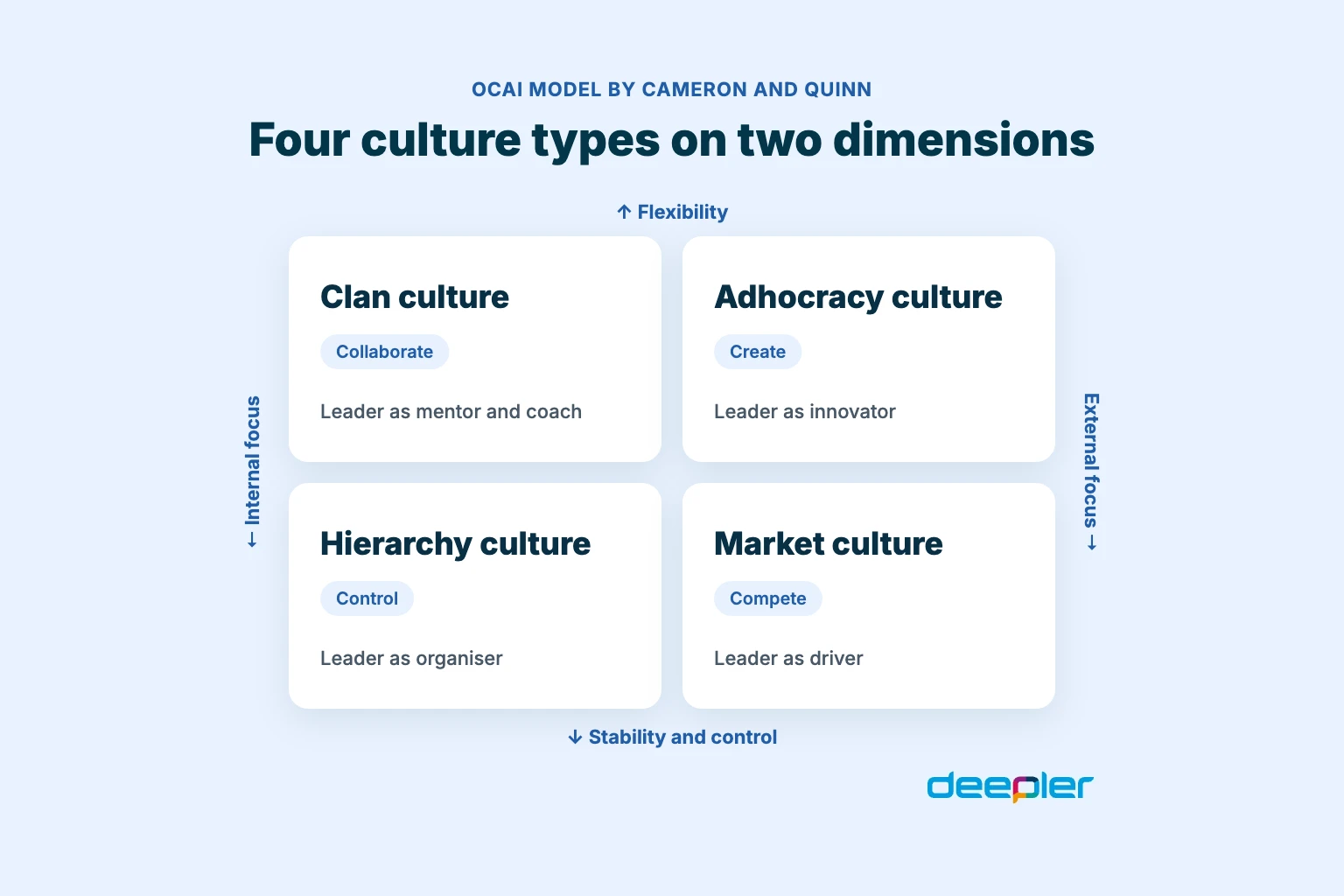
| Culture type | Position | Core value | Typical leader | Success means |
|---|---|---|---|---|
| Clan culture | Flexible, internal | Collaborate | Mentor, coach | Engagement and development of people |
| Adhocracy culture | Flexible, external | Create | Innovator, entrepreneur | New products, ideas and growth |
| Market culture | Stable, external | Compete | Driver, competitor | Results, market share and winning |
| Hierarchy culture | Stable, internal | Control | Organiser, coordinator | Reliability, efficiency and low costs |
In a clan culture the organisation feels like a close-knit group. Loyalty, teamwork and personal development are central, and managers act mainly as coaches. Its strength is engagement and trust. The pitfall is that difficult conversations are avoided and the group turns inward.
The adhocracy culture is dynamic and entrepreneurial. People get room to experiment, taking risks is part of the job and innovation is the yardstick. Its strength is agility. The pitfall is a lack of focus and commitments that are not followed through.
A market culture is results-driven. Goals are clear, performance is measured and the focus is outward: customers, competitors and market position. Its strength is decisiveness. The pitfall is high pressure, internal competition and too little attention to the long term.
In a hierarchy culture everything revolves around structure, procedures and care. Roles are clear and processes are predictable. Its strength is reliability, which can be essential in sectors such as healthcare, government or manufacturing. The pitfall is slowness and little room for initiative.
In practice, no organisation has a single pure culture type. Every organisation is a mix, usually with one or two dominant types. So the question is not which type is best, but which mix fits what your organisation wants to achieve. You can read more about the different types of company culture in our overview.
The OCAI questionnaire consists of six dimensions. Each one describes an aspect of the culture:
Each dimension has four descriptions, A to D. Each description belongs to one culture type: A to clan, B to adhocracy, C to market and D to hierarchy. The respondent divides 100 points across those four descriptions. The better a description fits, the more points it gets.
This happens twice: first for the culture as it is now, then for the culture the respondent would prefer. Completing it usually takes about fifteen minutes.
A simplified example of one dimension (illustrative, not the official wording of the questionnaire):
| Organisational glue | Now | Preferred |
|---|---|---|
| A. Loyalty and mutual trust | 20 | 35 |
| B. Innovation and room for initiative | 10 | 25 |
| C. Achieving goals and delivering results | 30 | 25 |
| D. Rules, procedures and a smooth-running organisation | 40 | 15 |
| Total | 100 | 100 |
Because you divide points instead of rating each statement separately, the questionnaire forces choices. You cannot rate everything as important. That makes the outcome sharper than a regular 1 to 5 scale.
A worked example for a fictional department:
| Culture type | Current | Preferred | Difference |
|---|---|---|---|
| Clan culture | 22 | 34 | +12 |
| Adhocracy culture | 13 | 24 | +11 |
| Market culture | 30 | 24 | -6 |
| Hierarchy culture | 35 | 18 | -17 |
In this example the current culture is mainly hierarchical and results-driven. Employees want more collaboration and more room for innovation, and fewer rules and less control.
You read an OCAI profile on five points:
Then translate the outcome into behaviour. A practical format is to agree, per culture type, what you will do more of, what you will do less of and what you will keep. That turns an abstract profile into something concrete: “more room for teams to decide for themselves” says more than “more adhocracy”.
The OCAI model is popular for good reasons. At the same time it has limits you should know before basing decisions on it.
If you look beyond the OCAI model, you will find several related models:
What many of these models share is the idea that culture is about tensions between values that are both worthwhile. That insight is also the basis of a more modern way of measuring culture.
Deepler Culture builds on that thinking. The method is inspired by the theories of Quinn and Cameron, Hofstede and Trompenaars, and translated into daily practice. Instead of four broad culture types, Deepler Culture measures six cultural opposites:
In doing so, Deepler Culture addresses several limitations of the OCAI model:
Want to see how this works for your organisation? Explore Deepler Culture or request a demo. Curious which work culture suits you best? Take the free culture mini-analysis: twelve short dilemmas on the same six opposites, and your personal culture profile within three minutes.
OCAI stands for Organizational Culture Assessment Instrument. It is a questionnaire by Kim Cameron and Robert Quinn for measuring organisational culture based on the Competing Values Framework.
The four culture types are clan culture (collaborate), adhocracy culture (create), market culture (compete) and hierarchy culture (control). Every organisation is a mix of these four.
The questionnaire has six dimensions, each with four descriptions. You complete it twice, for the current and for the preferred culture. For each dimension you divide 100 points.
The questionnaire is published in Cameron and Quinn’s book and the copyright belongs to the authors. If you want to use it in your organisation, check the terms of use of the rights holders or work with a provider that is licensed to use the instrument.
The OCAI model works with four culture types on two dimensions and compares the current with the preferred culture. Hofstede’s model describes organisational culture along several separate dimensions and has no fixed culture types.
Yes. You can calculate the scores per team or department. That is often more useful than an organisation-wide average only, because culture can differ greatly between teams.
Culture changes slowly. So do not measure too often, but often enough to see whether interventions have an effect. After a change project or a change of strategy, measuring again after a few months makes sense.

Leon zu Salm-Salm
Founder / CIO
Leon is a co-founder of Deepler and is responsible for product development, compliance, and the ongoing evolution of the Deepler platform. He translates organizational needs into effective tools—ranging from surveys and 360-degree feedback to onboarding. Leon works in Dutch, English, German, and French, and easily switches between strategy, technology, and practical client applications.