Home » Blogs » Two gaps in your culture, and why the second one matters most
Leadership and organisational culture
Two gaps in your culture, and why the second one matters most
Culture can't be captured in a single score. On the execution gap, the alignment gap and why differences between leadership and employees are mostly information.
Stijn van der Vat
6 min read
In this article
How is your culture doing?
Take the free culture mini-analysis and see where you stand.
“Our culture scores a 7.2.” It is a sentence you often hear after a culture survey. A nice number, comfortably above average. But what does it actually say? And what do you do with it, especially if you are working on culture change?
The answer is often: not much. Because a culture can’t be captured in a single number.
What gets lost in a single score
An average score makes culture manageable, but also flat. It doesn’t tell you which direction the organisation is moving in, what employees are missing or where leadership and the shop floor think differently. It doesn’t tell you what good looks like either. A 7.2 on innovation can be excellent for a hospital and too low for a software company.
Culture is not a performance you want to push as high as possible. It is a set of choices that has to fit your organisation.
A single score has another drawback: it invites comparison. With last year, with other departments, with a benchmark. But a higher score is not always better, and a lower one not always worse. It depends on where you want to go.
Culture change starts with tensions
A more useful way to look at culture is as a tension between opposites. Think of:
speed versus care;
structure versus flexibility;
individual performance versus collaboration;
renewing versus preserving.
Both sides have value. An organisation that is only fast makes mistakes. An organisation that is only careful falls behind. The question is not which side is right, but where you want to stand as an organisation.
This idea has solid roots. Quinn and Rohrbaugh developed the Competing Values Framework, which describes organisations along opposing values such as flexibility and control. Cameron and Quinn later turned it into a well-known method for diagnosing culture. Smith and Lewis described how organisations don’t have to resolve tensions, but can consciously learn to work with them. And Schein showed that culture runs deep, in shared assumptions that you don’t simply change.
Three points, two gaps
For every dimension, we look at three points:
The current culture, as employees experience it.
Leadership’s ambition: where does the management team want to go?
Employees’ wishes: where do they themselves want to go?
Between those three points, two gaps appear.
The execution gap is the difference between the current culture and leadership’s ambition. That gap is familiar territory: it is the change the organisation wants to make.
The alignment gap is the difference between leadership’s ambition and employees’ wishes. That gap is mapped far less often, but may well be the most important one. Because if leadership and employees want to go in different directions, every change stalls, however good the plan. The alignment gap is therefore a signal for change management.
An example
The following example is fictional.
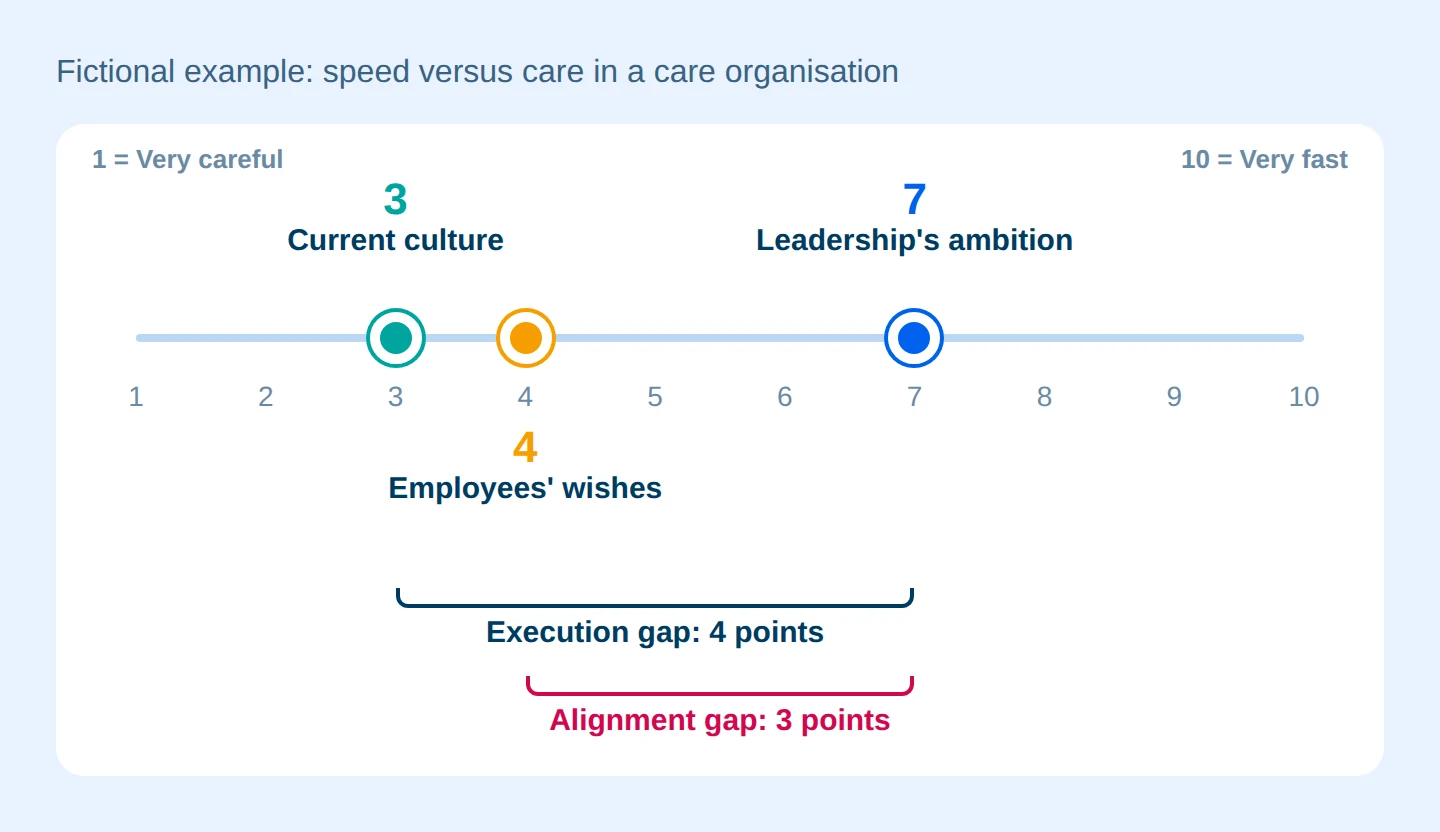
A mid-sized care organisation looks at the dimension of speed versus care. On a scale from 1 (very careful) to 10 (very fast), it looks like this:
Current culture according to employees: 3. Everything is thorough, but slow.
Leadership’s ambition: 7. The management team wants to respond faster to changes in healthcare.
Employees’ wishes: 4. They want things a little faster, but care remains important to them.
The execution gap is large: four points. But the interesting part is the alignment gap of three points. Leadership wants a big leap, employees a small step.
Without this picture, the management team launches a change programme focused on speed and is surprised by the resistance. With this picture, it can first open the conversation: why do we want to be faster, what does that mean for care, and what are employees worried about?
What to do if the alignment gap is large
A large alignment gap is not a problem, it is information. It tells you a conversation is needed before there is a plan.
Explore the reasons. Why do employees want something different from leadership? They often have good reasons that are not known at the top. In the example, employees know exactly where speed in care becomes risky.
Share the picture. Show employees where leadership and the shop floor differ. That alone often opens the conversation.
Reconsider the ambition. Perhaps the ambition is too big, or aimed at the wrong point. Perhaps administration can move faster, but not care itself.
Build together. Let employees help think about how the gap can be closed. Those who help build it, carry the outcome.
And if the alignment gap is small?
That is information too. A small alignment gap means leadership and employees want to go in the same direction. That is a strong basis for change. The challenge then lies mainly in execution: how do we get from here to there together?
Sometimes employees’ wishes even go further than leadership’s ambition. Employees might, for example, want more room for innovation than the management team has in mind. That is a valuable signal as well. Perhaps the organisation is further along than leadership thinks, and the ambition can be raised.
Whatever picture emerges: it is not about right or wrong, but about the conversation it makes possible.
How to have the conversation
The picture of the three points works best when you look at it together, not when you present it. Let the management team first estimate where employees will stand, and then compare that with the actual results. The difference between expectation and reality is often a conversation in itself. Then involve a group of employees in interpreting the results, so the picture is not only explained from the top.
Three questions for a management team session
On which two or three culture dimensions do we as leadership want a shift, and why?
Do we know what our employees themselves want on those dimensions, or do we assume they want the same?
If leadership and employees want to go in different directions, are we willing to adjust our ambition?
The second gap first
Most culture programmes focus on the execution gap: from here to there. But if you explore the alignment gap first, you avoid pulling in the wrong direction, or pulling alone. You don’t change a culture for employees, but with them.
Curious how we help organisations map culture as a set of tensions? Visit deepler.io.
Sources
Cameron, K. S., & Quinn, R. E. (2011). Diagnosing and changing organizational culture: Based on the competing values framework (3rd ed.). San Francisco: Jossey-Bass.
Quinn, R. E., & Rohrbaugh, J. (1983). A spatial model of effectiveness criteria: Towards a competing values approach to organizational analysis. Management Science, 29(3), 363-377.
Schein, E. H., & Schein, P. A. (2017). Organizational culture and leadership (5th ed.). Hoboken, NJ: Wiley.
Smith, W. K., & Lewis, M. W. (2011). Toward a theory of paradox: A dynamic equilibrium model of organizing. Academy of Management Review, 36(2), 381-403.
How is your culture doing?
Take the free culture mini-analysis and see where you stand.
Stijn founded Deepler in 2021 together with three other change managers, driven by a shared conviction: organizations only truly change when employees are taken seriously. As CEO, he shapes Deepler’s strategic direction and builds lasting partnerships with clients and partners. Stijn is often the first point of contact for organizations looking to get more out of their employees' voices.
Deepler Culture
Making culture measurable and open to discussion?
Discover how Deepler Culture maps your organisational culture.