Home » Blogs » Those who leave speak most honestly, but too late: listening at the moments things tip
Engage & Captivate
Those who leave speak most honestly, but too late: listening at the moments things tip
The exit interview is candid, but it comes too late. On the moments when doubt arises, the stay interview and how to make good use of exit interviews after all.
Leon zu Salm-Salm
6 min read
In this article
Preventing staff turnover?
Download the free turnover prevention toolkit with practical guidance.
The exit interview is often one of the most candid conversations an employee has with their employer. The decision has been made, there is little left to lose. What went unsaid for a long time suddenly comes out.
Valuable, certainly. But it comes at the wrong moment. The new contract has been signed. Whatever you hear, you can no longer fix for this person.
Leaving rarely starts with the resignation letter
If you ask someone why they are leaving, you usually get a story that has been going on for much longer. A first doubt after a reorganisation. A development wish that was left lying. A new manager they didn’t click with. A valued colleague who left, after which the work felt different.
Lee and Mitchell described this in their so-called unfolding model. According to them, leaving often starts with a shock: an event that makes someone think about their job. That can be something big, like a reorganisation, but also something small, like a conversation that went down badly. From that moment on, a process can start that sometimes ends in departure only months later.
That is actually good news. It means there is a period in which you can still do something. If you hear about it, at least.
It does require you to recognise that period, and for employees to feel free to share their doubts before the decision is made.
Why people stay
Research into turnover often focuses on why people leave. At least as interesting is the question of why they stay. Mitchell and colleagues introduced the concept of job embeddedness for this: the degree to which someone is woven into their work and their organisation. Think of how well someone fits the work, their ties with colleagues and what they would give up by leaving. The stronger that embeddedness, the smaller the chance of leaving.
In the meta-analysis by Griffeth, Hom and Gaertner, job satisfaction, organisational commitment and the relationship with the manager were among the predictors of turnover.
So if you want to know whether people will stay, you should not only ask whether they are satisfied. But also whether they feel connected, whether they can grow and whether something has changed recently.
The moments when things tip
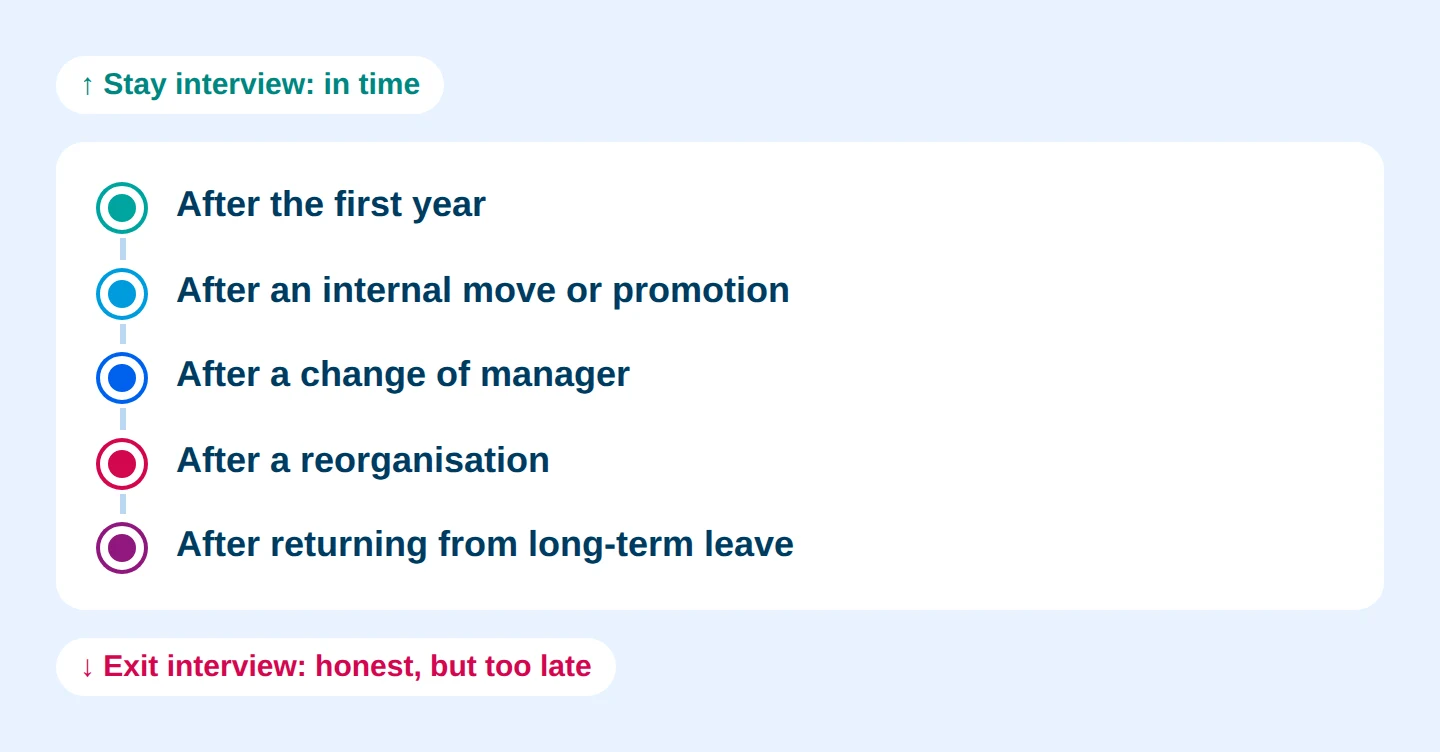
Not every moment in a career is equally sensitive. There are moments when doubt arises more often. That is exactly where it pays to listen:
After the first year. The novelty has worn off. Does the job live up to what someone expected?
After an internal move or promotion. A new role brings new expectations, and sometimes new uncertainty.
After a change of manager. The relationship with the manager weighs heavily in the choice to stay or go.
After a reorganisation. Change makes people think about their place, even if their own job doesn’t change.
After returning from long-term leave. Those who come back sometimes see the organisation with different eyes.
A few short questions at such a moment often say more than an extensive annual survey. How did the transition go? What do you need? What are you having doubts about?
The stay interview
Alongside the exit interview there is the stay interview: a conversation with employees who are not about to leave. The aim is simple: to understand what keeps someone here, and what could disrupt that. Five questions that help:
What do you look forward to when you start your working day?
What would make you doubt your job here?
What do you need to keep growing here?
What has changed in the past year in how you experience your work?
What could I do differently as your manager?
A stay interview only works if something happens with the answers. Otherwise it becomes a delayed exit interview.
The role of the manager
Managers are often the first to notice that something is changing. Someone who contributes less in meetings, no longer thinks along about the longer term or takes time off strikingly often. None of these signals proves someone will leave, and it is no reason to distrust anyone. But it is a reason to start a conversation.
An open question works better than a direct one. “How do you feel about your work at the moment?” is more inviting than “Are you applying for jobs?”. And here too: the conversation only has value if something happens afterwards.
Managers need information themselves, too. Do they know which moments are sensitive? Do they hear what comes out of the short questions at those moments? Helping managers with that turns retention into a shared responsibility rather than an HR metric.
Making good use of the exit interview after all
The exit interview remains useful, especially if you combine the results and look for patterns. Are people mainly leaving one team? After a certain period? For the same reason? Then the departure says something about the organisation, not just about the person.
Preferably have someone other than the direct manager conduct the exit interview, and consider a short anonymous questionnaire alongside it. Not everyone says everything in a conversation, especially not if the manager is part of the story.
Share the patterns with the management team and with managers, too. Reasons for leaving that keep coming back deserve a place on the agenda, just like absence or revenue.
Hearing earlier what is going on
If you only listen when people leave, you learn in hindsight. If you listen at the moments when things tip, you can still do something. The difference is not in the questions, but in the timing.
Want to know how we help organisations hear the signals around leaving sooner? Take a look at deepler.io.
Sources
Griffeth, R. W., Hom, P. W., & Gaertner, S. (2000). A meta-analysis of antecedents and correlates of employee turnover. Journal of Management, 26(3), 463-488.
Lee, T. W., & Mitchell, T. R. (1994). An alternative approach: The unfolding model of voluntary employee turnover. Academy of Management Review, 19(1), 51-89.
Mitchell, T. R., Holtom, B. C., Lee, T. W., Sablynski, C. J., & Erez, M. (2001). Why people stay: Using job embeddedness to predict voluntary turnover. Academy of Management Journal, 44(6), 1102-1121.
Preventing staff turnover?
Download the free turnover prevention toolkit with practical guidance.
Leon is a co-founder of Deepler and is responsible for product development, compliance, and the ongoing evolution of the Deepler platform. He translates organizational needs into effective tools—ranging from surveys and 360-degree feedback to onboarding. Leon works in Dutch, English, German, and French, and easily switches between strategy, technology, and practical client applications.
Deepler Journeys
Listening at the moments that matter?
Discover how Deepler Journeys follows the employee journey, from onboarding to exit.