



Listening without action costs trust
Imagine you are an employee filling in a questionnaire. You take your time, because something is bot...
Verder lezen



The survey is closed. The response was good, the report is in, the management team has discussed it. And then? For employees, this is the moment the survey really begins. For many organisations, it is exactly the moment everything goes quiet. Yet this is when it becomes clear whether your employee survey results actually set something in motion.
A report that disappears into a drawer seems free. Nothing went wrong, nothing happened. Yet it costs a lot. You just don’t see those costs in a budget.
Trust. Employees who see that nothing happens with their input are less positive about their organisation than employees who do see follow-up. That emerged from the multi-year research by Church and colleagues into feedback and action planning after employee surveys.
Response. Anyone who experienced an earlier survey as pointless is less likely to take part the next time (Rogelberg & Stanton). That makes every next measurement less reliable.
Cynicism. Perhaps the most expensive item. “They only ask for the sake of asking” is a phrase that spreads quickly and disappears slowly. It colours the reception of everything that follows, from a reorganisation to new policy.
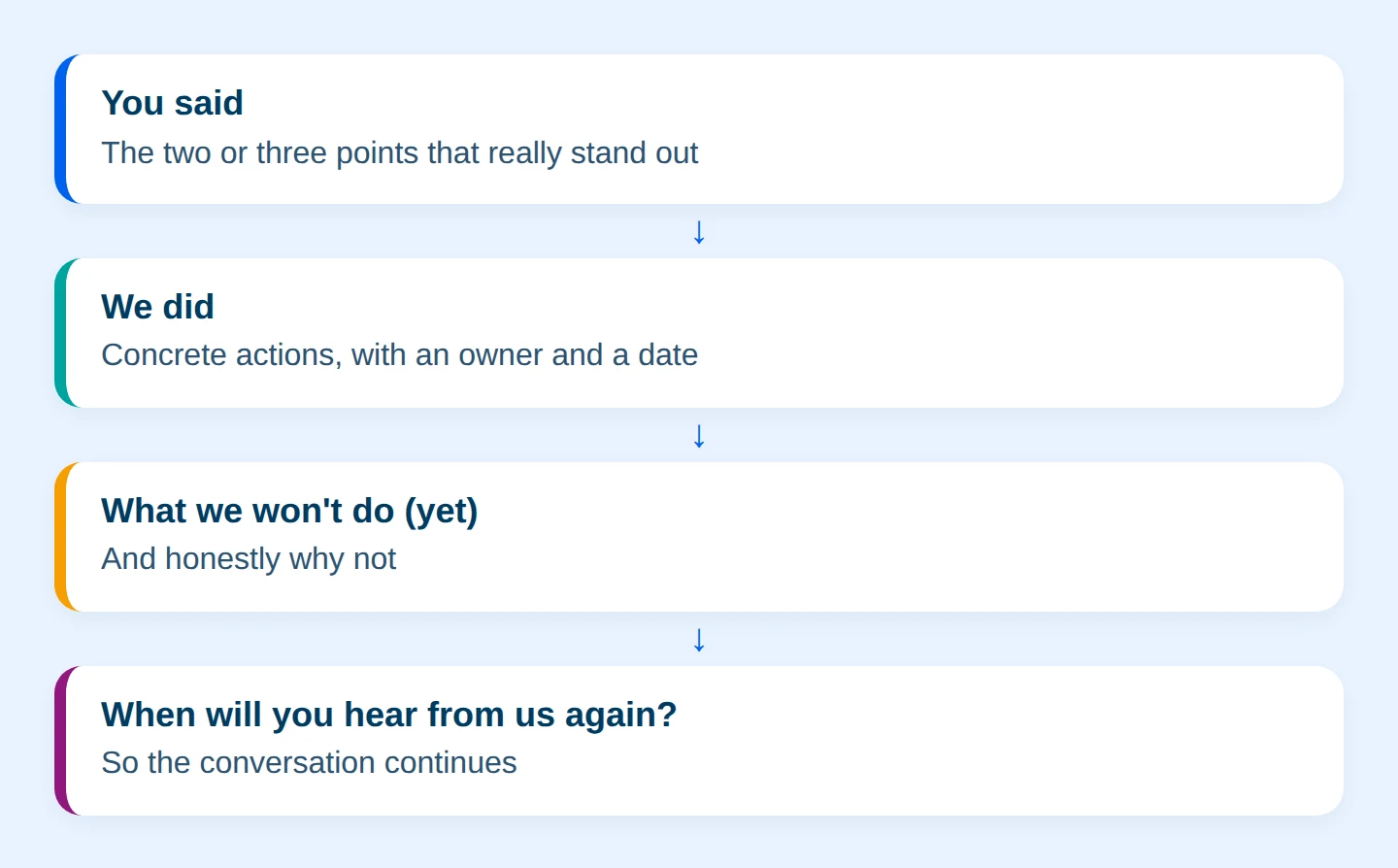
Sharing results doesn’t have to be complicated. The core fits in one sentence: this is what you said, and this is what we did with it. The idea is not new. As early as the 1970s, Nadler described how survey data only sets things in motion when it is given back to the people who provided it and discussed together with them.
What is often forgotten: also say what you are not doing, and why not. Perhaps an idea doesn’t fit the budget, a wish conflicts with regulations, or the organisation deliberately chooses a different direction. Saying that honestly feels uncomfortable, but it is much better than silence. Employees can live perfectly well with a well-reasoned no. What they can’t live with is the feeling that their input was never read.
The manager discusses the results of their own team. Three striking points, one question to the team: what do you recognise, and where do we start? Short, concrete and close to the work.
One page with the key results, what the team thinks of them and the agreed actions. Put it up, share it, and bring it out again at the next team meeting.
Two or three minutes, without a script that sounds like a press release. What struck the leadership team, what are they picking up themselves, and what are they asking of managers? A video like that shows that the results have reached the top too.
Physically on the shop floor or digitally on the intranet: which actions are running, who owns them and what is their status? An action board makes progress visible, even when it is slow.
Start every new questionnaire with a short look back: last time you said this, and this is what we did. It connects two measurements and shows that taking part leads somewhere.

Sharing results works best in a fixed order. First the management team, so that leadership knows the results and decides on its own actions. Then the managers, so that they go into the conversation with their team prepared. And then the teams themselves. Keep the time between these steps short: ideally within a few weeks of the questionnaire closing.
Don’t wait until all actions are finalised. A first round of feedback with the main results and a date for the follow-up is better than a perfect plan that arrives only after months.
The example below is fictional and intended as inspiration.
Customer Service team (25 employees): you said, we did
You said: the peak hours on Monday mornings are unmanageable, and new colleagues are put on the phones on their own too quickly.
We did: from next month, two extra colleagues will help out on Mondays from 8:00 to 12:00. New colleagues will have a fixed buddy for their first two weeks.
What we are not doing (yet): an extra FTE. There is no budget for that this year. We will look at it again in next year’s budget and let you know the outcome.
Owner: customer service team leader. Next check: team meeting in six weeks.
Whatever format you choose, good feedback always answers the same five questions:
Keep it short. Feedback that nobody reads is as good as no feedback at all.
The direct manager makes or breaks the feedback. They lead the conversation, get the questions and follow up the actions. Research by Detert and Burris shows that employees mainly speak up to managers they experience as open. The conversation about the results is an ideal moment to show that openness.
Three tips for managers:
Managers need support themselves, too. Give them the results in good time, a simple structure for the conversation and the space to say they don’t know something yet.
Anyone who sees sharing results as the finishing touch misses the point. The conversation after the survey is where understanding grows, where priorities become clear and where employees notice that taking part makes sense. The report is only the beginning.
Curious how we help organisations share results quickly and visibly? Take a look at deepler.io.

Leon zu Salm-Salm
Founder / CIO
Leon is a co-founder of Deepler and is responsible for product development, compliance, and the ongoing evolution of the Deepler platform. He translates organizational needs into effective tools—ranging from surveys and 360-degree feedback to onboarding. Leon works in Dutch, English, German, and French, and easily switches between strategy, technology, and practical client applications.