



You said, we did: how to share the results of an employee survey
The survey is closed. The response was good, the report is in, the management team has discussed it....
Verder lezen



Imagine you are an employee filling in a questionnaire. You take your time, because something is bothering you. The planning doesn’t work, or a colleague has been off for months without a replacement. You write it down. Then you hear nothing more. That is how survey fatigue begins.
A year later the next invitation arrives. What do you do?
Chances are you ignore it. Or you fill it in, but more cautiously. Less open, more socially desirable. Not out of unwillingness, but because you have learned how it works.
Anyone who asks employees something implicitly promises something in return. Not that every idea will be implemented, but that it will really be looked at and that something will be done with it. That promise is rarely spoken, but everyone feels it.
That is why starting an employee survey is never neutral. You set something in motion: expectations, conversations at the coffee machine, sometimes hope. The moment of asking is also the moment you start building trust, or start losing it.
Research into employee surveys shows a consistent picture. Church and colleagues analysed data from large organisations over several years. Employees who said something had been done with the results were more positive on almost every topic than employees who did not see that. The difference was not in the measuring, but in the follow-up.
Response suffers too. In their review of research on non-response, Rogelberg and Stanton describe how people are less inclined to take part if they experienced earlier surveys as pointless or receive too many questionnaires. Porter, Whitcomb and Weitzer found among students that taking part in earlier surveys was associated with a lower response to a subsequent survey. That weariness is often called survey fatigue. It is not only about the number of questionnaires, but above all about the feeling that filling them in achieves nothing.
And then there is the effect on what people dare to say. Milliken, Morrison and Hewlin found that employees stay silent partly because they expect that speaking up won’t change anything. A survey without visible follow-up confirms exactly that expectation.
The result is a vicious circle: lower response, more cautious answers, and a management team that decides on the basis of increasingly unreliable information.

The good news: employees usually expect less than managers fear. They don’t expect miracles or a complete change of course. Above all, they want to know three things. Was my answer read? What were the main findings? And what happens now?
If you answer those three questions within a few weeks, you have already largely kept the promise. Even if the big improvements will take months. It is about the signal that the conversation doesn’t stop once the form is submitted.
It works the other way round too. An organisation that stays silent for months and then comes up with a big improvement programme surprises its employees. They no longer see the link with what they filled in themselves. The programme then feels like something imposed from above, when in fact it came from them.
Following up does not mean doing everything employees ask for. Sometimes the answer is no: there is no budget, it doesn’t fit the strategy, or it isn’t legally allowed. That’s fine, as long as you say so. A well-reasoned no builds more trust than silence. Silence leaves people guessing, and they usually guess the worst.
The solution doesn’t start after the survey, but before it. We use a simple check of three questions. If you can’t answer them, it is too early to start.
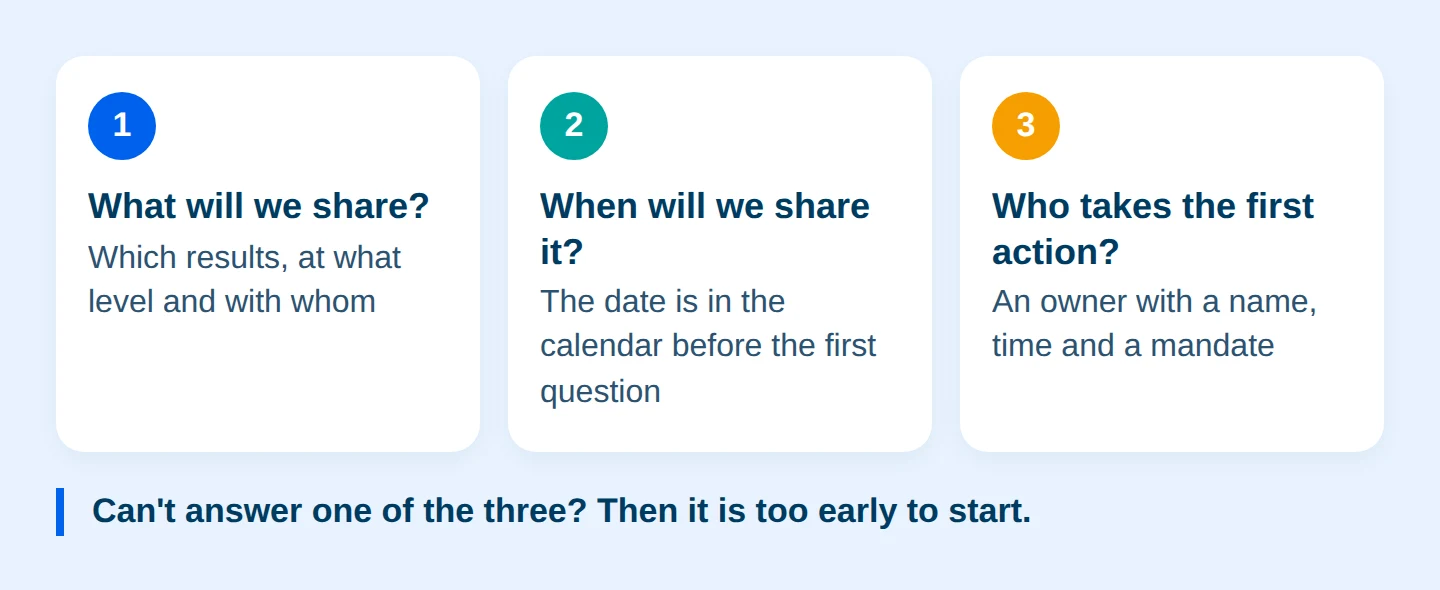
Agree in advance which results you will share, at what level and with whom. Everything, or just the headlines? Per team, or only organisation-wide? If you only decide afterwards, you will be tempted to share just the pleasant results.
Put the date in the diary before the first question goes out. The bigger the gap between filling in and feedback, the smaller the chance that employees still see the connection. Weeks work better than months.
Appoint an owner for the follow-up in advance, per theme or per team. Not “HR”, but a person with a name, time and a mandate. An action without an owner is just an intention.
Is an employee survey on the agenda? Then first discuss these seven questions in your management team.
It sounds contradictory, but an organisation that asks less and follows up more ends up knowing more. Employees who see that their input leads somewhere take part more often and say more honestly what they think. That makes every next measurement more valuable than the last.
Listening is not a measurement moment. It is an agreement. Anyone who keeps that agreement builds trust that no score can capture.
Want to know how we help organisations move from asking to doing? Read more about our approach at deepler.io.

Leon zu Salm-Salm
Founder / CIO
Leon is a co-founder of Deepler and is responsible for product development, compliance, and the ongoing evolution of the Deepler platform. He translates organizational needs into effective tools—ranging from surveys and 360-degree feedback to onboarding. Leon works in Dutch, English, German, and French, and easily switches between strategy, technology, and practical client applications.