


You said, we did: how to share the results of an employee survey
The survey is closed. The response was good, the report is in, the management team has discussed it....
Verder lezen



In March everyone is busy with it for a while: the invitation, the reminders, the response rate. A few weeks later a report lands with the management team and HR draws up an action plan. Then it goes quiet, until the next invitation. Sound familiar? Then your organisation is in phase 1. Nothing wrong with that, it is a start. But if you want to grow towards continuous listening, above all you need to do something other than measuring more often.
Many organisations think of pulse surveys when they hear continuous listening: more often, shorter, faster. But the difference between an annual employee survey and continuous listening is not in the number of questionnaires. It is in what happens between two measurements. In phase 1 the measurement ends in a report. From phase 2 onwards, every measurement leads to something teams see, do and measure again. Only then does asking more often make sense.
The growth model in four phases
→
→
→
Growth model of the Deepler Knowledge Centre, a practical model
Deepler’s Knowledge Centre describes growth in four phases. You look at each phase along the same four dimensions:
Three rules make the model usable. Your phase is your weakest link: asking a lot and doing little is not phase 3, but phase 1 with more questions. You grow one step at a time: if you skip a phase, you get more data and the same report. And phase 4 is not an obligation. The best phase is the one your organisation can follow up on.
In a field study spanning eleven years, groups that saw something being done with the results judged more positively. Those who took part and saw nothing come back even judged more negatively than those who did not take part (Church et al., 2012). A review of 53 studies shows that outcomes usually improve after follow-up, although the effect varies by organisation (Huebner and Zacher, 2021). More feedback is not automatically better either: in over a third of cases performance actually declines (Kluger and DeNisi, 1996).
What research says about follow-up
Sources: Huebner and Zacher (2021), Church et al. (2012), Kluger and DeNisi (1996)
Also read why survey fatigue rarely has to do with the questionnaire.
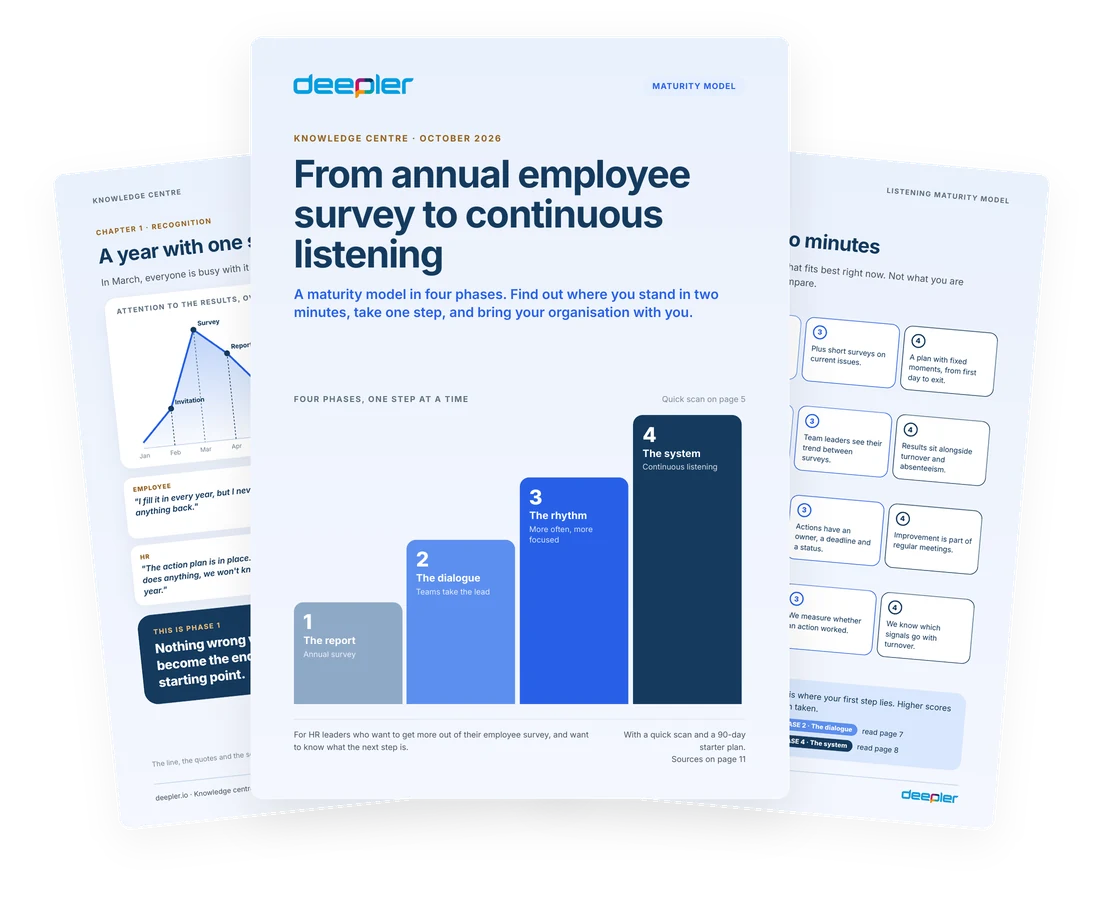
Free whitepaper
From annual employee survey to continuous listening
The growth model on one page, a self-scan with sixteen questions, three steps per phase and a worksheet for your management team.
For each dimension, tick what is already true now, not what you are planning:
If the answer to the first question is no, that is where your next step begins. The full self-scan in the whitepaper has sixteen questions and lets you draw a profile. Hardly any organisation is in the same phase on all four dimensions, and precisely that imbalance tells you where to start.
Moving from phase 1 to phase 2 does not mean measuring more often. The results go from the management team to the teams. Three steps help:
How to approach that feedback is explained in how to report employee survey results back to teams. Then comes the rhythm: actions as small projects, short measurements on the teams’ themes, and often a first moment in the career journey, such as onboarding. Unsure whether you are ready for pulse surveys? Then read are you ready for a pulse survey?
Most problems do not arise because organisations measure too little, but because measuring grows faster than follow-up:
With Deepler Research every team gets its own results and actions become projects with an owner and a deadline. With Deepler Journeys you listen at fixed moments in the career journey, such as onboarding. See how a logistics company switched to continuous feedback.
Knowledge Centre
What is your next step?
Download the whitepaper with the self-scan, the twelve-month example route and the worksheet.

Sanne Huisman
Knowledge center Deepler
Sanne is the heart of Deepler’s Knowledge Center. She translates research, data, and practical experience into real-world applications for organizations. Whether it involves an employee survey, a whitepaper, or hands-on support, Sanne ensures that knowledge doesn’t go to waste but is instead used to improve both our work and our products.