


Winter blues at work: what to do before January
Absence in winter is flu, and there is little an organisation can do about it. That is the common as...
Verder lezen



Think back to your first week with your current employer. You probably noticed all sorts of things. A cumbersome way of logging in. A meeting nobody quite knew the reason for. A colleague everyone turned to, while nothing described everything she knew. That is exactly why onboarding new employees is a unique moment to listen.
A few months later you no longer saw it. Not because it had been fixed, but because you had got used to it.
New employees look at an organisation differently. They compare it with their previous employer, ask questions others no longer ask and run into things that experienced colleagues take for granted.
As early as 1980, Louis described how newcomers are constantly surprised: by what differs from what they expected, and by what differs from their previous job. They try to make sense of those surprises and gradually adapt. That adapting is necessary and good. But it also means the fresh view disappears. What stands out in week one is normal after three months.
That fresh view is valuable information. Not only about how onboarding is going, but about how the whole organisation works. Only hardly anyone asks about it, and when someone does, the moment has often passed.
What new employees notice is often surprisingly concrete. Think of:
For experienced colleagues this is background noise. For the organisation it is a free audit.
The first months largely determine how someone finds their place. In a meta-analysis, Bauer and colleagues showed that newcomers who understand their role well, have confidence in their own abilities and feel accepted by colleagues perform better, are more satisfied and are more likely to intend to stay.
So if you listen during that period, you hear two things at once: whether the new colleague is landing well, and where the organisation itself could do better.
Listening during onboarding works best at fixed moments, with a few short questions that suit the phase someone is in.
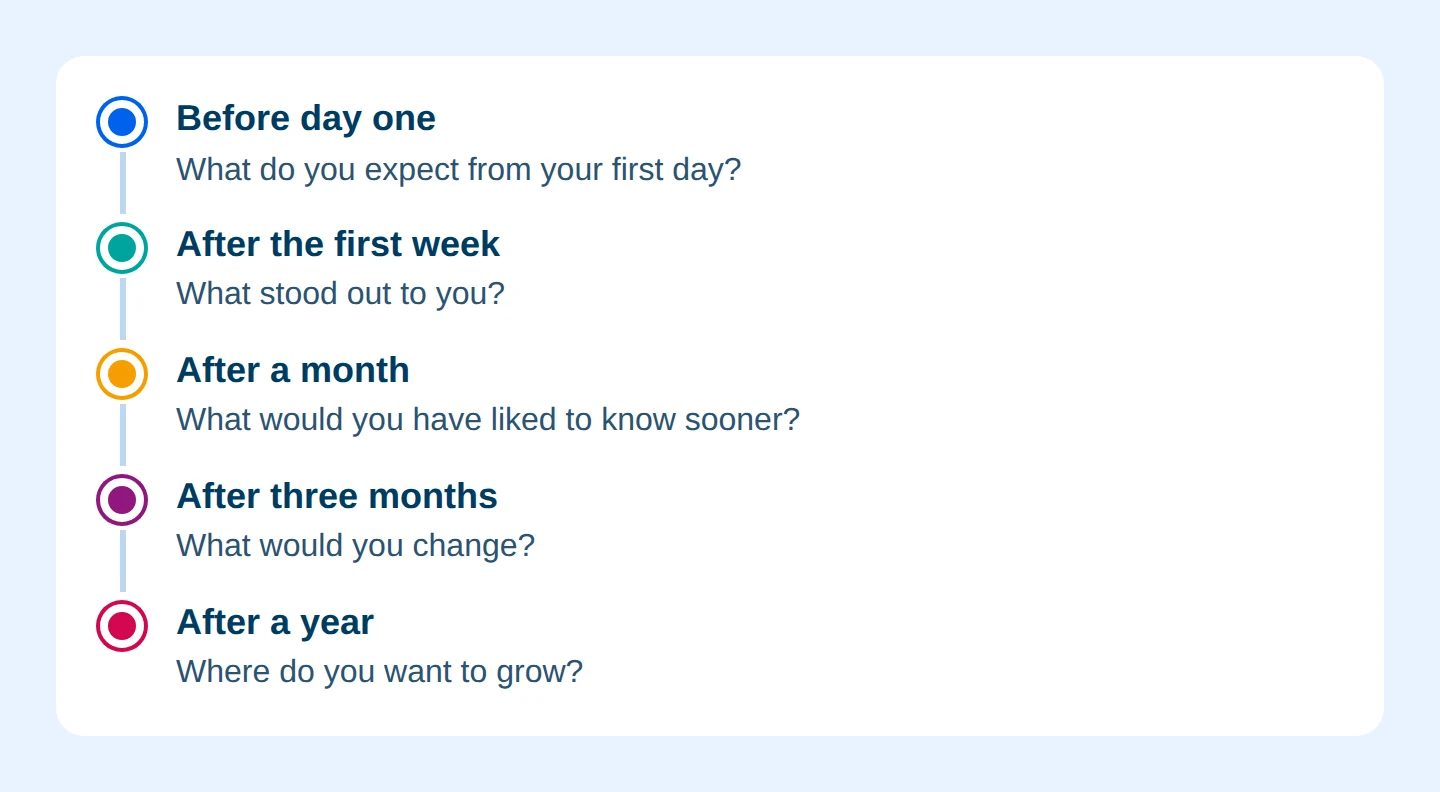
How has contact been so far? What do you expect from your first day? Do you know who to turn to with questions?
What struck you? What was different from what you expected? Did you have everything you needed to get started?
What would you have liked to know earlier? Who can you turn to? What is costing you unnecessary time right now?
Do you feel at home in your team? Is your role clear? What would you change about how we work here, now that you know it from the inside?
How do you look back? What helped you, and what didn’t? Where do you want to grow?
Keep it short. It is about the rhythm, not the length of the questionnaire.
The same applies here: listening without action costs trust. Perhaps even more so for a new colleague than for someone who has worked there for years. The first impression of how an organisation deals with feedback sticks.
This is how you arrange the follow-up:

A questionnaire doesn’t replace the conversation. In the first months, the manager and, if there is one, the buddy are the most important points of contact. They are the first to notice whether someone is settling in, and can ask more about what a new colleague noticed.
So give them the results of the short check-ins, and a few simple questions for the conversation. That way the questionnaire becomes a reason for a good conversation, rather than a replacement for it.
Onboarding is usually seen as something the organisation gives a new colleague: information, a laptop, a buddy, an introduction programme. That matters, but it is only half of it.
The other half is what a new colleague can give the organisation: a fresh look at how the work really goes. Anyone who asks for that view at the right moment gets insights that appear in no consultancy report.
Curious how we help organisations listen at the right moments in the employee journey? Take a look at deepler.io.

Leon zu Salm-Salm
Founder / CIO
Leon is a co-founder of Deepler and is responsible for product development, compliance, and the ongoing evolution of the Deepler platform. He translates organizational needs into effective tools—ranging from surveys and 360-degree feedback to onboarding. Leon works in Dutch, English, German, and French, and easily switches between strategy, technology, and practical client applications.