December is annual review season. Managers work their way through a pile of forms, employees prepare for the conversation. And for some there is a surprise: feedback about something from months ago that they never heard about before. With continuous feedback, that doesn’t happen.
The annual review may well be the worst-timed feedback there is.
Why one moment a year falls short
Feedback works best when it comes close to the moment itself. If you hear that a presentation could have been better, you can apply that next time. If you only hear it in December, you hardly remember which presentation it was about.
Research also shows that feedback doesn’t work automatically. Kluger and DeNisi analysed a large number of studies on feedback. On average, feedback improved performance, but in a sizeable share of cases the effect was actually negative. Feedback that shifts attention from the task to the person worked out particularly badly.
Pulakos and O’Leary concluded that many performance management systems revolve mainly around forms and procedures, while the value lies in the day-to-day conversations between manager and employee. In their review of a hundred years of research into performance appraisal, DeNisi and Murphy drew a similar lesson: it is less about the perfect form and more about how feedback is given and received.
Appraising is not the same as developing
The annual review often tries to do two things at once: appraise and develop. The two get in each other’s way.
Appraisal is about a judgement of the past, often linked to pay or career. That makes people cautious. Development is about the future: what do you want to learn, and what do you need for that? That calls for openness.
If you put both into one conversation, you usually get neither right. Better to separate them: an appraisal moment where necessary, and alongside it conversations throughout the year that are entirely about development.
That doesn’t mean appraisal disappears. Organisations simply have to make decisions about pay and careers. But those decisions get better when they build on a year full of conversations, rather than on a single moment.
Feedback from several sides
A manager sees only part of what someone does. Colleagues, direct reports and customers see other sides. Feedback from several sides, often called 360-degree feedback, therefore gives a more complete picture.
It only works under certain conditions, though. In their meta-analysis, Smither, London and Reilly found that performance improves only slightly on average after such feedback, and that the effect is greater when people take the feedback seriously and link goals to it. Bracken, Rose and Church stress that it must be clear in advance what the feedback is for: development or appraisal.
What should you pay attention to?
Anonymity. Colleagues and direct reports are more honest when they know their answers can’t be traced back.
Good questions. Ask about concrete behaviour, not vague traits. “Shares information on time” says more than “is communicative”.
Discussing it safely. Discuss the results with someone who helps interpret them, such as a manager or coach. Bare scores without a conversation often raise more questions than they answer.
Why more often doesn’t have to mean heavier
A common concern: if we give feedback more often, surely that takes much more time? Not necessarily. An annual review often takes hours of preparation, because a whole year has to be summarised. Short conversations throughout the year each take just a few minutes of preparation, because they are about recent, concrete situations.
What’s more, giving feedback gets easier the more often you do it. It becomes normal, for the giver and for the receiver. What is nerve-racking once a year becomes, with regularity, a normal part of working together.
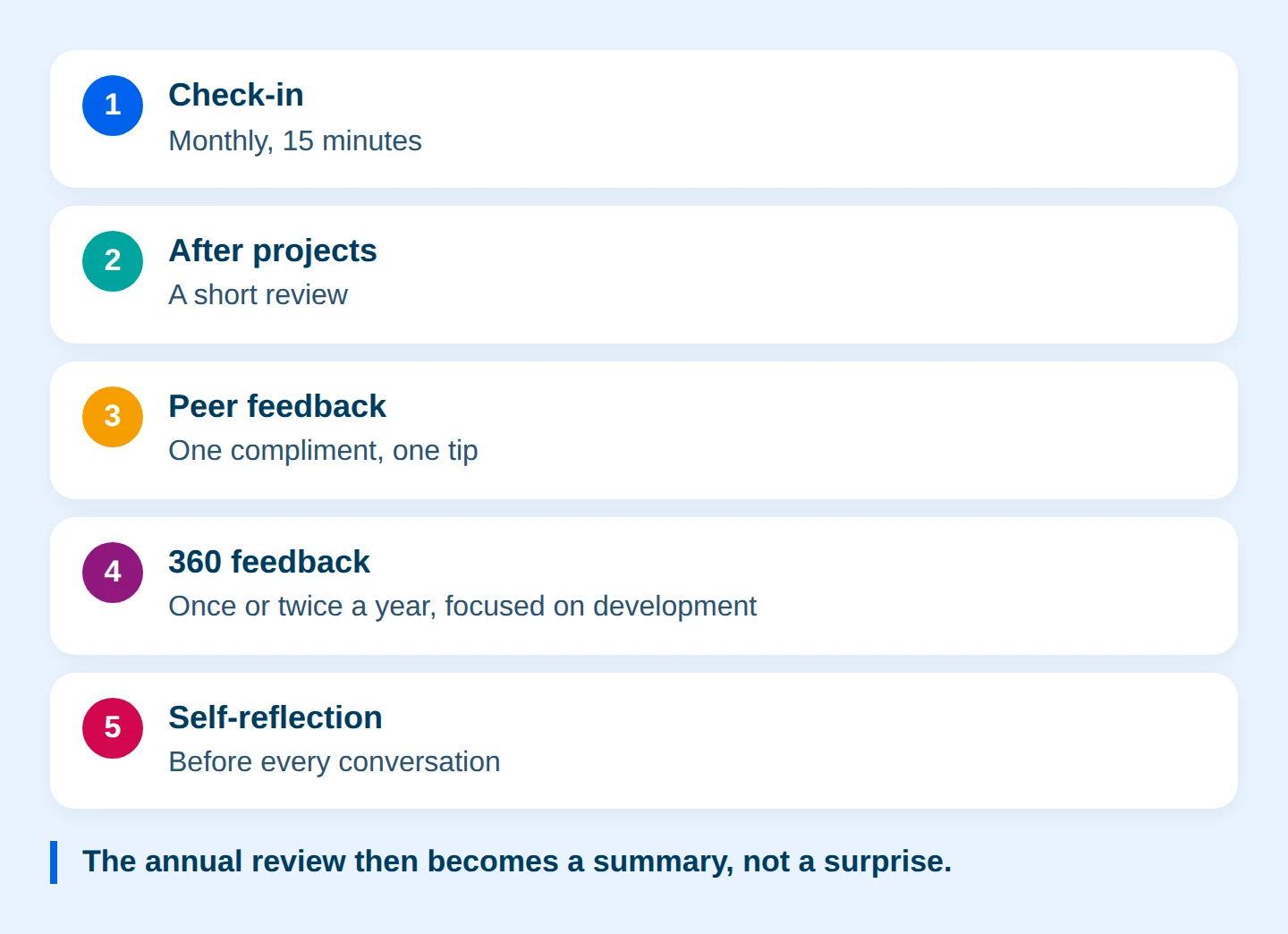
Five formats for continuous feedback throughout the year
1. A monthly 15-minute check-in
A short conversation with three questions: what is going well, what are you running into, and what do you need from me? Short enough to keep up, frequent enough to make a difference.
2. Feedback after projects
Close every project with a short look back. What went well, what would we do differently? Personal feedback can naturally be part of it.
3. Peer feedback
Teach colleagues to give each other feedback. A simple format: name one thing you appreciate and one thing you would recommend to the other person.
4. Development-focused 360-degree feedback
Once or twice a year, focused on development and not on appraisal. The employee helps choose who gives feedback and discusses the results with a manager or coach.
5. Self-reflection beforehand
Before each conversation, have employees briefly write down for themselves what they are proud of and what they want to work on. That way the conversation starts from their own perspective.
The good feedback conversation
Whatever format you choose, the quality of the conversation determines the effect. A few rules of thumb:
Make it concrete. Name a situation, the behaviour and the effect. “In Tuesday’s meeting you interrupted Sanne twice, and after that she didn’t say anything” helps more than “you are sometimes dominant”.
Focus on the task. Feedback about what someone does works better than feedback about who someone is.
Ask first. How do you look back on it yourself? Often the person already knows.
Make it mutual. Also ask what the other person needs from you. Feedback is not a one-way street.
The annual review as a summary
If you give feedback regularly throughout the year, the annual review changes by itself. It is no longer a moment of surprises, but a summary of what has already been discussed: a look back at the year and a look ahead to the next.
The rule of thumb is simple: nothing said in the annual review should be new.
Curious how we help organisations give feedback a place throughout the year? Take a look at deepler.io.
Sources
Bracken, D. W., Rose, D. S., & Church, A. H. (2016). The evolution and devolution of 360° feedback. Industrial and Organizational Psychology, 9(4), 761-794.
DeNisi, A. S., & Murphy, K. R. (2017). Performance appraisal and performance management: 100 years of progress? Journal of Applied Psychology, 102(3), 421-433.
Kluger, A. N., & DeNisi, A. (1996). The effects of feedback interventions on performance: A historical review, a meta-analysis, and a preliminary feedback intervention theory. Psychological Bulletin, 119(2), 254-284.
Pulakos, E. D., & O’Leary, R. S. (2011). Why is performance management broken? Industrial and Organizational Psychology, 4(2), 146-164.
Smither, J. W., London, M., & Reilly, R. R. (2005). Does performance improve following multisource feedback? A theoretical model, meta-analysis, and review of empirical findings. Personnel Psychology, 58(1), 33-66.
How do colleagues see you?
Compare your self-image with a colleague’s view in the free 360 mini-analysis.
Sanne is the heart of Deepler’s Knowledge Center. She translates research, data, and practical experience into real-world applications for organizations. Whether it involves an employee survey, a whitepaper, or hands-on support, Sanne ensures that knowledge doesn’t go to waste but is instead used to improve both our work and our products.
Deepler 360
Organising feedback structurally in your teams?
Discover how Deepler 360 gathers feedback from colleagues in a structured way and makes it easy to discuss.