























4,9/5 reviews
Measure and improve company culture with behavioral insights
A strong company culture doesn’t emerge from core values on the wall, but from what people do, say and allow every day. How do people work together?
Do employees feel space to contribute? Does leadership behavior align with the organization’s values?
With Deepler’s culture module, you make visible how employees truly experience the culture in an organization. This reveals where company culture provides strength, where behavior creates friction, and which patterns prevent change.
- Measure how employees experience company culture daily
- Discover where culture, behavior and core values diverge
- Translate culture research into concrete improvement actions
Company culture: what is it and how do you map it?
Many organizations discuss their culture when something changes: growth, merger, reorganization, new leadership or increasing distance between teams. But company culture is not one separate topic.
It sits in decision-making, communication, leadership, collaboration and the way people interact with customers and colleagues. A culture survey helps make those often invisible patterns visible and discussable.
In this article we explain:
- What company culture means and how you recognize it
- Why culture in an organization influences behavior
- How you can measure and describe company culture
- What helps in changing or improving company culture
- How Deepler translates culture into concrete action
Table of contents
What is company culture?
Company culture is the sum of beliefs, habits, behaviors and unwritten rules within an organization. It determines how people work together, how decisions are made, how leaders provide direction and how employees handle change, mistakes, customers and each other.
The formal values of an organization often tell you what is important. The real culture shows what employees experience in practice. That’s why measuring company culture is valuable: it reveals whether desired behavior actually appears in teams, processes and leadership.
From core values to daily behavior
Core values are only credible when employees recognize them in their daily work. For example, an organization might say it is open, while employees experience major decisions as top-down.
Or claim that ownership is important, while mistakes are punished. By examining culture, you connect words to behavior and it becomes clear where desired culture already exists and where adjustment is needed.
Why is company culture important?
Culture in an organization often determines how people act faster than a procedure or policy document. When the culture is safe, clear and learning-oriented, employees are more willing to take responsibility. When the culture is unclear, closed or defensive, delays, confusion and dependency on leaders emerge.
Measuring company culture provides organizations with various benefits
Company culture is influenced by leadership, communication, collaboration, decision-making, role modeling and how successes or mistakes are handled. Precisely because culture runs through everything, it’s difficult to steer by intuition alone. A culture survey reveals which patterns employees recognize and which aspects of organizational culture need attention.
1. Visibility of unwritten rules
A culture survey reveals which norms and habits employees experience daily. Think about how easily people give feedback, how decisions are made or how much space there is for initiative. This gives you insight into the real work culture, not just formal values.
2. Better alignment between values and behavior
Many organizations have core values but don’t always know if they come through in practice. By measuring company culture you discover where values are recognizable and where behavior shows something different. This makes culture change more concrete and honest.
3. Stronger collaboration between teams
Cultural differences between teams or departments can cause misunderstandings, frustration or delays. A culture survey reveals where teams work, communicate or prioritize differently. This allows you to work more directly on shared norms and better collaboration.
4. Greater clarity during change
During growth, reorganization or strategic change, culture often determines whether plans land. If employees are used to waiting, change requires different interventions than in a culture where people naturally take initiative. Culture data helps tailor your approach accordingly.
Conduct your culture survey with Deepler’s software
With Deepler’s culture module, you examine how employees experience company culture in their daily work. You measure topics such as collaboration, leadership, safety, decision-making, ownership, communication and alignment with core values.
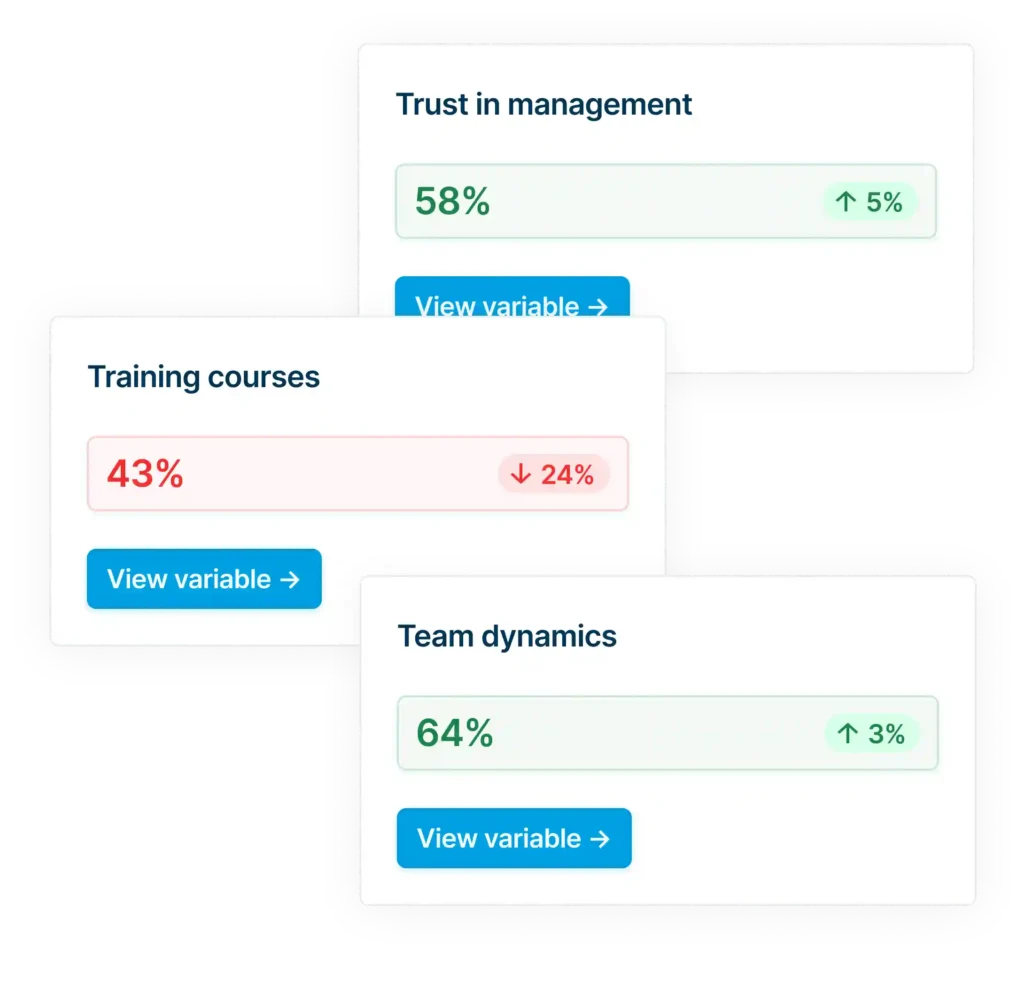
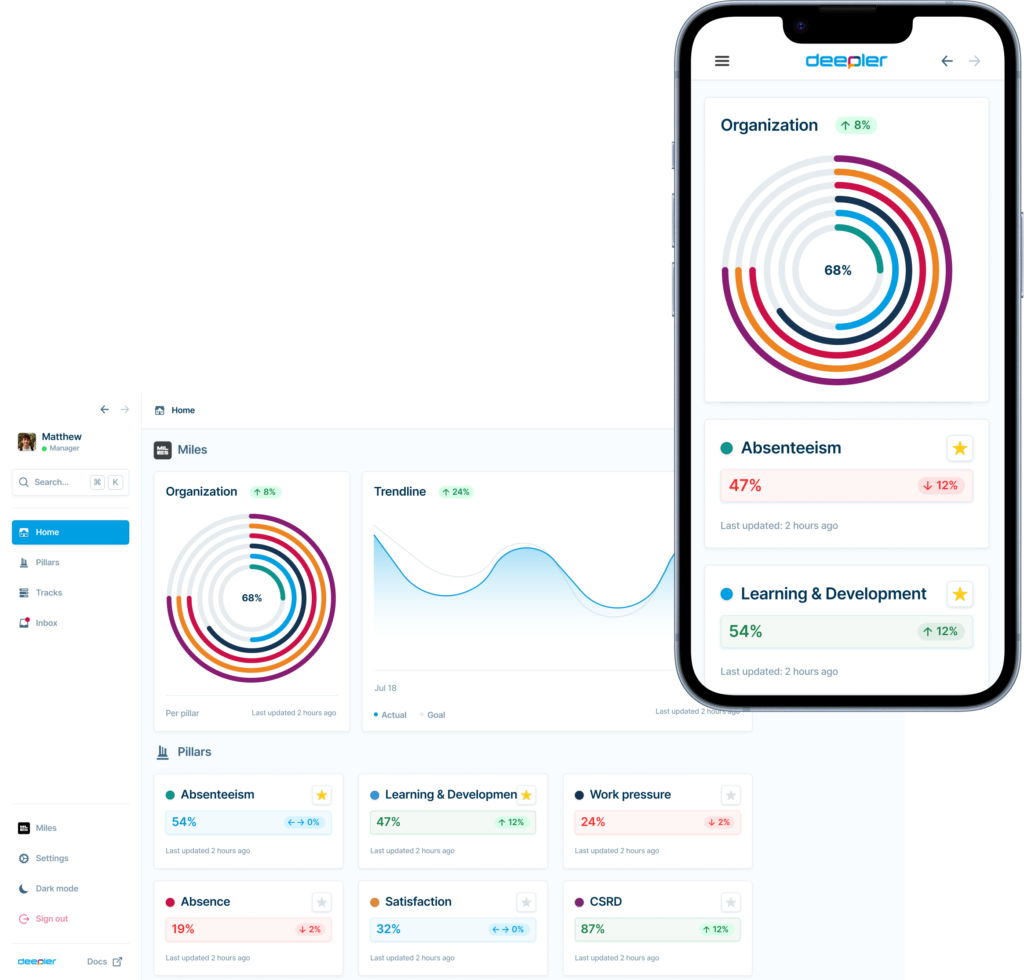
The results are translated into clear dashboards and team insights, so HR, management and leaders don’t get stuck in abstract culture language. You see where desired culture is already visible, where teams experience different patterns and which conversations are needed to improve company culture.
Our happy customers
What are the benefits of a culture survey?
A culture survey helps organizations make an abstract subject practical. Instead of talking about ‘the culture’ as if everyone means the same thing, you gain insight into concrete behaviors, tensions and differences between teams. This makes it easier to describe, improve and change company culture.
From feeling to shared perspective
Without research, company culture often remains a collection of opinions. One person calls the culture entrepreneurial, another experiences mainly chaos.
One sees openness, another doesn’t dare voice important concerns. A culture survey brings those different experiences together and clarifies where patterns resonate organization-wide.
This creates a shared starting point. Not to assign blame, but to jointly determine which behavior helps and which behavior hinders the organization’s development.
What are the benefits of a culture survey?
A culture survey helps organizations make an abstract subject practical. Instead of talking about ‘the culture’ as if everyone means the same thing, you gain insight into concrete behaviors, tensions and differences between teams. This makes it easier to describe, improve and change company culture.
Describe company culture concretely
Many organizations find it difficult to describe their company culture without falling into vague language. With culture data you see which characteristics employees truly recognize.
Is the organization mainly results-oriented, cautious, informal, hierarchical, learning-focused, people-oriented or entrepreneurial? By linking those characteristics to behavior, culture becomes less vague and more useful for leadership, HR, onboarding and communication.
More targeted company culture improvement
Improving company culture only succeeds when it’s clear which behavior needs to be reinforced or changed. If employees experience little ownership, it could stem from unclear frameworks, lack of trust or a culture where initiative isn’t rewarded. By measuring underlying patterns, you avoid generic culture programs and choose interventions that match the real cause.
More control over culture change
Changing company culture requires repetition, role modeling and clear choices. A survey shows where the organization currently stands and which topics deserve priority.
Afterward you can track whether new agreements, leadership behavior or change interventions take effect. This makes culture change not a one-time session, but a process you can guide and adjust.
Trusted by young and old alike
Experiences of customers who make a difference with us.
-
Larren
Recruitment Lead,
De Selectie
“Recently, I used Deepler to arrive at an EVP. Great what they were able to achieve in a short time! In a period of two weeks, we collected information and were able to continue with our AMC plan. In any other situation, it takes weeks, if not months, to get this done. Contact is good, friendly and constructive. Very nice club to work with.”
-

Douwe
Recruiter,
Securitas
“Ideal tool and company to gain more and better insight into the organization and employees as an organization! And especially with speed! For us, it was also the need to get tools for the topics of retention, to prevent future absenteeism or turnover. I also have experience with other parties and I sincerely value the speed of switching, follow-up and personal contact with Deepler. Absolutely recommended.”
-

Jolanda
HR Business Partner,
Nedcargo
“Deepler is a great tool for continuously collecting feedback from our employees. This input is then centrally available for us as management, but also for managers who benefit from it.”
-

Jonathan
Manager,
UWV
“What makes Deepler special is that it doesn’t get stuck in numbers. It helps you immediately understand where it is and what teams need. For us, this ensured that employees themselves came up with areas for improvement and took responsibility for them. The insights were sharp and useful, but most importantly: the conversation that started afterwards made the difference. Thanks to Deepler, we didn’t get a paper plan, but change that was supported by the people themselves.”
-
Amadeus
COO,
OSRE
“The software has a positive impact on us as a rapidly growing organization. By better understanding what is going on in the workplace and what people offer as solutions for improvements, we can make more effective decisions. The platform helps us to gain real-time insight and to respond directly to it via the tool.”

Is a culture survey mandatory and what about privacy?
A culture survey is usually not legally required in the Netherlands. Still, it can be highly valuable for organizations, especially when culture impacts workload, psychological safety, leadership, collaboration or change capacity.
Because a culture survey concerns employee experiences, care is important. Communicate in advance why the survey is being conducted, which topics are measured, how results will be used and who will access reports.
Only ask for information necessary for the survey’s purpose and report at group level where needed to prevent traceability. This builds trust and increases the likelihood that employees answer honestly.
Is a culture survey anonymous?
A culture survey works best when employees can speak freely about how they experience the company culture. Anonymity or confidential group reporting is therefore important.
Especially on sensitive topics such as leadership, safety, feedback or decision-making, employees must be able to trust that their answers will not be fed back individually. Deepler helps to structure results in such a way that patterns become visible without individual employees taking center stage.
What about GDPR and privacy in a culture survey?
In a culture survey, you process personal data or at least data that can be traced back to groups of employees. Therefore, the processing must comply with GDPR.
That means, among other things, that you formulate a clear purpose, do not collect more data than necessary, inform employees about use and retention periods, and handle small groups carefully. Open answers and segmentations require particular attention, because they can be more recognizable. Privacy is not only a legal requirement, but also determines the quality of the answers.
What is the role of HR, management and leaders in a culture survey?
HR can prepare the culture survey and ensure that the approach is careful, understandable and safe. The board and management have above all a role model function: they must make clear why culture matters and be willing to look at their own behavior.
Leaders then play a major role in follow-up, because culture is visible daily in teams. The works council can be involved when the survey touches on personnel policy, privacy or broader organizational development.
Why do many organizations conduct a culture survey?
Organizations conduct a culture survey because culture often makes the difference between making plans and implementing them. Strategy, core values and processes can be logical on paper, but if the daily work culture doesn’t match them, change stalls.
A culture survey makes visible where the organization helps itself and where behavior works against ambition. That makes it easier to make improving business culture practical.
Get more out of your culture survey
Link culture to recognizable behavior
Don’t just ask whether employees experience the culture positively. Investigate concrete behavior: do people speak up to each other, are mistakes discussed, is there room for initiative and are decisions clearly explained? This prevents culture from remaining a vague umbrella term.
Make differences between teams discussable
Business culture is not the same everywhere. Teams can differ greatly in leadership, safety or collaboration. Don’t use those differences to judge, but to understand which patterns work and where support is needed.
Translate insight into exemplary behavior
Culture changes especially when people see and experience different behavior. Therefore, link results to concrete exemplary behavior from leaders, agreements in teams and recurring moments when the desired culture is practiced.
Do’s of a culture survey
A good culture survey requires clear language and careful follow-up. Employees must understand that this is not an abstract project, but about the way they work together daily.
- Explain why you want to measure business culture
- Use recognizable examples from work practice
- Report carefully at team and organizational level
- Discuss results with leaders and employees
- Choose some behaviors you want to visibly strengthen
Don’ts of a culture survey
- Don’t make culture too abstract with only values or models
- Don’t use results to settle scores with teams or leaders
- Don’t ask for feedback if there is no follow-up
- Don’t draw conclusions from small groups that are traceable
- Don’t start a culture program without clear priorities
What do you do with the results of a culture survey?
The results of a culture survey are only valuable when they are translated into behavior. Start by recognizing patterns: where does the desired business culture already appear, where is there friction and what differences are visible between teams or levels in the organization?
Then determine which themes have the most impact on collaboration, leadership and change capacity. Share the results in a way that invites conversation, not defensiveness.
Improving culture requires repetition: small behavior agreements, visible exemplary behavior, clear frameworks and regular follow-up. This way culture becomes not a standalone project, but part of how the organization learns and works.
Actively take up progress
From insight to behavioral change
It is essential to not only recognize culture patterns, but also convert them into concrete behavioral changes. This starts with prioritizing themes that have the greatest impact on your organization. Focus on areas where collaboration, leadership and change capacity can grow the most, and deploy targeted interventions there. Actively involve teams in interpreting results, so everyone understands why certain changes are necessary and what their role is in them.
Successful culture change requires a rigorous approach with measurable milestones and progress. By regularly feeding results back to teams and implementing improvements incrementally, you prevent improvement trajectories from stalling. This ensures that culture change is not a one-time exercise, but a structural shift that manifests itself in daily behavior. That’s why we have defined a framework of six follow-up steps that you can execute after the initial research:
Do you want more tips on how to effectively follow up an employee satisfaction survey (ESS)? Then read our article:
Effective ESS Follow-up: Why Is That Important?
Analyze culture patterns
Look at recurring themes in collaboration, leadership, communication, safety and ownership. Pay attention not just to average scores, but also to differences between teams, functions or organizational departments.
Describe the current and desired culture
Make clear what behavior employees currently experience and what behavior fits the organization’s ambition. Avoid abstract labels and describe concretely what people should see more or less often.
Share insights without oversimplifying
Culture is sensitive. Therefore, present results as patterns to learn from, not as a judgment of one team or leader. Create space to recognize, nuance and deepen outcomes.
Have the conversation about behavior
Use the results to have teams discuss which behaviors help and what holds them back. Think about giving feedback, making decisions, taking responsibility or dealing with mistakes.
Choose a few culture interventions
Don’t tackle everything at once. Choose, for example, better leadership behavior modeling, clearer decision-making, more psychological safety or stronger collaboration between departments.
Keep measuring and adjusting
Changing organizational culture takes time. By measuring regularly, you can see whether agreements, leadership behavior and interventions are having an effect. This way you can adjust before old patterns become the standard again.
Make organizational culture discussable with insight into behavior
With Deepler, HR, management and leaders see how employees experience the culture in an organization. Dashboards show where values, behavior and collaboration reinforce each other or drift apart. This means you have conversations not based on loose opinions, but on recognizable patterns that teams can translate into action.
Organizational research without high costs
Match your needs with our Basic or Plus package. Want to compare multiple countries or organizations? Then the Enterprise package is the best choice.
Basic
€2.99
Per user/per month
The best for your team or smaller organizations that want to gain insights quickly.
- Maximum of 1 module
- Score segmentation
- In-depth analysis for Managers
- Unlimited number of languages
- Personal dashboard for employees
Plus
€3.49
Per user/per month
The best option if you want to survey multiple teams and SMEs.
- Everything from Basic
- 2 additional research modules
- Personal success manager
- Non-desk employees
- Custom questions
Most popular
Enterprise
On request
Per user/per month
The best for large organizations and custom modules.
- Everything from Plus
- Single Sign-On
- Custom modules
- Advanced Security
- Personal onboarding
Basic
€36
Per user/per year
The best for your team or smaller organizations that want to gain insights quickly.
- Maximum of 1 module
- Score segmentation
- In-depth analysis for Managers
- Unlimited number of languages
- Personal dashboard for employees
- Suitable for employees company email address
Plus
€42
Per user/per year
The best option if you want to survey multiple teams and SMEs.
- Basic
- 2 additional research modules
- Personal support from a Deepler expert
- Suitable for all employees
- Add your own questions
- Option to conduct surveys using QR codes
Most popular
Enterprise
On request
Per user/per year
The best for large organizations and custom modules.
- Plus
- Unlimited research modules
- Custom modules
- Unlimited number of languages
- Personal dashboard for employees
- Suitable for employees company email address
Frequently asked questions
What is organizational culture?
Organizational culture is the way people within an organization think, work together and act. It’s about values, norms, habits and unwritten rules. You see organizational culture reflected in communication, leadership, decision-making, collaboration, how mistakes are handled and the space employees feel to take initiative.
What does organizational culture mean?
How can you measure corporate culture?
How do you describe corporate culture?
What is a healthy corporate culture?
What is a toxic corporate culture?
How can you improve corporate culture?
How can you change corporate culture?
What is the difference between culture and core values?
What topics do you measure in a culture survey?
What does a culture survey cost?
How often should you measure corporate culture?
How do you ensure that employees answer honestly about company culture?
Schedule a consultation
Ready to take the next step? Get in touch, and we’ll work together to find the best approach. Whether you have a question or just want to bounce some ideas around, we’re here for you.
- A glimpse into the Deepler dashboard
- Personal advice and start with honest insight
- A no-obligation consultation to answer all your questions