Home » Blogs » Your listening plan for 2027 starts with one question
HR Strategy
Your listening plan for 2027 starts with one question
Not what do you want to measure, but what are you willing to change? Four ways of listening, a worksheet for a one-hour management team session and three mistakes to avoid.
Leon zu Salm-Salm
5 min read
In this article
How high is the workload in your team?
Take the free work stress test and find out where the pressure comes from.
January is the time for planning, for HR too. Often the HR plan starts with the question: what do we want to measure this year? Engagement, workload, leadership, onboarding, culture? The list grows quickly.
We suggest a different first question: what are we willing to change?
Why asking less often delivers more
The more you ask, the more you have to follow up. And the less you follow up, the less willing employees are to take part. Research on non-response shows that people are less likely to take part if they see earlier surveys as pointless or receive too many questionnaires (Rogelberg & Stanton). And research on feedback shows that it is the follow-up that makes the difference (Church et al.).
A listening plan with three themes you really act on delivers more than a plan with ten themes you never get round to.
Not every question belongs in the same questionnaire
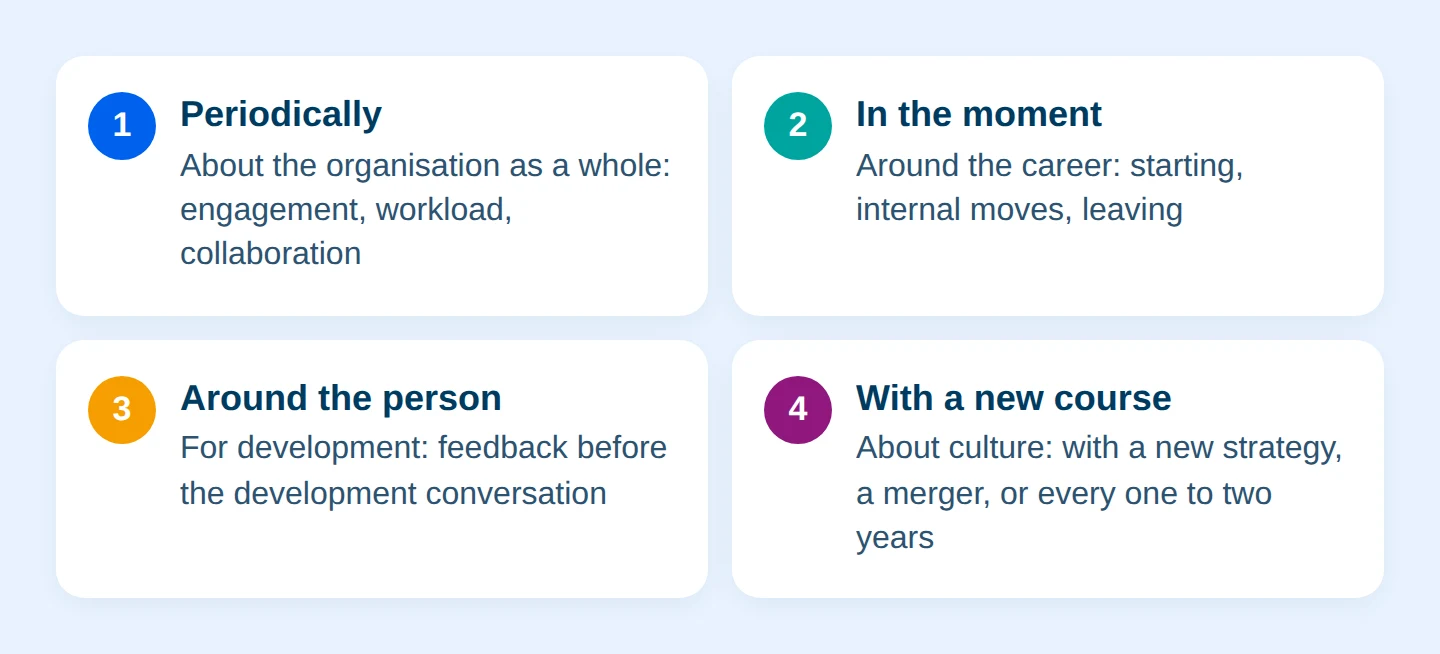
Many organisations put everything into one annual survey. Understandable, but not every question fits that moment. Broadly speaking, there are four ways of listening, each with its own rhythm:
Periodically, about the organisation as a whole. How are engagement, workload or collaboration doing? You ask that at fixed moments, with short follow-up surveys to see whether actions are working.
In the moment, around the career. How is a new colleague settling in? How is an internal move going? Why is someone leaving? You ask that when it happens, not months later.
Around the person, for development. How is someone growing as a manager or specialist? You ask the people around them, as preparation for the development conversation.
With a new course, about culture. Does our culture fit where we want to go? You ask that when the strategy changes, during a merger, or once every one to two years.
A good listening plan chooses the right way for each theme. That way you get better answers, and you don’t ask employees for input at a moment when it doesn’t matter.
Worksheet for a one-hour management team session
Use this worksheet for a session with your management team. Allow about eight minutes per question, and keep a quarter of an hour for agreements.
1. Which three themes matter most to us in 2027? Choose three at most. Look at the strategy, at what happened over the past year and at what employees themselves are saying.
2. What are we willing to change? For each theme, discuss what is on the table: budget, ways of working, policy? And what is fixed? If there is nothing to change, perhaps you shouldn’t ask about the theme.
3. Which way of listening fits? Periodically, in the moment, around the person or with a new course?
4. Who is the owner? Appoint one owner per theme in the management team: someone with a name, time and a mandate.
5. When do we share results? Agree when employees will hear what happens with their input, and put it in the calendar straight away.
6. How do we know it is working? Agree how you will see that the theme has improved, and when you will look at it again.
An annual rhythm for your HR plan
For periodic listening, a simple rhythm over four quarters works well: measure, share results, improve and measure again. Listening around the career runs through that, at the moments when someone starts, moves up or leaves. You plan feedback for development around the development conversations, and a culture survey around a strategy session or a major change.
Put all these moments straight into the management team’s annual planning, just like the budget. What is in the calendar gets done.
Three common mistakes
Too many themes. It is tempting to want to know everything at once. But ten themes means ten tracks, and no organisation follows those up well at the same time.
No owner. “HR will pick it up” is not ownership. Without an owner in the line, results stay on the shelf.
Everything in one questionnaire at one moment. Questions about onboarding, leaving or culture disappear among the rest in an annual survey, and come too late or at the wrong moment.
One question to start with
The best resolution for 2027 may well be the simplest: ask less, do more. Don’t start your planning with what you want to know, but with what you are willing to change. The rest follows.
At deepler.io you can read more about how we help organisations build a listening plan that works.
Sources
Church, A. H., Golay, L. M., Rotolo, C. T., Tuller, M. D., Shull, A. C., & Desrosiers, E. I. (2012). Without effort there can be no change: Reexamining the impact of survey feedback and action planning on employee attitudes. Research in Organizational Change and Development, 20, 223-264.
Rogelberg, S. G., & Stanton, J. M. (2007). Understanding and dealing with organizational survey nonresponse. Organizational Research Methods, 10(2), 195-209.
How high is the workload in your team?
Take the free work stress test and find out where the pressure comes from.
Leon is a co-founder of Deepler and is responsible for product development, compliance, and the ongoing evolution of the Deepler platform. He translates organizational needs into effective tools—ranging from surveys and 360-degree feedback to onboarding. Leon works in Dutch, English, German, and French, and easily switches between strategy, technology, and practical client applications.
Deepler Research
Listening to your whole organisation?
Discover how Deepler Research makes employee surveys easier, from questionnaire to team conversation.