


From annual review to ongoing conversation: how to make development a cycle
In many organisations, development revolves around one moment: the annual review. A year of work, su...
Verder lezen


A recruiter who summarises CVs with a free tool. A team leader who lets AI phrase a performance review. Nobody has banned it, nobody has arranged it. AI in the workplace stopped being a thing of the future a long time ago. The question is not whether your employees use AI, but whether someone stays in control. And that is an HR question.
AI at work in the Netherlands
Sources: PwC Hopes and Fears 2025, CBS (2025), KPMG and Ipsos I&O (2025)
Almost half of working people are not aware of any AI policy, or do not know what it says. Without agreements, everyone picks their own tool. Then you do not know where personal data ends up, whether a text is correct and whether everyone gets the same opportunities.
The first experiments are clear. In a study with 758 BCG consultants, people using AI completed 12% more tasks, 25% faster and with 40% higher quality, but only on tasks that AI handles well. On tasks outside that frontier, they were 19 percentage points less likely to give the right answer: they accepted the AI output too easily (Dell’Acqua et al., 2023).
Productivity gain with AI in customer service
AI mainly helps beginners. Experienced people remain necessary to judge outcomes and to teach starters the trade.
Issues resolved per hour. Source: Brynjolfsson, Li and Raymond (2025), field study of 5,179 employees
So experience becomes more valuable, not less. Someone has to judge the outcome, and starters still have to learn the trade. Read more about how AI changes the employee experience in this blog.
The European AI Act is coming into force in stages:
And in the Netherlands it has long been the case that a decision with major consequences may not be taken by a computer alone (GDPR, Article 22), and the works council must approve systems that can monitor behaviour or performance (Dutch Works Councils Act, Article 27). This is not legal advice; check the details with your lawyer or data protection officer.
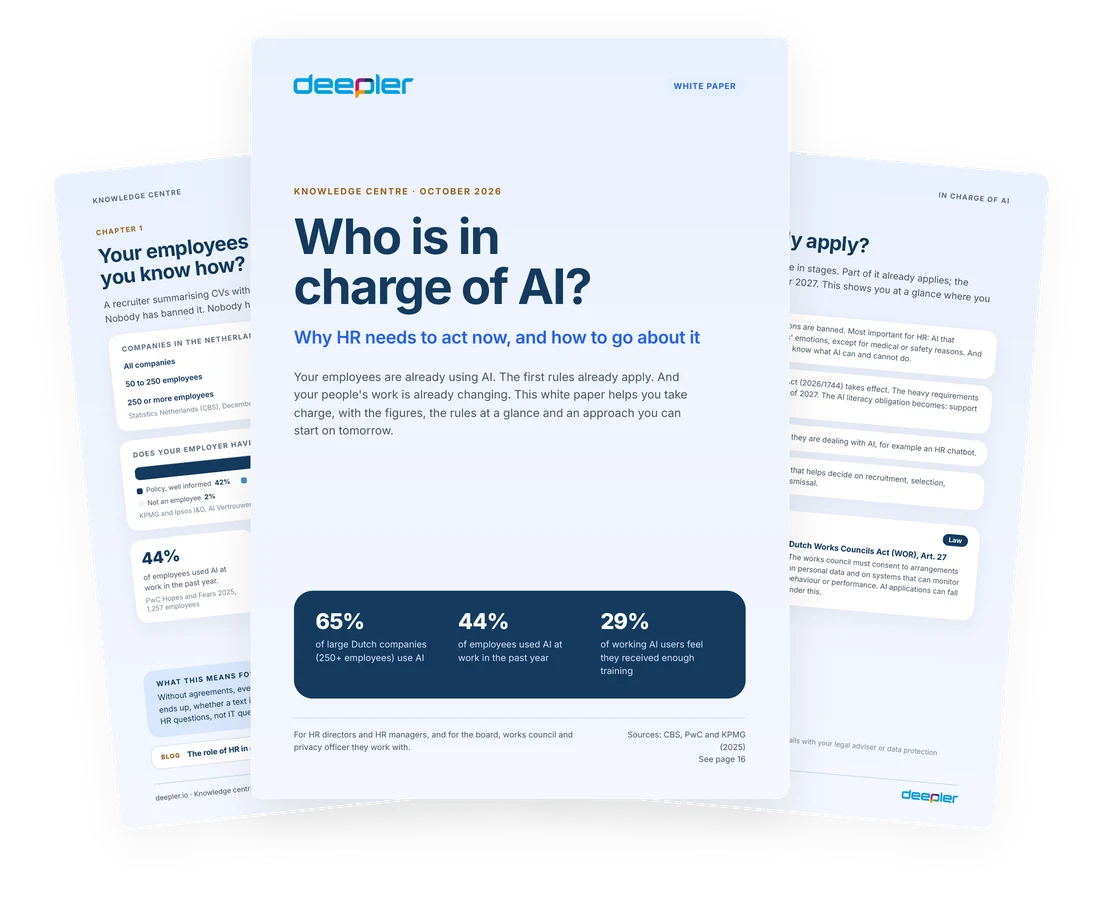
Free whitepaper
Who is in control of AI?
The figures, the rules at a glance, when AI is high risk, seven actions and ten questions for your vendor.
Not every AI in HR falls under the strict rules. The question is always: does it influence a decision about someone’s job or career? Drafting a job ad or summarising a policy is usually not high risk. Filtering or ranking CVs, assessing candidates and monitoring performance is. The vendor supplies the system, but you are responsible for how you use it: human oversight, keeping logs and informing people in advance.
Employees are curious and often positive. But 84% worry about privacy with AI, only 37% trust AI to give correct answers and 16% feel pressure to use AI. Ask them what they need. Anonymously, per team: what am I allowed to do, what do I need, what changes for me? Do not measure it with AI: emotion recognition in the workplace is prohibited.
With the Learning and development module in Deepler Research you measure development needs per team and role, anonymously and at group level. The whitepaper includes a quick scan, an inventory and ten questions to ask before you sign with a vendor.
Knowledge Centre
Does your organisation know which AI is already in use today?
Download the whitepaper with the quick scan and the vendor checklist.

Sanne Huisman
Knowledge center Deepler
Sanne is the heart of Deepler’s Knowledge Center. She translates research, data, and practical experience into real-world applications for organizations. Whether it involves an employee survey, a whitepaper, or hands-on support, Sanne ensures that knowledge doesn’t go to waste but is instead used to improve both our work and our products.