

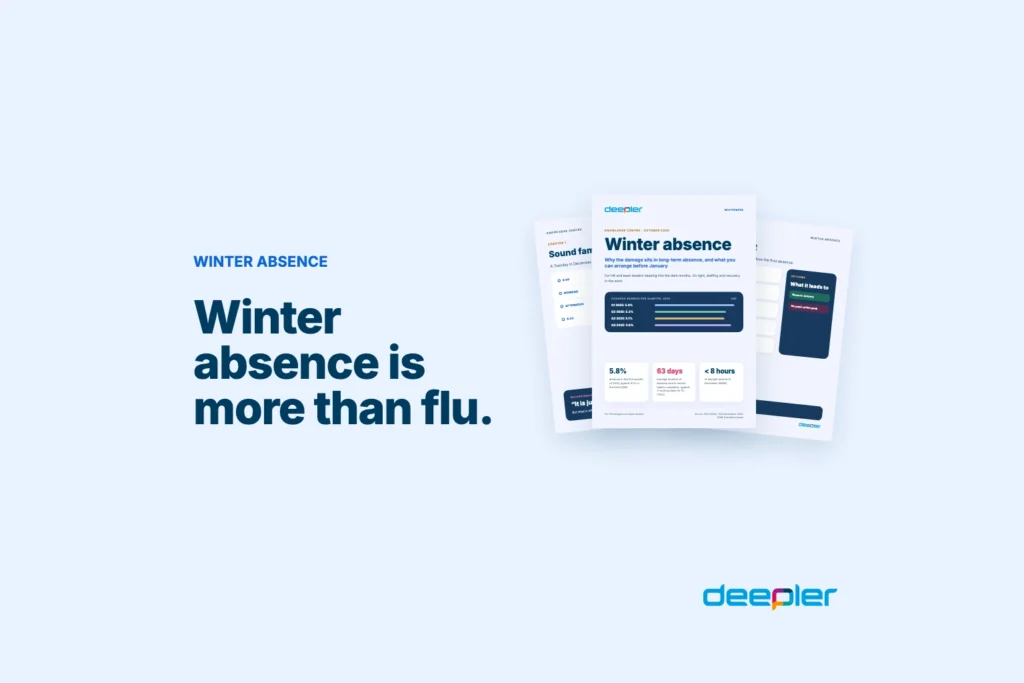
Winter blues at work: what to do before January
Absence in winter is flu, and there is little an organisation can do about it. That is the common as...
Verder lezen



One in three Dutch people has sleep problems, and more than four in ten structurally sleep too little. In a team of ten, that is three people on average. You rarely see it in absence figures, more often in concentration, patience and energy. Sleep and work influence each other. And that makes sleep an HR topic too. Not to interfere with people’s nights, but to organise the day well.
Dutch people aged 18 to 70
Source: Kerkhof, Sleep Medicine (2017), representative sample of 2,089 adults
Of employees with sleep problems, 49% name work as the cause, as often as personal circumstances. The main reasons given are too much work and not being able to switch off. A meta-analysis of 152 studies shows that higher workload goes together with shorter and poorer sleep, and poor sleep with lower health and job satisfaction (Litwiller et al., 2017). Four characteristics of work are most clearly linked to sleep, and all four lie within the organisation’s influence:
The cycle you want to break
→
→
→
After 17 to 19 hours without sleep, participants scored as poorly on some tests as with a blood alcohol level of 0.05% (Williamson and Feyer, 2000). If you get up at 7, you reach that point around midnight. And it applies to managers too: after a bad night they respond more dismissively to their team, and that team’s engagement drops with it (Barnes et al., 2015). Also read how to spot work stress earlier.
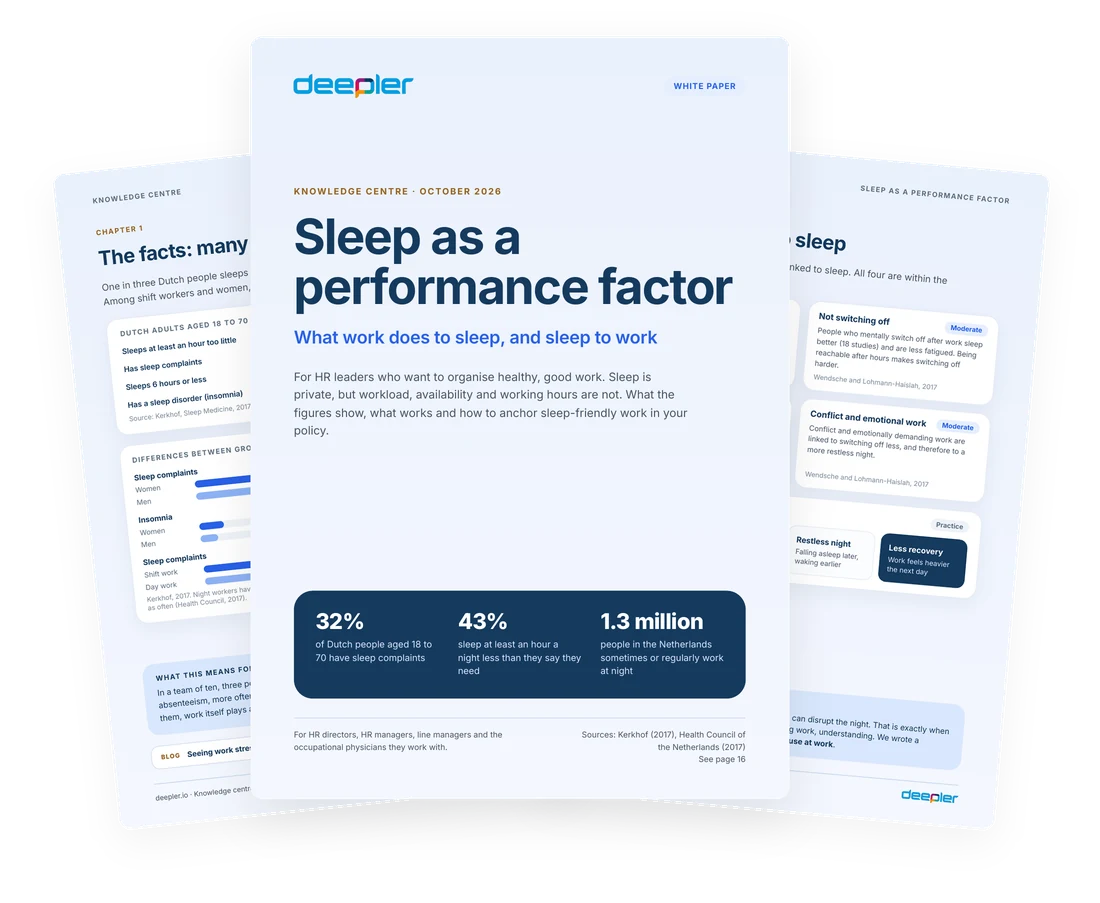
Free whitepaper
Sleep as a performance factor
The facts, six misconceptions, what works, five building blocks, ten rostering rules and a worksheet for team agreements.
Sleep is personal. An employer who interferes damages trust. An employer who organises work well actually helps. Up to the employer: realistic workload and planning, agreements on availability, healthy rosters, managers who lead by example and voluntary, confidential support. Not up to the employer: measuring sleep, linking sleep to performance reviews, or blaming the employee with “go to bed earlier”.
In 2016 the Dutch Data Protection Authority ruled that employers may not process health data from wearables, such as sleep patterns, not even with consent. In an employment relationship, that consent is rarely truly free.
The quickest to notice: team agreements on email and apps after working hours. Agree together after what time you no longer send messages, how you can be reached in a real emergency and how you respect days off and part-time days. The manager is the first to stick to it.
The Workload module in Deepler Research measures working hours, recovery and mental load per team: anonymously, by generation or age group, without asking about anyone’s sleep. See also how an education organisation mapped workload per team.
Knowledge Centre
What time does your organisation send its last email?
Download the whitepaper with the quick scan, the rostering rules and the worksheet for team agreements.
Sanne Huisman
Knowledge center Deepler
Sanne is the heart of Deepler’s Knowledge Center. She translates research, data, and practical experience into real-world applications for organizations. Whether it involves an employee survey, a whitepaper, or hands-on support, Sanne ensures that knowledge doesn’t go to waste but is instead used to improve both our work and our products.