








Menopause affects the work of many women. You barely see it in absence figures.
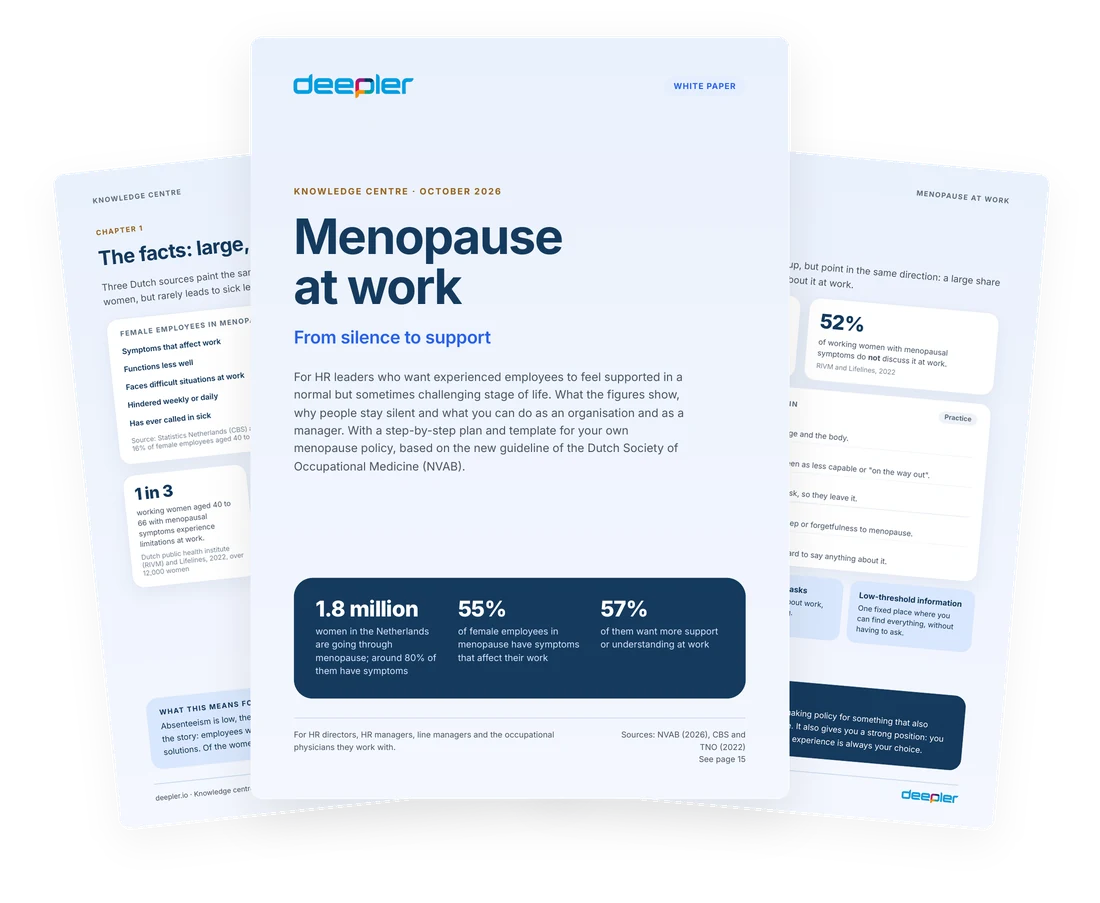
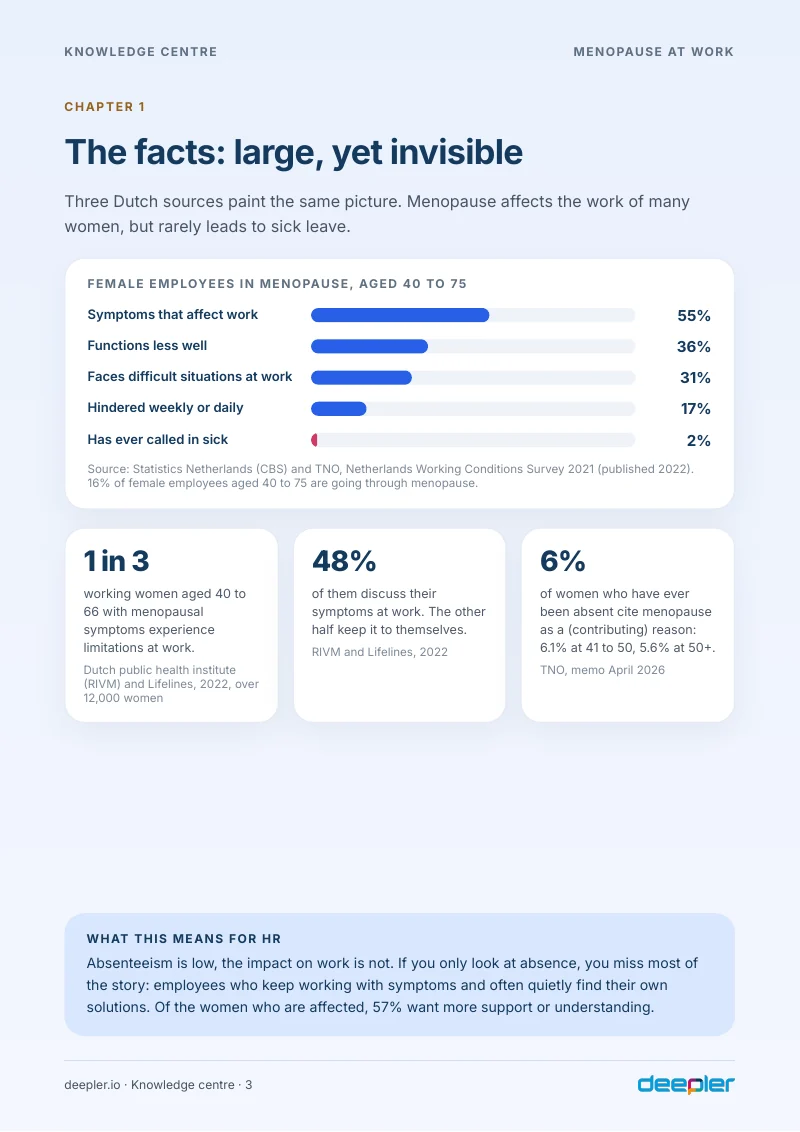
Over half of female employees going through menopause notice it in their work, yet only 2% have ever called in sick. This white paper shows why people stay silent, what works and how to set up a menopause policy based on the new NVAB guideline.
- The Dutch figures on menopause and work
- Five barriers that block the conversation
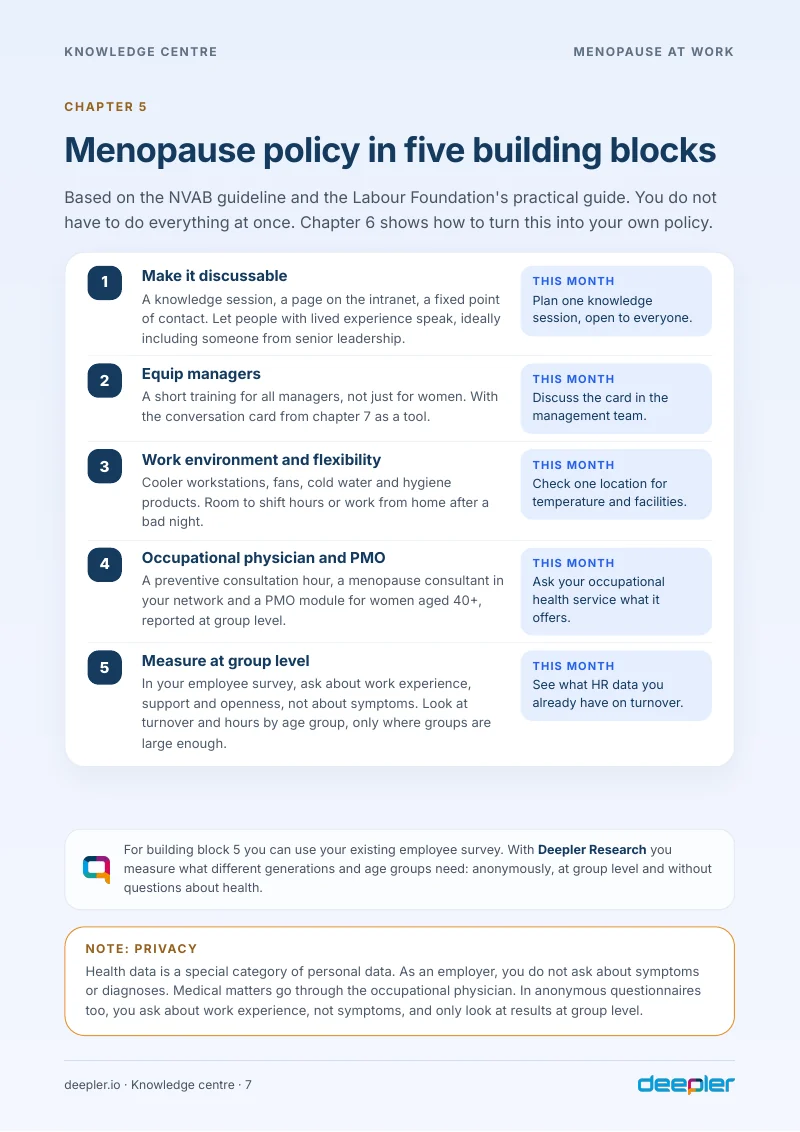
- Menopause policy in five building blocks
- A template and a conversation card for managers
Sources: NVAB (2026), CBS and TNO (2022)
Trusted by 400+ employers
4.9/5 reviews
Download the free white paper
Straight to your inbox. No spam. No obligations.
You get right away:
The figures, what works and how strong the evidence is, five building blocks for policy, a step-by-step plan, a template for your menopause policy and a conversation card.
Why it stays so quiet.
Around half of women with symptoms say nothing about it at work. Four barriers we hear again and again:
Barrier 1.
Taboo and shame
The subject feels private and touches on age and the body.
Barrier 2.
Fear of being labelled
Anyone who mentions symptoms fears being seen as less capable.
Barrier 3.
Uncertain managers
They do not know what they are allowed to ask, so they leave it alone.
Barrier 4.
Symptoms you do not recognise
Around the age of 45, women do not always link poor sleep or forgetfulness to menopause.
What is in the white paper
The facts
Three Dutch sources side by side: large, yet invisible.
What symptoms do to work
Sleep, concentration and self-confidence, and the knock-on effects.
What works
From self-help CBT to workplace adjustments, with the strength of the evidence.
Five building blocks for policy
Based on the NVAB guideline and the Labour Foundation's practical guide.
Step-by-step plan, roles and template
From idea to policy, with sample wording for each section.
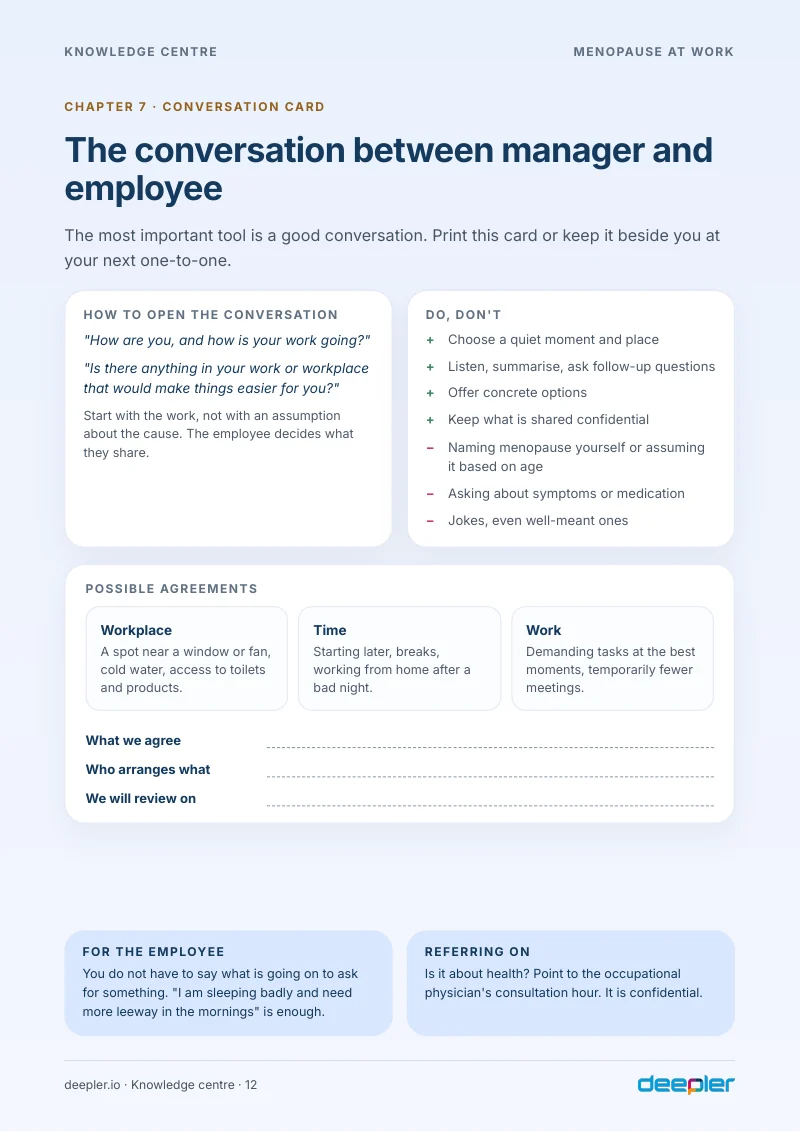
Conversation card
How a manager opens the conversation, without diagnosing.
White paper: Menopause at work
- The Dutch figures on menopause and work
- Five building blocks following the NVAB guideline
- A step-by-step plan and who does what
- A template for your menopause policy
- A conversation card for managers
A look inside the white paper
This is what it looks like


From the white paper
The impact is on work, not on absenteeism.
Over half of female employees going through menopause notice it in their work, yet only 2% have ever called in sick. If you only look at absence figures, you miss most of the picture. The white paper shows what HR and managers can do.
Download the white paperFemale employees in menopause, aged 40 to 75
Source: Statistics Netherlands (CBS) and TNO, Netherlands Working Conditions Survey 2021 (published 2022)
Measure what age groups need. Without asking about symptoms.
Health data is a special category of personal data. With Deepler you ask about work experience, support and openness, and you only see results by age group where groups are large enough. Anonymous, at group level.
- Work experience by age group
- No questions about health
- Anonymous and at group level
Trusted by small and large
Experiences of customers who make a difference with us.
-
Larren
Recruitment Lead,
De Selectie
“Recently, I used Deepler to arrive at an EVP. Great what they were able to achieve in a short time! In a period of two weeks, we collected information and were able to continue with our AMC plan. In any other situation, it takes weeks, if not months, to get this done. Contact is good, friendly and constructive. Very nice club to work with.”
-

Douwe
Recruiter,
Securitas
“Ideal tool and company to gain more and better insight into the organization and employees as an organization! And especially with speed! For us, it was also the need to get tools for the topics of retention, to prevent future absenteeism or turnover. I also have experience with other parties and I sincerely value the speed of switching, follow-up and personal contact with Deepler. Absolutely recommended.”
-

Jolanda
HR Business Partner,
Nedcargo
“Deepler is a great tool for continuously collecting feedback from our employees. This input is then centrally available for us as management, but also for managers who benefit from it.”
-

Jonathan
Manager,
UWV
“What makes Deepler special is that it doesn’t get stuck in numbers. It helps you immediately understand where it is and what teams need. For us, this ensured that employees themselves came up with areas for improvement and took responsibility for them. The insights were sharp and useful, but most importantly: the conversation that started afterwards made the difference. Thanks to Deepler, we didn’t get a paper plan, but change that was supported by the people themselves.”
-
Amadeus
COO,
OSRE
“The software has a positive impact on us as a rapidly growing organization. By better understanding what is going on in the workplace and what people offer as solutions for improvements, we can make more effective decisions. The platform helps us to gain real-time insight and to respond directly to it via the tool.”
From silence to support.
Download the white paper and set up a menopause policy that suits your organisation.
- Understand what menopause can do to work
- Remove the barriers that block the conversation
- Build policy on five building blocks
- Use the template and the conversation card
- Keep experienced employees on board
Download the free white paper
Straight to your inbox. No spam. No obligations.