













Informal care alongside your job, even if you are an HR leader.
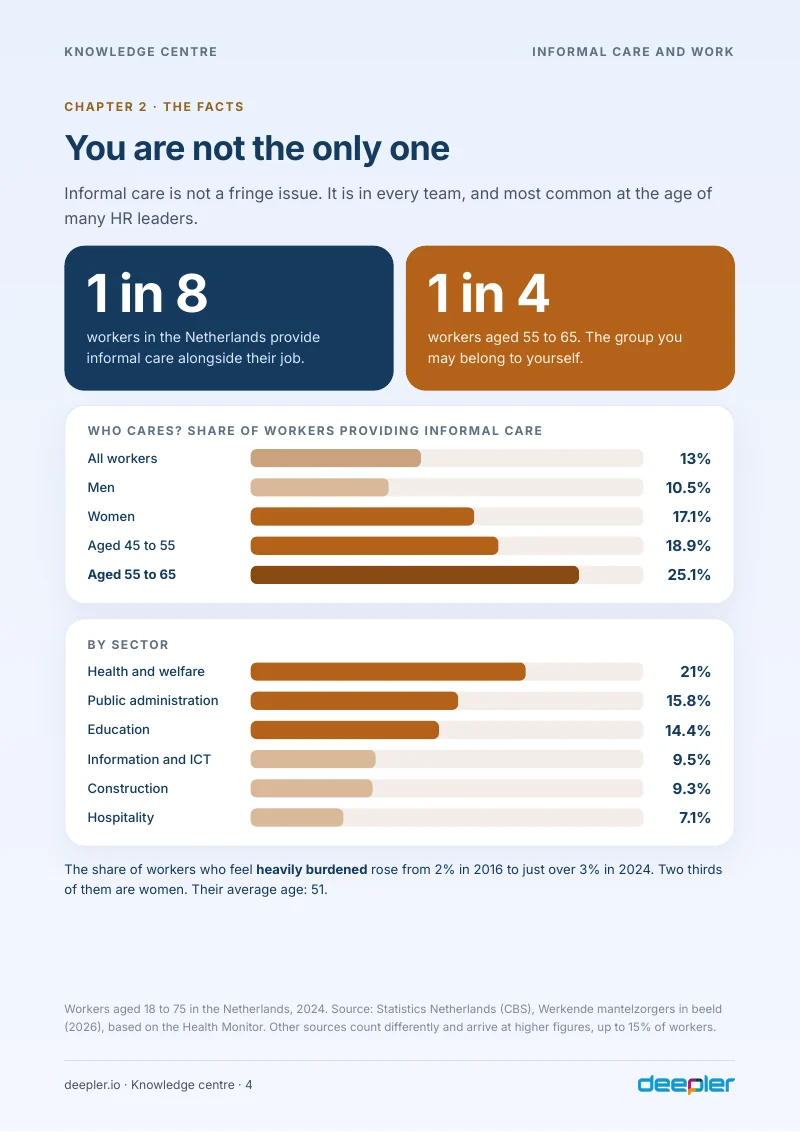
One in eight workers in the Netherlands cares for someone close to them. Between 55 and 65, it is one in four. Yet it often goes unspoken. This white paper starts with you and then looks at your colleagues and your organisation: what caring does to you, what helps and what is already in place.
- Working carers in figures
- Why it so often goes unspoken
- What helps, according to research
- A reflection and a conversation card for managers
Sources: Statistics Netherlands (CBS) and Stichting Werk&Mantelzorg
Trusted by 400+ employers
4.9/5 reviews
Download the free white paper
Straight to your inbox. No spam. No obligations.
You get right away:
The figures, the tipping point in hours of care, why it goes unspoken, what helps and which leave already exists, four steps for your organisation, a reflection for yourself and a conversation card.
Why care stays out of sight.
Informal care is not the problem. The problem is when it grows and nobody sees it. Four barriers keep it unspoken:
Barrier 1.
It starts small
A drive, a form, a phone call. Until the care grows bigger than you had planned.
Barrier 2.
Not a carer
It is just your mother, your partner or your child. So that is not what you call it.
Barrier 3.
Sorting it out yourself
You don’t want to be an exception, or a burden.
Barrier 4.
Nobody asks
It never comes up, so you say nothing.
What is in the white paper
Does this sound familiar?
An ordinary Tuesday, when work and care run into each other.
The facts and the tipping point
Who provides care, and why the hours of care per week make the difference.
The silence
Why people don't say anything, and how you can say it.
And you?
A page for yourself, with three questions. No test, no score.
What helps and what is possible
Support that works according to research, and the care leave that Dutch law already provides.
Your organisation and the conversation card
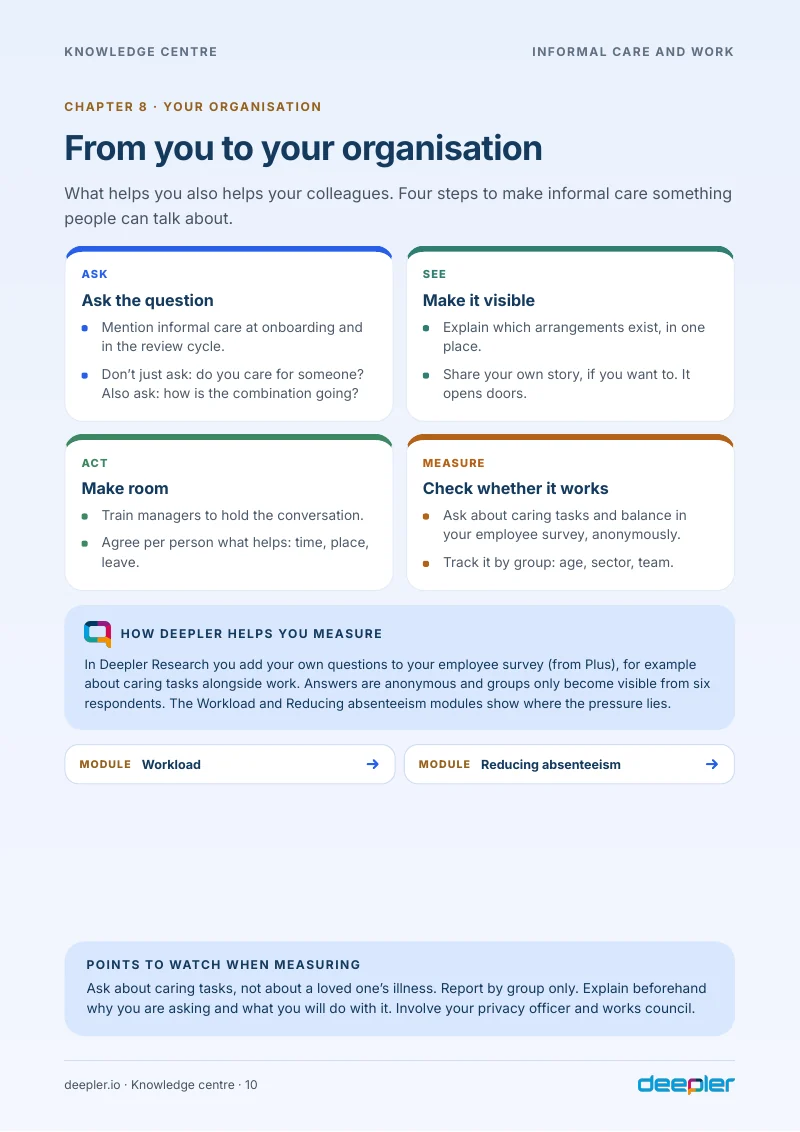
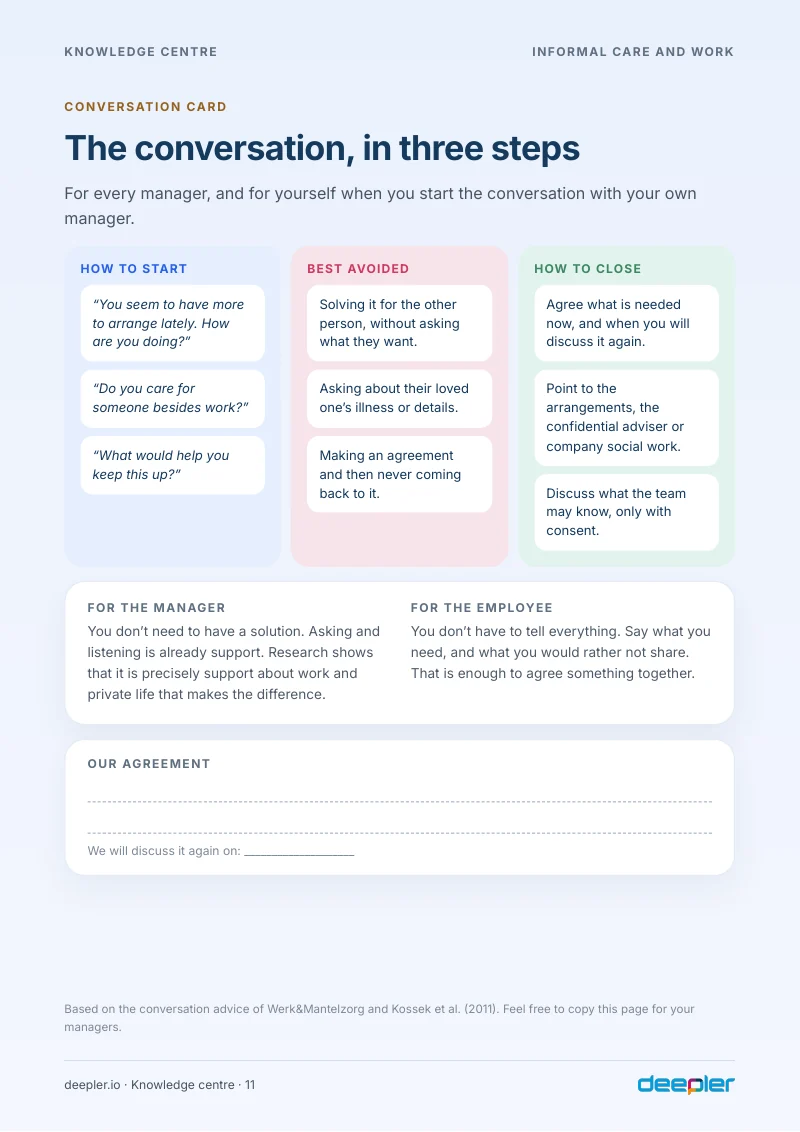
Four steps to make informal care something people can talk about, and the conversation in three steps.
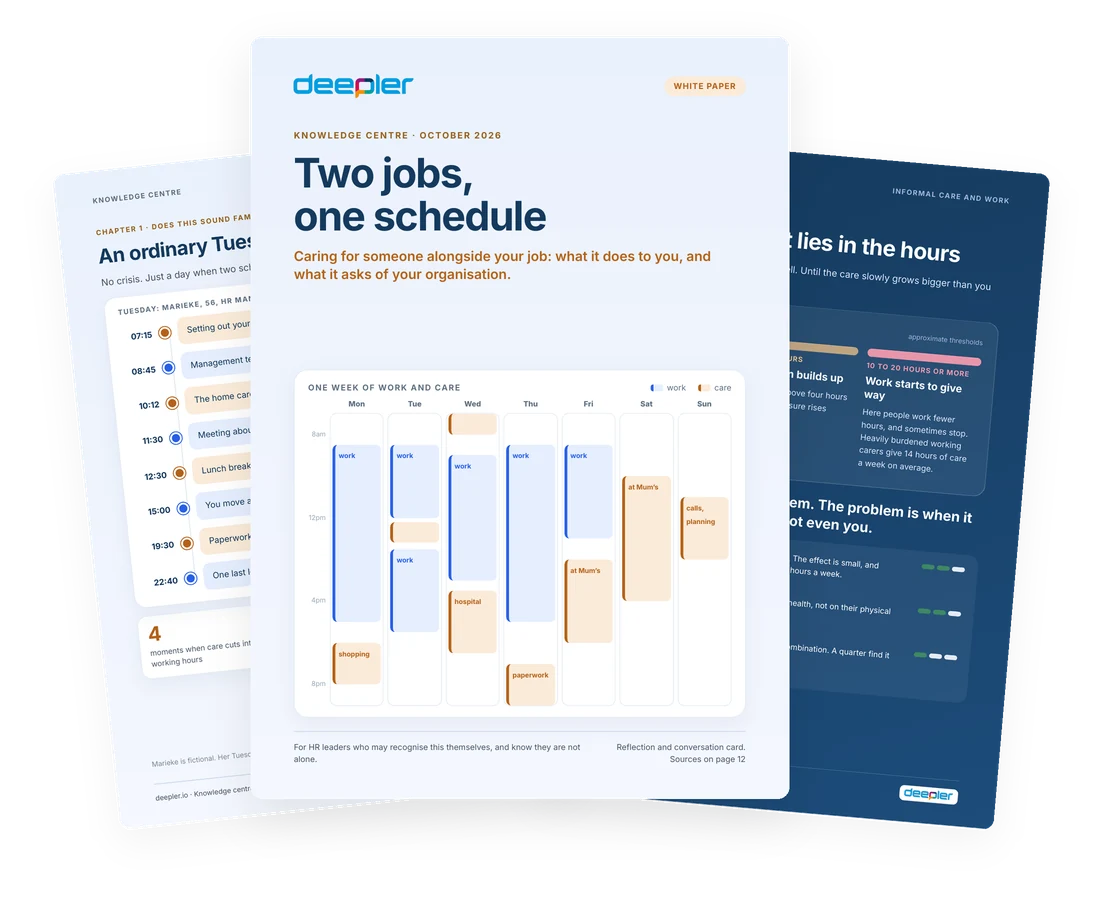
White paper: Two jobs, one schedule
- The figures on working carers
- The tipping point in hours of care per week
- Three questions for yourself
- The care leave Dutch law already provides
- Four steps and a conversation card
A look inside the white paper
This is what it looks like


From the white paper
Informal care is in every team.
In the Netherlands, the share of workers who feel heavily burdened by caring rose from 2% in 2016 to just over 3% in 2024. Two thirds of them are women, with an average age of 51. The white paper shows when care tips over and what helps then.
Download the white paperShare of workers providing informal care
Workers aged 18 to 75 in the Netherlands, 2024 (Statistics Netherlands CBS, Werkende mantelzorgers in beeld, 2026). Other sources count differently and arrive at higher figures
Does your organisation know how many colleagues provide care alongside their work?
In Deepler Research you add your own questions about caring tasks and balance to your employee survey. Answers are anonymous and groups only become visible from six respondents. That way you see where work and care clash, before someone drops out.
- Caring tasks and balance, asked anonymously
- By group: age, sector, team
- See where workload and absenteeism arise
Trusted by small and large
Experiences of customers who make a difference with us.
-
Larren
Recruitment Lead,
De Selectie
“Recently, I used Deepler to arrive at an EVP. Great what they were able to achieve in a short time! In a period of two weeks, we collected information and were able to continue with our AMC plan. In any other situation, it takes weeks, if not months, to get this done. Contact is good, friendly and constructive. Very nice club to work with.”
-

Douwe
Recruiter,
Securitas
“Ideal tool and company to gain more and better insight into the organization and employees as an organization! And especially with speed! For us, it was also the need to get tools for the topics of retention, to prevent future absenteeism or turnover. I also have experience with other parties and I sincerely value the speed of switching, follow-up and personal contact with Deepler. Absolutely recommended.”
-

Jolanda
HR Business Partner,
Nedcargo
“Deepler is a great tool for continuously collecting feedback from our employees. This input is then centrally available for us as management, but also for managers who benefit from it.”
-

Jonathan
Manager,
UWV
“What makes Deepler special is that it doesn’t get stuck in numbers. It helps you immediately understand where it is and what teams need. For us, this ensured that employees themselves came up with areas for improvement and took responsibility for them. The insights were sharp and useful, but most importantly: the conversation that started afterwards made the difference. Thanks to Deepler, we didn’t get a paper plan, but change that was supported by the people themselves.”
-
Amadeus
COO,
OSRE
“The software has a positive impact on us as a rapidly growing organization. By better understanding what is going on in the workplace and what people offer as solutions for improvements, we can make more effective decisions. The platform helps us to gain real-time insight and to respond directly to it via the tool.”
Informal care is not the problem. The silence is.
Download the white paper and discover how work and care can stay sustainable, for yourself and for your colleagues.
- Recognise when care becomes too much
- Know which care leave already exists
- Make informal care open to discussion in your organisation
- Ask about caring tasks in your survey, anonymously
- Hold the conversation using the conversation card
Download the free white paper
Straight to your inbox. No spam. No obligations.