




Development of a strategic training plan with data
Developing a strategic training plan with data Most organizations invest thousands of euros annually...
Verder lezen




For many parents in the Netherlands, part-time work is the norm. But careers are often still designed around full-time work: if you are there, you count. For HR professionals, the job itself is also becoming more demanding. How do you build a part-time career without giving up your ambition? Part-time work is not a lack of ambition, but a different distribution of time. The question is whether organisations design their careers accordingly.
The part-time reality
Sources: CBS (2025), Personio and Censuswide (2025, poll)
More and more people work 28 to 35 hours, including fathers. Among mothers with a partner, that share rose from 27.4% to 31.4%, among fathers from 11.5% to 13.3% (2021 to 2025). And many people actually want to work less: 17.1% of working men and 13.9% of working women. If you keep careers open only to full-timers, you exclude not only parents, but also a large share of the people who still work full-time today.
According to the Netherlands Institute for Social Research (SCP), hours worked and overtime are strongly linked to progression into management positions, and even more strongly to progression to the top. Part-timers are promoted less often, and that difference accumulates. Four mechanisms keep careers designed around full-time work:
HR absorbs the tensions of the whole organisation: absenteeism, conflicts, reorganisations. Combining that with a family means carrying a double load.
What HR professionals say themselves
Poll among 500 HR professionals (Censuswide for Personio, December 2024). Read it as a signal
On top of that comes the cobbler’s paradox: HR makes the policy for balance and flexibility, but by no means always uses it itself.
Free whitepaper
Ambition in part-time work
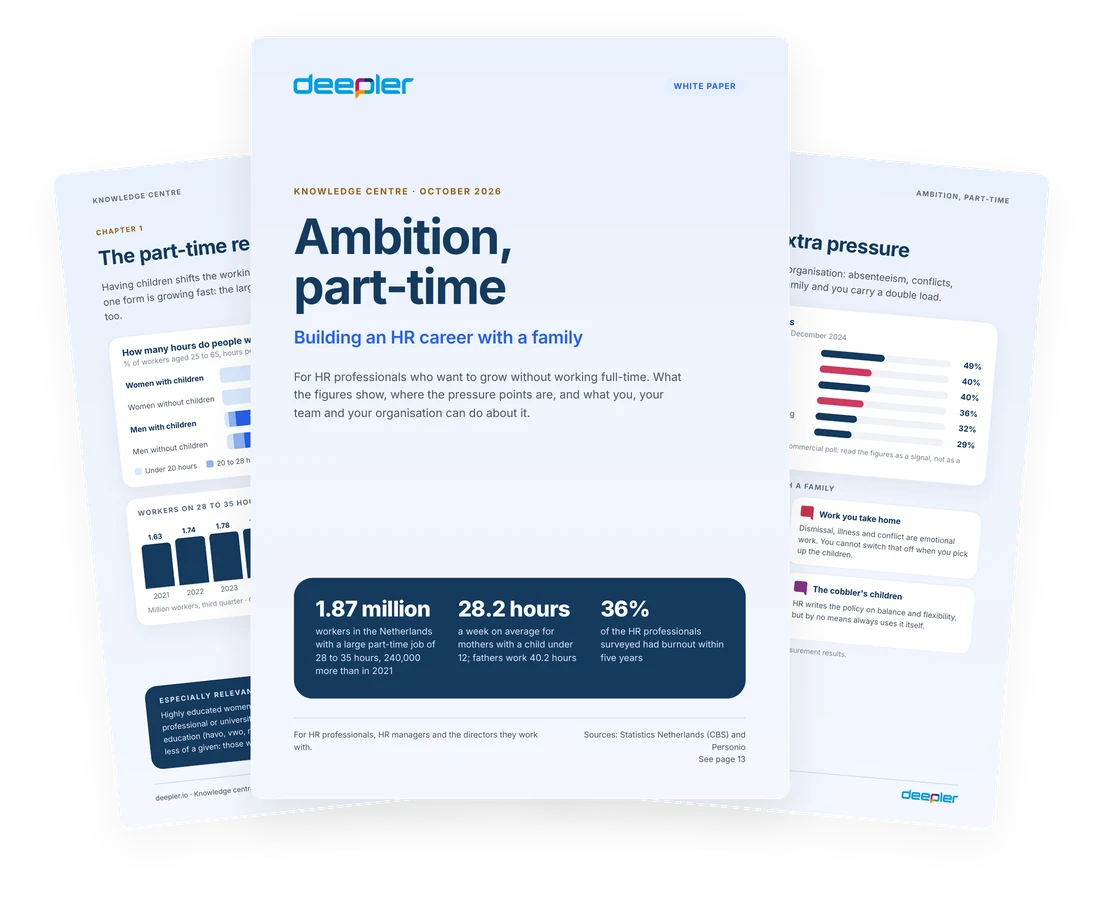
The figures, four design principles, five team agreements, what the organisation needs to arrange, a worksheet and a conversation card.
You do not have to wait for the organisation to arrange it:
A part-time HR career only works if the team around it is organised: cover for urgent matters every day, a fixed handover, consciously sharing heavy work and meetings on days when everyone works. And the organisation turns four dials: promoting on impact instead of visibility, part-time management as standard, careers in phases, and board members who make their own boundaries visible. Also read how a continuous conversation cycle helps you manage by results.
Prepare the conversation with six topics: your ambition in two years’ time, your ideal week, the results you want to be assessed on, availability on days off, visibility in important decisions and an evaluation after three months. For each topic, ask a question back, so it becomes a conversation instead of a request. And if the answer is no? Propose a three-month trial period. If it is about your hours, the Dutch Flexible Working Act offers a formal route.
With Deepler Research you measure per team how employees experience workload, flexibility and career prospects. With Deepler 360 you see whether managers manage by results and give room. What HR arranges for itself will soon be a blueprint for the whole organisation.
Knowledge Centre
Do we measure ambition by hours, or by what someone contributes?
Download the whitepaper with the worksheet and the conversation card.

Sanne Huisman
Knowledge center Deepler
Sanne is the heart of Deepler’s Knowledge Center. She translates research, data, and practical experience into real-world applications for organizations. Whether it involves an employee survey, a whitepaper, or hands-on support, Sanne ensures that knowledge doesn’t go to waste but is instead used to improve both our work and our products.