


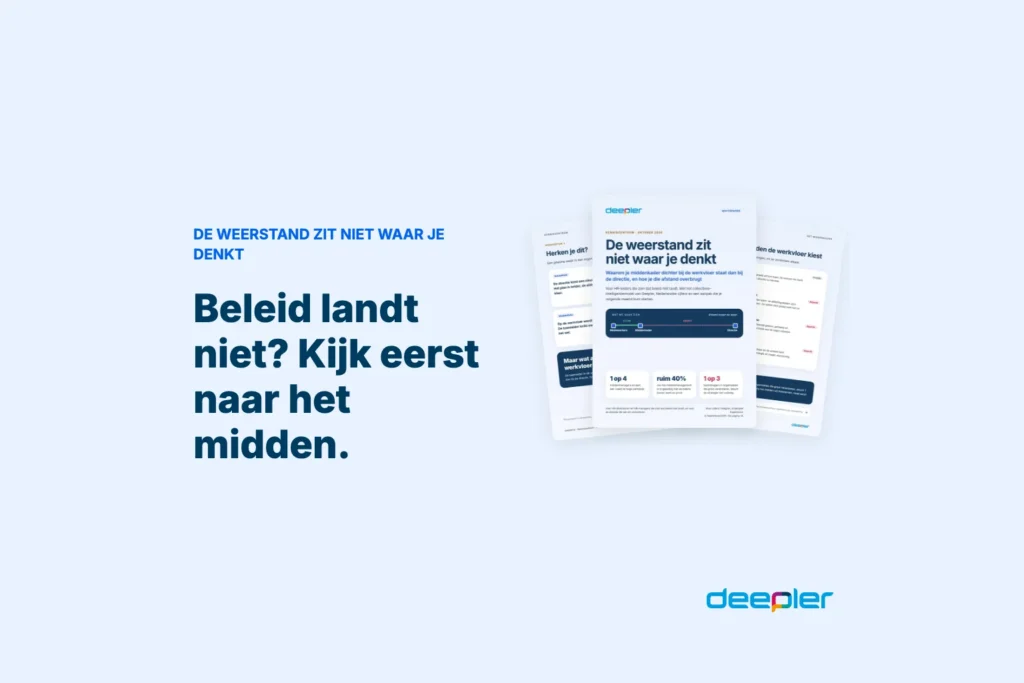
Weerstand bij verandering: waarom het middenkader de sleutel is
Maandag kiest de directie een nieuwe koers. Dinsdag legt de teamleider het uit aan haar team, maar z...
Verder lezen



Workplace motivation is crucial, especially in large organizations with more than 500 employees. Unfortunately, motivation is often seen as a general concept, where as many initiatives as possible are started without specifically addressing the needs of employees. The problem? These initiatives often fail because they are not tailored to what employees really need. In this article, you’ll learn why it’s essential to first understand your employees’ needs before implementing motivational strategies. This not only saves time and money, but also increases the effectiveness of your measures.
Before you start implementing motivational strategies, you need to thoroughly understand the specific needs of your employees. Without this insight, you run the risk of investing resources in initiatives that may have little impact. Studies have shown that motivation is most effective when it is tailored to the individual needs and expectations of employees. For example, if you know that a team needs more flexibility, an initiative such as flexible working hours is likely to be more successful than a generic rewards program.

Many organizations make the mistake of investing in a wide range of motivation programs without taking into account the specific needs of their employees. The result? High costs and little effect. A typical example is the introduction of expensive bonus programs that, however, do not have the desired effect because they do not address the underlying motivations of employees. Another mistake is implementing measures that are based more on assumptions than solid data.
Do you want to motivate your employees? The key to an effective motivational strategy lies in knowing their needs thoroughly. You can achieve this through targeted employee questionnaires, personal conversations and the use of modern tools such as Deepler. Deepler allows you to collect and analyze personalized data, helping you identify the real needs of your employees. With these insights, you can develop measures that have a real effect and increase the motivation of your employees in a sustainable way.
Once you’ve identified your employees’ needs, you can develop targeted motivation strategies. An example of this could be the introduction of flexible working hours if your employees want more autonomy. Or maybe a mentoring program makes sense to fulfill the desire for professional development. The most important thing is that your measures are directly tailored to the identified needs of your employees. This not only increases satisfaction, but also productivity.
Motivation is not one-size-fits-all. The key to success lies in understanding the individual needs of your employees and developing appropriate measures. By responding specifically to these needs, you not only increase motivation, but you also create a positive work environment that contributes to the long-term success of your organization.

Sanne Huisman
Knowledge center Deepler
Sanne is the heart of Deepler’s Knowledge Center. She translates research, data, and practical experience into real-world applications for organizations. Whether it involves an employee survey, a whitepaper, or hands-on support, Sanne ensures that knowledge doesn’t go to waste but is instead used to improve both our work and our products.