



Happy employees, happy customers? Why you should look at both together
In many organisations they live in two separate worlds. HR measures employee satisfaction, customer ...
Verder lezen




The drivers of customer satisfaction largely determine how customers perceive an organization. Many companies look primarily at an overall satisfaction score, but that doesn’t tell you exactly where that score comes from. Anyone who really wants to improve the drivers of customer satisfaction must understand the underlying factors that make the difference.
The five most important drivers of customer satisfaction are product experience, service quality, communication, loyalty and customer experience. Together, these five elements form the basis of a strong customer relationship. Once you have insight into these themes, you can improve in a much more targeted way.
That’s why we at Deepler believe that customer feedback only gets value if you not only measure whether customers are satisfied, but also understand why that is. It is precisely by focusing on the real drivers of customer satisfaction that you make better choices.
The term drivers of customer satisfaction refers to the components of the customer relationship that directly affect how satisfied customers are. This is important because an overall score is often too general. A customer may well give a passing grade, while under the surface there are problems in communication or service. Without understanding the drivers, you miss those signals.
When you know which drivers have the strongest impact on your customers’ satisfaction, you can prioritize. You make targeted investments in the areas that have the most impact, instead of improving broadly without focus.
Moreover, it helps to deepen the relationship. Customers notice when an organization truly listens and acts on their experiences. This strengthens trust and loyalty. Also read how to avoid common mistakes in a satisfaction survey, because the same principles apply to customer research.
The first driver of customer satisfaction is product experience. This is about how customers experience the product or service they purchase. Not just whether it works technically, but whether it matches what they expected and needed.
Product experience includes:
When a product works complicated, is not stable or does not do what customers expect, customer satisfaction drops quickly. Conversely, a strong product experience creates trust, appreciation and a greater likelihood of repeat purchases.
The best way to improve product experiences is to actively solicit feedback from customers. Ask not only if they are satisfied, but also why. What are they running into? What works well? What features really add value?
By collecting and analyzing these signals structurally, you can better inform product choices and work toward a product that demonstrably better meets customer needs.
Alongside product experience, service quality is one of the strongest drivers of customer satisfaction. Even a good product can be rated negatively if the service around it falls short. Customers remember not only what you deliver, but also how you treat them when they have a question, experience a problem or need help.
Service quality is about:
Customers who experience prompt, knowledgeable and friendly service are not only satisfied; they are more likely to become loyal and recommend the organization to others.
Start by mapping all customer contact moments. Where are customers waiting the longest? Where do they get stuck most often? Which questions are recurring? With those insights, you can make targeted improvements, such as better employee training, smarter process designs or expanding self-service capabilities.
The third driver of customer satisfaction is communication. This is a factor that is often underestimated. Much dissatisfaction occurs not because the product or service is necessarily bad, but because expectations are unclear, information is lacking or customers feel inadequately included.
Good communication creates calm, clarity and confidence. Poor communication creates noise, doubt and irritation.
Communication often falls short at times like:
For customers, communication is an important signal of professionalism. If information is incorrect or incomplete, it immediately reflects on the entire organization.
Loyalty is the fourth driver of customer satisfaction, and at the same time an outcome of it. Satisfied customers become loyal, but loyalty itself is also a driver. Customers who feel connected to a brand or organization are more willing to forgive, more likely to innovate and more likely to talk enthusiastically about others.
However, loyalty is built by:
Loyal customers are more commercially valuable than new customers. They stay longer, buy more often and regularly provide word-of-mouth advertising. As a result, loyalty not only affects customer satisfaction, but also growth, retention and commercial stability. See also how HR Analytics can be used to measure employee satisfaction and loyalty.
The fifth and overarching driver is customer experience. This is the sum total of all the impressions, emotions and experiences a customer has with your organization. Product experience, service quality, communication and loyalty all come together in this.
In fact, customer experience goes beyond a single isolated contact moment. It is the broader experience created across the entire customer journey. From orientation and purchase to use, support and follow-up contact.
Moreover, more and more organizations are competing not just on price or product, but on total experience. If two providers are similar in content, the customer often chooses the one with the best experience. Customer experience has thus become a strategic differentiator.
To improve customer experience structurally, you need insight into every step of the customer journey. Where are customers pleasantly surprised? Where do they drop out? Which moments determine the overall impression? Deepler’s research modules allow you to systematically map these insights.
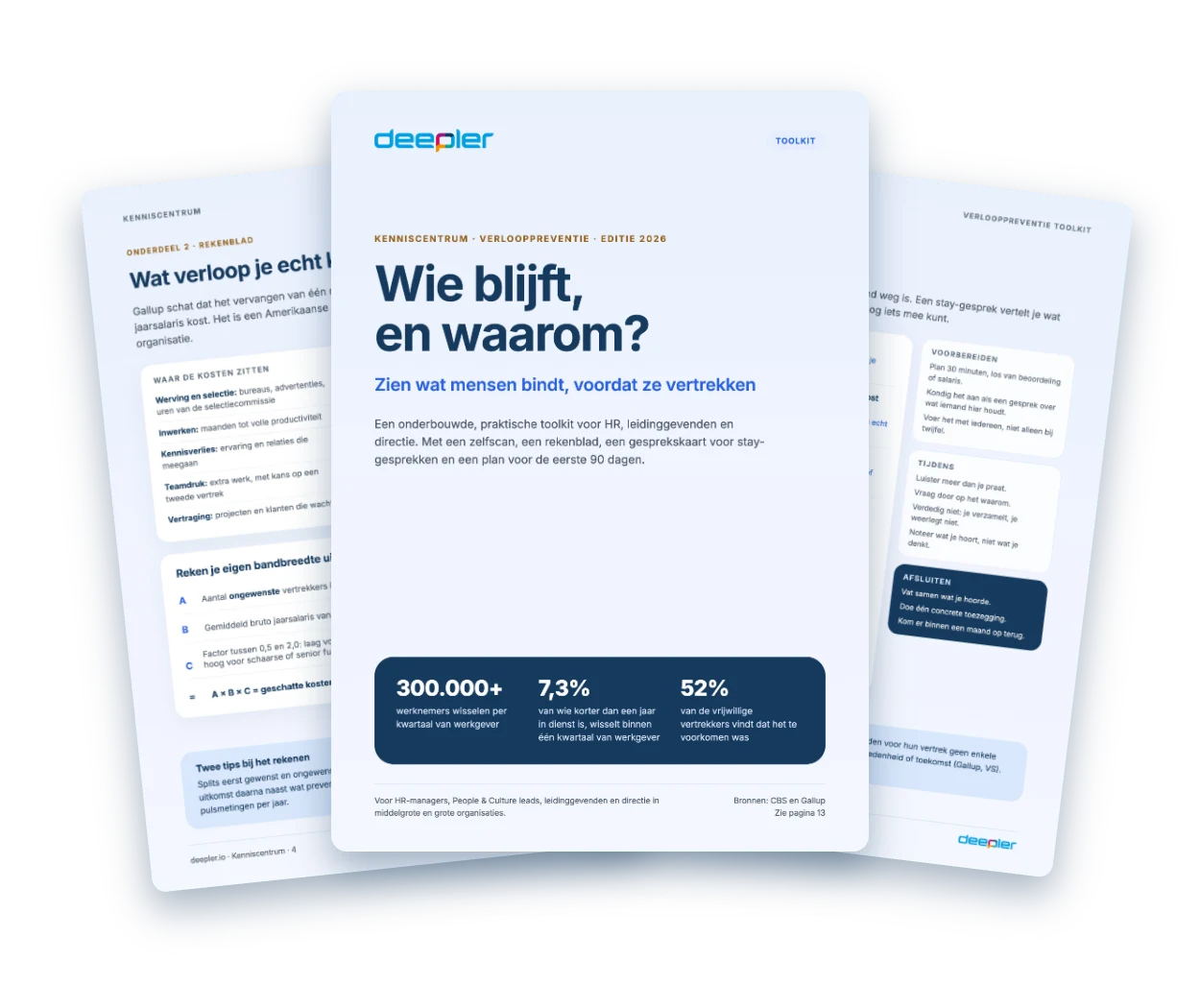
Free toolkit
Turnover prevention toolkit
See what keeps people on board, where the risk of leaving lies and how to start the conversation in time.
To measure the drivers of customer satisfaction, you need more than one general question. You want to know how customers are performing for each driver so that you can steer in a targeted manner. To do that, you use targeted customer satisfaction surveys, asking questions for each theme that provide reliable insights.
Effective methods for measuring floats are:
But it’s not about collecting as much data as possible; it’s about asking the right questions at the right time. A reliable customer satisfaction survey is short, relevant and leads to concrete action.
Although many organizations collect customer feedback, but do too little with it in practice. A shame, because it is precisely in this feedback that there are often the most valuable opportunities for improvement. The trick is not to see signals as incidents, but as input for structural improvement.
That requires an approach in which you:
In this way, customer feedback becomes not a mandatory number, but a concrete source for better decisions.
If you want to increase customer satisfaction, it helps not to turn all the knobs at once. Based on your measurement, choose the one or two drivers with the greatest impact and work on them in a targeted way.
What exactly is customer loyalty? Customer loyalty is the extent to which customers come back, stay and recommend you, even when there are alternatives. Satisfaction is a precondition, but loyalty only develops when customers keep trusting you over a longer period.
Customer satisfaction is not a loose number that falls out of the sky somewhere. It is the result of five interrelated drivers: product experience, service quality, communication, loyalty and customer experience. By systematically identifying and improving these drivers of customer satisfaction, you work to create a customer relationship that is sustainable and commercially profitable.
Want to know how Deepler helps you measure and improve the drivers of customer satisfaction in your organization? Request a no-obligation demo and find out what really matters to your clients.

Stijn van der Vat
Founder / CEO
Stijn founded Deepler in 2021 together with three other change managers, driven by a shared conviction: organizations only truly change when employees are taken seriously. As CEO, he shapes Deepler’s strategic direction and builds lasting partnerships with clients and partners. Stijn is often the first point of contact for organizations looking to get more out of their employees' voices.