




4.9/5 reviews

How to reduce stress at work: recognise the causes and regain your energy
Work-related stress develops when workload stays too high for too long and you cannot recover enough. On this page you can read what work stress is, which signs to look out for, what the main causes are and what you and your organisation can do to reduce stress at work.
Want to know what costs you the most energy? Take the free work stress test: 15 short statements and your personal energy profile straight away.
Workload, work stress and energy: how they are connected
Workload is not a bad thing in itself. A busy week with a clear goal can actually give you energy. It becomes a problem when the pressure does not let up, when you have little influence over your work and when you cannot recover enough. Then work costs more energy than it gives. That is what we call work stress.
On this page you will read:
- the difference between workload and work stress
- which signs may point to work stress
- the five main causes of work stress
- what you can do yourself to reduce stress at work
- how organisations measure and tackle workload and work stress
Contents
What is work stress?
Work stress is the strain you experience when the demands of your job are greater than what you can handle for a longer period. So it is not just about the amount of work. Unclear expectations, constant interruptions, little room to manoeuvre and too little recovery also play a part.
The difference with workload: workload describes how much is asked of you in the time you have. Work stress is what happens when that pressure stays too high for too long. Workload can be healthy, prolonged work stress is not. That is why it is important to see in time where the pressure is coming from.

Signs of work stress
Work stress often creeps in slowly. Signs that many people recognise are:
- you feel tired, even after a weekend or holiday
- you find it harder to concentrate
- you get irritated or low more quickly
- you keep worrying about work after hours
- you sleep less well
- you enjoy work you used to like less
Do you recognise several signs and do they persist? Talk about it with your manager, the occupational health doctor or your GP. The sooner you talk about it, the easier it is to change something.
The five main causes of work stress
Work stress almost never has a single cause. It is usually a combination of factors in the work itself. These are the five energy drains that play a role most often.
1. Workload and time pressure
There is structurally more work than time. You work against the clock, keep postponing tasks and go home with work that is not finished.
2. Unclear priorities
You do not really know what matters most. Several people ask you for something at the same time, or plans change without explanation.
3. Interruptions and disruptions
Messages, questions and notifications keep pulling you out of your work. Every interruption takes time to get going again.
4. Little autonomy and room to manoeuvre
You have little influence over how and when you do your work. When it gets busy, there is little you can adjust yourself. That makes the same pressure feel heavier.
5. Too little recovery
Breaks get skipped and after work your head stays full. Work always costs energy, but without recovery that energy does not come back.
Discover your biggest energy drain
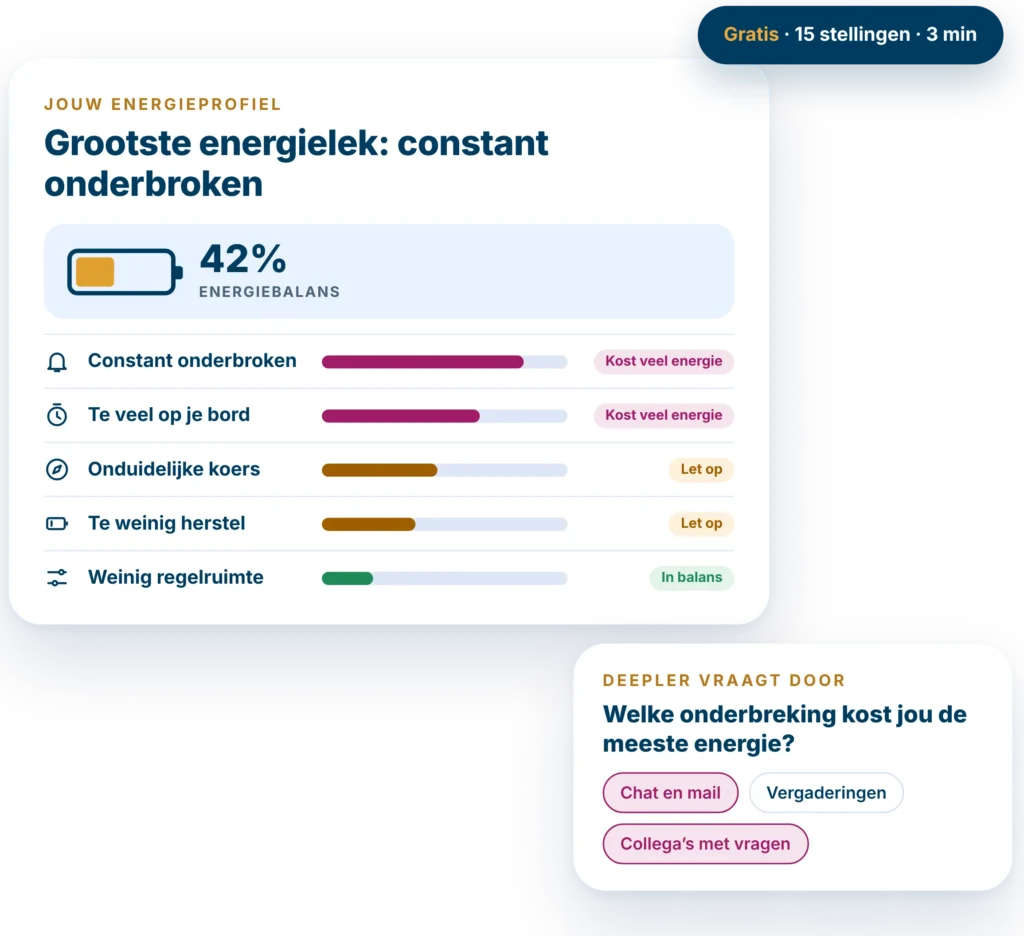
Which of these five factors costs you the most energy? With Deepler’s free work stress test you answer 15 short statements about your work. You immediately see your personal energy profile: your biggest energy drain and how the other factors score. You receive practical tips in your inbox and can challenge colleagues to take the test too. That way you see whether you share the same energy drains.

How to reduce stress at work: 7 practical tips
There is a lot you can do yourself to reduce work stress. Start with the factor that costs you the most energy.
- Make your work visible: write down for a week what you do and how long it takes. Then you talk to your manager about facts.
- Choose your top three: decide each morning which three things really have to be done.
- Ask about priorities: two requests coming in at the same time? Hand the choice back to the people asking.
- Plan focus time: block an hour in your calendar every day without email, chat and notifications.
- Increase your room to manoeuvre: choose one thing you would like to decide yourself and make a concrete proposal.
- Take real breaks: at least one break a day away from your screen, preferably outside.
- Close your working day: write down what comes first tomorrow, then switch off your notifications.
Personal tips help, but they do not solve everything. If the cause lies in how the work is organised, more is needed than better planning.
Measuring workload in your organisation
One test shows what costs you energy. But when several people in a team have the same energy drain, the cause usually lies in how the work is organised. Think of staffing, unclear agreements or a culture in which everyone is always reachable. Then it helps to measure workload structurally, per team.
With Deepler Research and the Workload module employees give feedback in two minutes on workload, priorities, disruptions, room to manoeuvre and recovery. Managers see per team where energy is leaking away and get concrete actions to work on. Also read how to measure and reduce workload.
The work stress test is an indicative self-reflection, not a validated workload measurement or medical test. Have you had complaints for a longer period? Contact the occupational health doctor or your GP.
Frequently asked questions about work stress
What is the difference between workload and work stress?
Workload is about how much is asked of you in the time you have. Work stress develops when that pressure stays too high for too long and you cannot recover enough. Workload can be healthy, prolonged work stress cannot.
What are the main causes of work stress?
The five main causes are: too much work in too little time, unclear priorities, many interruptions, little room to manoeuvre and too little recovery. It is usually a combination of these factors.
How can you reduce stress at work?
Start with the factor that costs you the most energy. Make your work visible, ask about priorities, plan focus time without interruptions and take real breaks. Discuss structural causes with your manager.
Is the work stress test a burnout test?
No. The work stress test is an indicative self-reflection on workload factors, not a medical or psychological test. Have you had complaints for a longer period? Contact the occupational health doctor or your GP.
What does the work stress test cost?
The work stress test is free. You see your energy profile straight away and receive your report with tips by email. You can also challenge colleagues to take the test, free of charge.
How do you measure workload in an organisation?
With a short questionnaire on workload, time pressure, priorities, disruptions, room to manoeuvre and recovery, per team. With Deepler Research you see not only whether teams experience pressure, but also where that pressure comes from and which actions help.
Schedule an advisory call
Ready to take the next step? Get in touch and we will look at the best approach together. Whether you have a question or just want to talk things through, we are here for you.
- A look inside the Deepler dashboard
- Personal advice and a start with honest insight
- A no-obligation conversation for all your questions