























Three smiling people against coloured backgrounds, as a visual element for employers.
Review stars icon

4,9/5 reviews

Diversity and inclusion in the workplace: make visible where everyone can contribute

Diversity and inclusion are not only about who works in the organization, but especially about who feels seen, heard and taken seriously. An organization can be diverse on paper, while employees in practice still experience barriers to speaking up, growing or being themselves.

With the diversity and inclusion module of Deepler, you examine how employees experience culture, collaboration, safety and equality. This makes visible where inclusion already works well, where exclusion unintentionally arises and what steps are needed to build a work environment where everyone can contribute.

  • Measure how inclusive the workplace is truly perceived to be
  • Discover where barriers to equal participation arise
  • Translate employee input into a concrete D&I action plan
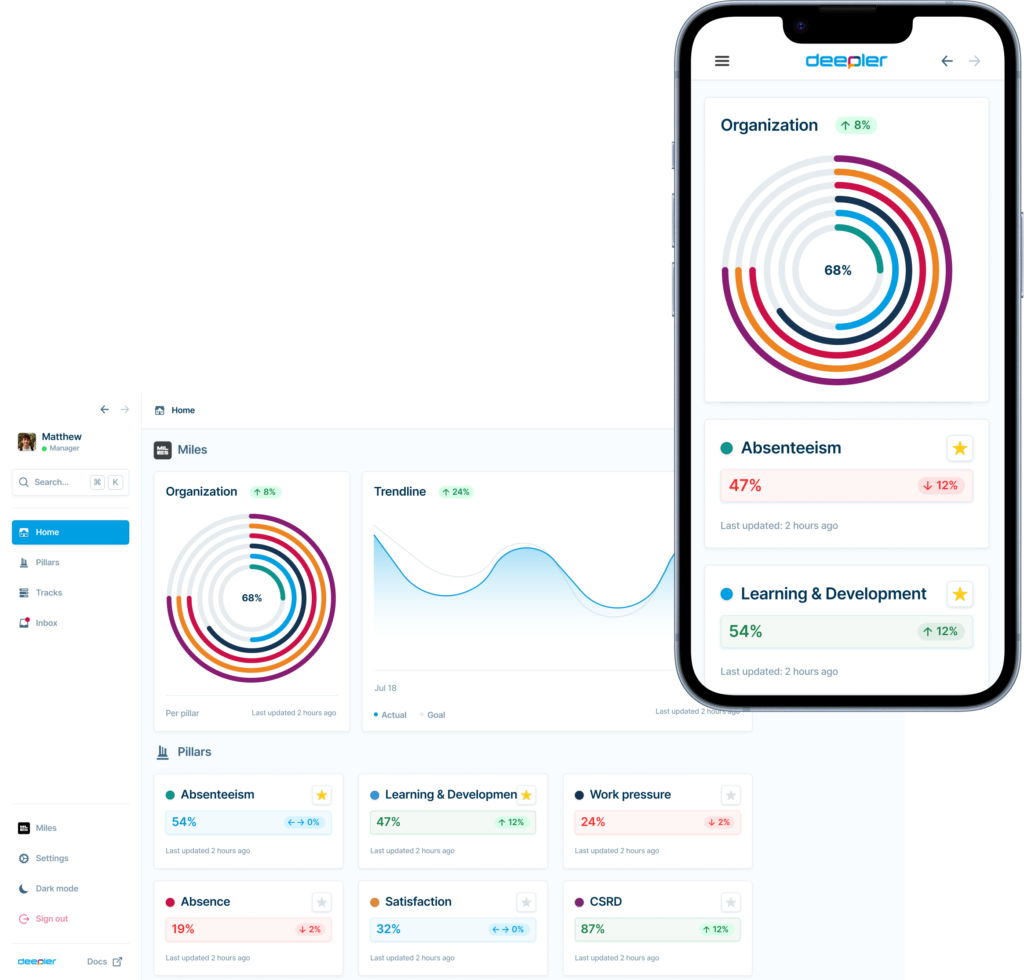
Screenshot of employee satisfaction survey results

Diversity and inclusion: what does it mean in the workplace?

Many organizations want to work on diversity and inclusion, but get stuck in general ambitions, isolated trainings or well-intentioned communication. The real question is not only whether policy exists, but whether employees in daily work notice that they experience equal opportunities, psychological safety and space for difference. A study into diversity and inclusion in the workplace helps make that experience concrete and choose priorities that fit the organization.

In this article we explain:

  • What diversity and inclusion mean within organizations
  • What the difference is between diversity and inclusion
  • Why diversity and inclusion in the workplace are important
  • How to survey employees safely and carefully
  • How Deepler helps move from insight to a practical action plan

Table of contents

What is diversity and inclusion?

Diversity is about the differences between people. Think of background, age, gender, education level, work experience, thinking style, culture, disability, neurodiversity, life stage or beliefs.

Inclusion is about the question of whether those differences are actually welcome in daily work. Are people taken seriously? Do they get equal opportunities?

Can they share their perspective without adapting to a dominant norm? A study into diversity and inclusion makes visible how employees experience this. So it’s not just about numbers or policies, but about behavior, culture, decision-making and the space people feel to participate.

Diversity without inclusion remains vulnerable

A diverse organization is not automatically an inclusive organization. If employees don’t feel safe expressing their opinion, experience little influence or believe that growth opportunities are unevenly distributed, diversity remains superficial. That’s why a good D&I study measures not just representation, but especially employees’ experience: where do people feel at home, where not, and what patterns need attention?

Visible and invisible forms of diversity

Diversity in the workplace is broader than what you see in a team photo. Some differences are visible straight away, others you only notice once you get to know someone better. It is precisely those invisible differences that often drop out of sight in policy.

  • Visible diversity: for example age, gender, skin color, cultural background or a physical disability
  • Invisible diversity: for example sexual orientation, religion, neurodiversity, a chronic illness, caring responsibilities or socio-economic background
  • Diversity in thinking and working: for example education, work experience, thinking style, personality and the way someone communicates
Consequence of low employee satisfaction: employee sitting at a desk with their head on the keyboard, apparently dejected or exhausted.

Diversity, equity and inclusion: what does DEI mean?

Alongside diversity and inclusion, you will often come across the term DEI: diversity, equity and inclusion. Equity is about fair opportunities. That does not mean everyone gets exactly the same, but that everyone gets what they need to take part fully. Think of an adapted workstation, flexible working hours or extra support when someone starts.

Together, diversity, equity and inclusion lead to something employees feel directly: belonging. People who feel at home in their team share ideas sooner, speak up more readily and stay with the organization longer.

Why is diversity and inclusion important?

Diversity and inclusion are important because organizations function better when people with different perspectives can contribute. New ideas don’t emerge automatically from difference; they emerge when difference is leveraged.

That requires a culture where employees feel safe, where decision-making is experienced as fair and where leaders actively create space for different voices. Without that inclusive foundation, talent, innovation and collaboration can actually stall.

Measuring diversity and inclusion provides organizations with various benefits.

The experience of inclusion is determined by a combination of factors: leadership, team behavior, social safety, communication, growth opportunities, recruitment, policy and how differences are handled. By measuring these factors deliberately, you prevent D&I from remaining an abstract topic. You see where employees experience progress and where the organization still unintentionally creates barriers.

What does research say about diversity and inclusion in the workplace?

International research, such as McKinsey’s Diversity Wins study from 2020, shows that organizations with more diverse executive teams are more likely to outperform the average. At the same time, the Netherlands Institute for Social Research (Sociaal en Cultureel Planbureau, SCP) concluded in 2025 that a more diverse workplace does not automatically become more inclusive. Without attention to exclusion and disadvantage, more diversity tends to lead to friction rather than inclusion.

The lesson for employers: recruiting diversely is a start, but the real difference is made in day-to-day collaboration. That is why it pays not only to track the make-up of your organization, but also to measure how employees experience inclusion.

1. Insight into inclusion in the workplace

A D&I study shows how employees experience daily collaboration. Do they feel free to ask questions, share dissenting opinions and be themselves? That insight helps make inclusion concrete at team and organizational level.

2. Fairer opportunities for development and growth

When employees experience unequal opportunities, talent remains underutilized. By measuring how people experience growth, assessment, guidance and recognition, you discover where processes or behavior need to be adjusted.

3. Stronger collaboration through greater understanding

Different perspectives can enrich collaboration, but can also create tension when expectations are unclear. An inclusion study helps teams make patterns discussable without basing the conversation on assumptions.

4. Less risk of exclusion or an unsafe work environment

Exclusion is often invisible. Sometimes it’s in jokes, meeting formats, decision-making, language use or who is and isn’t invited to contribute. By safely surveying employees, you can detect earlier where boundaries are crossed or where people disengage.

5. More concrete D&I policy

Many organizations have ambitions around diversity and inclusion, but lack direction. Research helps make policy based on what employees actually experience. This creates an action plan that is more practical, credible and easier to explain.

Conduct your diversity and inclusion study with Deepler’s software

With the diversity and inclusion module of Deepler, you examine how employees experience inclusion, equality and social safety within your organization. The questionnaire is short, carefully formulated and focused on concrete topics such as space for difference, equal opportunities, leadership, team culture and psychological safety.

The results are displayed clearly in dashboards, so HR, management and leaders can see where the organization is strong and where targeted action is needed. Deepler helps to treat D&I not as a separate project, but as part of organizational development.

Two people discussing work while looking at a tablet together.

Our satisfied customers

  • Logo Vereen
  • Logo-ABNAmro
  • Logo of "deSelectie" with the tagline "jouw recruitment marketing team" in bold, modern typography.
  • Logo of Van der Valk featuring a stylized toucan with a yellow beak and red accents.
  • Logo Securitas
  • Logo Brabant Water
  • Logo-eviden
  • Logo Smurfit Westrock
  • GestioNet logo with blue circular icons and the tagline "Play Think Learn".
  • Logo ABP
  • Logo-Gomes 1
  • Logo-uwv
  • Logo-headfirst
  • Logo Gemeente Velsen
  • Logo of Hendriks with a blue and orange icon and the Dutch slogan "Bedenkt, bouwt, beheert".
  • Truckland logo with blue and white text and an orange circle featuring horizontal white lines.
  • Logo-Site
  • Logo-Comtest
  • Logo of D&B The Facility Group in white text on a dark blue background with rounded squares.
  • Logo-Recruitment
  • Logo of Management Drives with bold "MD" initials and a colorful horizontal line beneath.
  • Logo-mateboer
  • Logo AM Groep
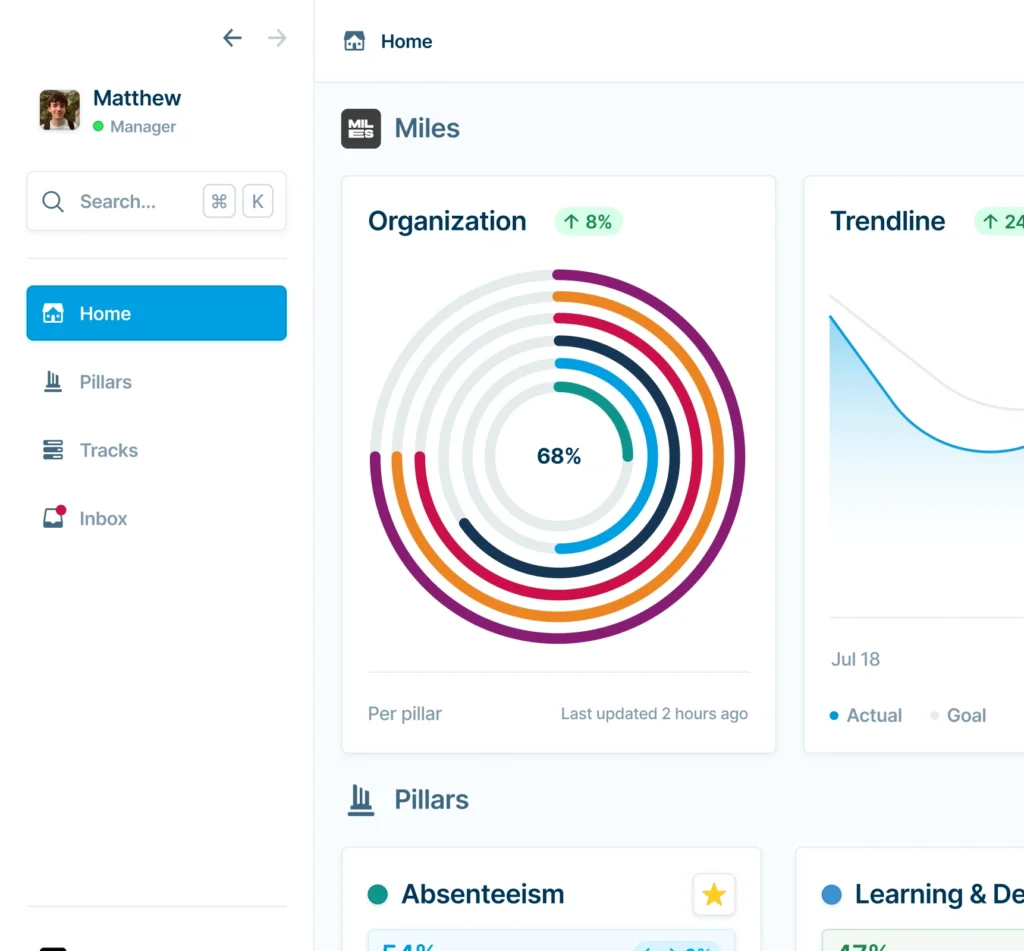
Dashboard view of the employee satisfaction survey system.

How do you measure diversity and inclusion in the workplace?

You measure diversity and inclusion on two levels. Diversity is about the make-up of your organization. You can often read it from HR data, such as the age profile, the ratio of men to women or the spread across job levels. Inclusion is about experience. You measure it by asking employees directly.

An inclusion survey uses statements about recognizable situations, such as “I can give my opinion without negative consequences” or “In my team, everyone gets the same opportunities to progress”. By comparing the results between teams and departments, you see where inclusion works well and where barriers arise.

Numbers don’t tell the whole story. So combine the results with team conversations or sounding board sessions, to understand what lies behind the scores.

Employee filling in the employee satisfaction survey.

A powerful tool

A D&I study is especially powerful when used as a starting point for conversation and improvement. The goal is not to pigeonhole people, but to make patterns visible that would otherwise remain undiscussed.

By surveying employees safely and carefully, you can better align policy, leadership and team agreements with reality. This creates not a symbolic D&I program, but an approach that employees recognize.

Three colleagues sitting together at a desk discussing the results of the employee satisfaction survey.

What are the benefits of diversity and inclusion in the workplace?

Diversity and inclusion in the workplace only deliver value when employees can leverage difference rather than hide it. An inclusive work climate helps to have better conversations, incorporate more perspectives and enable talent to grow more broadly. For organizations, this means not only stronger employer appeal, but also greater agility and better decision-making.

Better decision-making through different perspectives

Teams that create space for different experiences, perspectives and thinking styles can view problems from multiple angles. That doesn’t automatically lead to better decisions; for that, people also need to feel safe expressing their opinion. A D&I study shows whether that space actually exists. Possible benefits are:

  • More challenge in decision-making
  • Less groupthink
  • Better alignment with employees and customers
  • More ideas from different levels of the organization
Colleagues working together on documents and laptops during a meeting.
Two colleagues writing and conferring together at a whiteboard in the office.

Making the organization more inclusive

D&I policy becomes stronger when it’s not only developed by HR. By surveying employees, you discover what improvements are really needed: better conversation norms, fairer growth opportunities, more inclusive leadership, more accessible communication or clearer behavior around unwanted conduct. This makes inclusion not an abstract value story, but a concrete improvement agenda.

Stronger employer appeal and more engagement

Employees remain more engaged when they can be themselves and feel their contribution matters. Inclusion thus directly affects motivation, trust and loyalty. An organization that shows it listens to experiences around diversity and inclusion builds employer appeal that is more credible than a campaign or loose promise.

Three young people sitting on a pavement working together with a laptop and a smartphone.

How do you promote diversity and inclusion in the workplace?

An inclusive workplace does not come from a single training session or a well-written policy. It lies in the choices you make every day: who you hire, who you promote, how you run meetings and how you deal with difference. With these eight practical tips, you build an inclusive organization step by step.

1. Start with a baseline measurement

Know where you stand before you choose actions. With a short, anonymous questionnaire, you see how employees experience psychological safety, equal opportunities and room for difference. This baseline gives direction and later shows whether your actions are working.

2. Recruit inclusively

Write job ads in clear language, without unnecessary requirements, and look critically at words that unconsciously put off certain groups. Recruit through different channels, use fixed interview questions and put together a diverse selection panel.

3. Make unconscious bias open to discussion

Everyone has biases, often without noticing. They creep into recruitment, appraisals and promotions. Help managers and selection committees to recognize them and use fixed criteria, so decisions depend less on gut feeling. Also read our article on reducing bias in promotion decisions.

4. Check pay and progression opportunities

Compare salaries, bonuses and promotions between groups of employees. Unequal pay for work of equal value is not only unfair, but also against the law. Who does and does not progress often says a lot about how inclusive an organization really is.

5. Ensure an accessible workplace

Think of physical accessibility, but also of digital systems, clear communication and room for neurodiversity. A quiet workspace, flexible working hours or information in plain language can make all the difference for employees with a disability or chronic illness.

6. Make room for cultures, holidays and life stages

Employees celebrate different holidays and are in different stages of life. Flexible days off, attention for caregivers and a quiet room are small gestures that show everyone is welcome.

7. Encourage networks and dialogue

Employee networks, for example around LGBTIQ+, cultural background or young professionals, give people a voice and a place to share experiences. Also organize team conversations about collaboration and difference, so inclusion becomes a shared topic.

8. Make managers owners

Inclusive leadership is the strongest lever. Managers decide who gets to speak in meetings, how feedback is given and whether mistakes are allowed. Give them insight into what their team experiences and support them in translating those insights into behavior.

Trusted by small and large organizations

Experiences of clients who make a difference with us.

  • Portrait of a smiling man in a suit in front of an orange background, titled "Review-image-Larren (1)."

    Larren

    Recruitment Lead, 

    De Selectie

    Review stars icon

    “Recently, I used Deepler to arrive at an EVP. Great what they were able to achieve in a short time! In a period of two weeks, we collected information and were able to continue with our AMC plan. In any other situation, it takes weeks, if not months, to get this done. Contact is good, friendly and constructive. Very nice club to work with.”

  • Portrait of a smiling man named Douwe with a bald head and light eyes, against a turquoise background.

    Douwe

    Recruiter, 

    Securitas

    Review stars icon

    “Ideal tool and company to gain more and better insight into the organization and employees as an organization! And especially with speed! For us, it was also the need to get tools for the topics of retention, to prevent future absenteeism or turnover. I also have experience with other parties and I sincerely value the speed of switching, follow-up and personal contact with Deepler. Absolutely recommended.”

  • Portrait of Jolanda with long blonde hair, wearing a black lace top, set against a purple background.

    Jolanda

    HR Business Partner, 

    Nedcargo

    Review stars icon

    “Deepler is a great tool for continuously collecting feedback from our employees. This input is then centrally available for us as management, but also for managers who benefit from it.”

  • Portrait of Jonathan in a blue suit and tie, smiling in front of a blue background.

    Jonathan

    Manager, 

    UWV

    Review stars icon

    “What makes Deepler special is that it doesn’t get stuck in numbers. It helps you immediately understand where it is and what teams need. For us, this ensured that employees themselves came up with areas for improvement and took responsibility for them. The insights were sharp and useful, but most importantly: the conversation that started afterwards made the difference. Thanks to Deepler, we didn’t get a paper plan, but change that was supported by the people themselves.”

  • Vector

    Amadeus

    COO, 

    OSRE

    Review stars icon

    “The software has a positive impact on us as a rapidly growing organization. By better understanding what is going on in the workplace and what people offer as solutions for improvements, we can make more effective decisions. The platform helps us to gain real-time insight and to respond directly to it via the tool.”


Man leaning forward at a desk, looking at a laptop with concentration.

Is a diversity and inclusion study mandatory and what about GDPR, anonymity and careful measurement?

A diversity and inclusion study is usually not legally required as a separate study. However, employers have the responsibility to ensure a safe, healthy and equal work environment.

Topics such as discrimination, social safety, equal treatment and psychosocial work stress therefore relate to existing policy and good employer practice. Because D&I research can touch on sensitive subjects, care is important.

Only ask what is necessary, clearly explain why you are conducting the study and ensure that results are not traceable to individual employees. Especially with small teams or specific background characteristics, you must be careful with segmentation.

Which laws and regulations play a role?

There is no separate law that makes a D&I survey mandatory. However, several Dutch laws relate directly to diversity and inclusion in the workplace:

  • Dutch Equal Treatment Act (AWGB): prohibits discrimination on grounds including religion, belief, race, sex, nationality and sexual orientation
  • Equal Treatment of Men and Women Act: requires, among other things, equal pay for work of equal value
  • Equal Treatment in Employment (Age) Act: prohibits age discrimination in recruitment, terms of employment and dismissal
  • Equal Treatment on the Grounds of Disability or Chronic Illness Act: requires employers to make effective adjustments, unless these would impose a disproportionate burden
  • Dutch Working Conditions Act (Arbowet): requires employers to have a policy against psychosocial workload, such as bullying, harassment and discrimination
  • GDPR (AVG): data on, for example, ethnic origin, religion, health or sexual orientation are special categories of personal data and require extra protection

Is a diversity and inclusion survey anonymous?

Yes, in most cases anonymity is essential. Employees must be able to freely indicate how they experience inclusion, psychological safety and equal opportunities.

When people are afraid that answers are traceable, they will be less likely to share sensitive experiences. Deepler helps by presenting results in a way that makes patterns visible, without unnecessarily identifying individual employees.

A motivated group of colleagues listening and applauding during a presentation in the office.
Man on a Zoom call while drinking coffee at his desk.

What about GDPR and privacy in a D&I survey?

In a D&I survey, answers can be sensitive, especially when they concern background, identity, discrimination, safety or personal experiences. Therefore, you must be conscious about data minimization, anonymity and reporting. Be sure to pay attention to:

  • Only ask for data that is necessary for the purpose of the survey
  • Avoid unnecessary personal characteristics or make participation in such questions voluntary
  • Do not report on groups that are too small
  • Explain in advance who sees the results and what happens with them
  • Use outcomes for improvement, not to judge individual employees

What is the role of HR, management and the works council in diversity and inclusion?

Diversity and inclusion affect multiple roles within the organization. HR ensures the survey is conducted carefully and translates results into policy.

Managers make the topic concrete in teams, for example by improving meeting norms, decision-making and development opportunities. Leadership must make clear why the topic is important and what choices the organization is making.

In employee surveys, the works council can also play a role, especially when the survey concerns personnel policy, working conditions or the processing of employee data. Involve stakeholders early so the survey builds trust rather than resistance.

Two colleagues working on laptops at a shared desk in a modern office with brick walls, seen from above.
Woman in a grey blazer working on a laptop at a meeting table with colleagues in the background.

Why do many organizations conduct a diversity and inclusion survey anyway?

Organizations conduct a D&I survey because good intentions are not enough. Without measurement, it remains unclear whether employees truly feel seen, safe and treated equally.

Surveys help uncover blind spots, track progress and make choices that fit the reality of the organization. It makes diversity and inclusion less abstract and much more actionable.

How to get more out of your D&I survey

Make it safe and concrete

Use questions that relate to recognizable situations in the workplace, such as participation in meetings, equal opportunities, accountability and space for differences. The more concrete the question, the more useful the outcome.

Two smiling people in casual clothes posing against a blue background.

Always provide feedback on what you learn

With a sensitive topic like diversity and inclusion, feedback is especially important. Show what patterns are visible, what choices the organization is making and what employees can expect.

Two smiling colleagues in a meeting in the financial sector.

Make inclusion part of daily behavior

A training or policy document is not enough. Translate results into team agreements, leadership behavior, recruitment, development and decision-making. This is where inclusion is either realized or not in daily practice.

Smiling man in a red shirt with a colourful logo in the top left corner.

Do’s of a D&I survey

A successful diversity and inclusion survey requires careful preparation and clear communication.

  • Explain why you are conducting the survey and what you will do with the results
  • Use neutral, clear and respectful questioning
  • Protect anonymity, especially in small groups
  • Involve HR, leadership, managers and where necessary the works council
  • Translate outcomes into concrete actions and follow up on them

Don’ts of a D&I survey

  • Do not ask for sensitive characteristics if you don’t need them
  • Do not report results on groups that are traceable
  • Do not make the survey a symbolic action without follow-up
  • Do not use D&I as a marketing story when internal experience falls short
  • Do not leave managers unsupported with sensitive results
Two people discussing work while looking at a tablet together.

What do you do with the results of a diversity and inclusion survey?

The results of a D&I survey are only valuable when they are carefully discussed and translated into improvement. It requires more than sharing a dashboard.

Precisely because the topic can be sensitive, you must ensure context, safety and clear next steps. Start with patterns, not with blame questions. Look at where employees share positive experiences, where barriers arise and which themes have priority.

From insight to real change

Now that you have identified the patterns and vulnerable themes, it is time to translate those insights into concrete steps. This requires a structured approach in which you set priorities, involve stakeholders and make progress measurable. It is about not only knowing where the challenges lie, but also making it clear how your organization is going to work on it together.

Effective change in the field of diversity and inclusion does not happen by itself. It requires commitment, transparency and clear ownership. By methodically carrying out the following six follow-up steps, you ensure that your D&I insights lead to real improvement in the work environment and engagement of all employees. These are the follow-up steps:

Want to read more about building an inclusive work culture through feedback? Read our article:
Creating an inclusive culture through feedback

Analyze patterns and vulnerable themes

Look at which themes stand out: psychological safety, equal opportunities, leadership, team culture, communication or accessibility. Pay attention to differences between groups or teams, but avoid drawing conclusions based on small numbers.

Provide feedback on results in understandable language. State what is going well and where improvement is needed. Make clear that the goal is to learn and improve, not to assign blame.

Use the results as a basis for conversations. Ask which situations are recognizable, where employees need change, and what agreements can help make inclusion more concrete.

Choose actions that fit the outcomes. Think of leadership training, better conversation standards, more inclusive recruitment, more transparent career progression, more accessible communication, or clear procedures around undesired behavior.

Don’t tackle all topics at once. Choose one or a few priorities and determine who is responsible. Without ownership, D&I often remains stuck in intentions.

Diversity and inclusion require repetition. Measure periodically whether employees experience improvement, whether actions have effect, and where new points of attention arise.

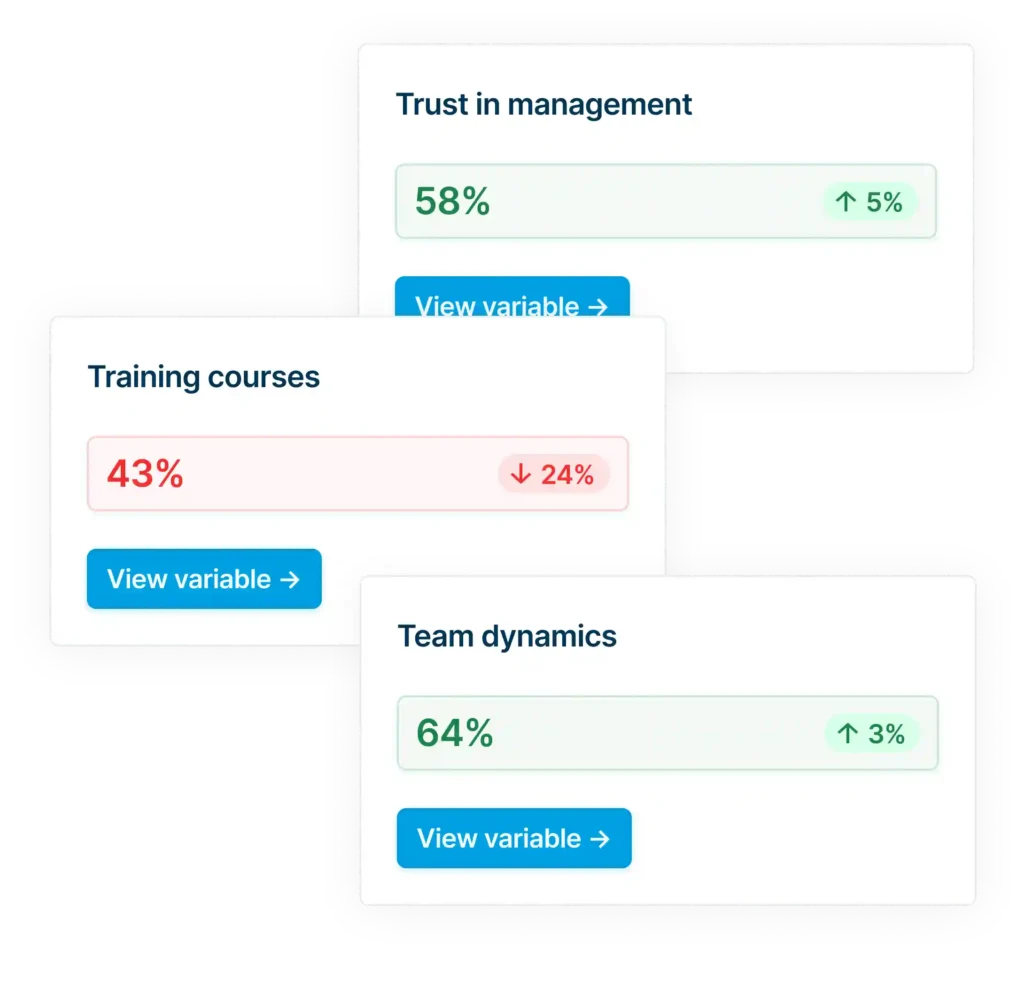
Three dashboard cards with percentages for trust in managers, training and team dynamics.

Make inclusion discussable with insight into what employees experience

Leaders and HR see through Deepler where employees experience room to participate and where barriers arise. The dashboard helps to have a concrete conversation: not about general opinions, but about patterns in how employees experience things.

Organizational research without high costs

Choose the Basic or Plus package to match your needs. Want to compare multiple countries or organizations? Then the Enterprise package is the best choice.

Basic

From

€2.49

Per employee per month, per suite

Get started quickly with insight into your organization.

View all features →Request a demo
Most popular

Plus

From

€3.49

Per employee per month, per suite

Reach multiple teams and follow up actively.

View all features →Request a demo

Enterprise

Price

Custom

Proposal tailored to your organization

For organizations from 500 employees, with customization.

View all features →Request a demo

750 employees or more? Then a tailored tiered price applies. Contact sales →

Combine suites and save: 2nd suite 50% off, 3rd suite 75% off, 4th suite free. Calculate your bundle price →

Prices shown assume annual billing.

Frequently asked questions

What is diversity and inclusion?

Diversity is about differences between people, such as background, age, gender, experience, perspective, and thinking style. Inclusion is about the question of whether people with those differences can truly participate, have influence, and feel safe being themselves within the organization.

Diversity and inclusion in the workplace mean that employees are not only present, but can also contribute on equal terms. It’s about daily experiences: who is heard, who gets opportunities, how differences are handled, and whether employees feel safe sharing their perspective.

Diversity describes the composition of a group. Inclusion describes how people within that group are treated and involved. A team can be diverse, but still not function inclusively when some employees experience less space, influence, or safety.

Diversity and inclusion are important because organizations make better use of talent when different perspectives are heard. It contributes to better collaboration, more engagement, fairer opportunities, and stronger employer branding. Without inclusion, differences can actually lead to distance or untapped potential.

A D&I survey can measure themes such as psychological safety, equal opportunities, space for difference, inclusive leadership, team culture, communication, career development opportunities, accessibility, and experiences with unwanted behavior or exclusion.

Many organizations measure D&I periodically, for example annually or semi-annually. With sensitive topics, it’s important to not only measure, but also visibly follow up. Repetition is especially valuable when you want to see if actions have an effect.

Yes, anonymity is strongly recommended. Employees share more honestly when they know that answers cannot be traced back to them personally. This is especially important for sensitive topics such as discrimination, psychological safety, and experiences with exclusion.

Not always. Only ask for characteristics if they are necessary for the purpose of the survey and if you can report carefully without traceability. Sometimes it’s better to mainly measure the experience of inclusion and keep demographic questions voluntary or limited.

After a D&I survey, you discuss the key patterns, determine priorities, and create a concrete action plan. Consider actions around leadership, team behavior, equal opportunities, communication, or psychological safety. It’s important that employees see what happens with their feedback.

A diversity and inclusion action plan describes what improvements the organization will implement, who is responsible, and how progress will be monitored. A good action plan is based on data and employee experience, not just general ambitions.

Examples include equal opportunities for career advancement, accessible communication, space for different holidays or life stages, inclusive leadership, clear standards regarding unwanted behavior, and consultation formats where quieter or less dominant voices are also heard.

A good response depends on the size of the organization and confidence in the research. With D&I, not only the percentage is important, but also whether employees feel safe enough to answer honestly. Clear communication and anonymity help increase response rates.

Make D&I part of existing processes such as leadership, recruitment, onboarding, development, team discussions and employee surveys. Measure periodically, provide feedback and clarify ownership. This way, inclusion becomes a way of working instead of a temporary campaign.

Diversity is about the differences between people. Equality, or more precisely equity, is about fair opportunities: everyone gets what they need to take part fully. Inclusion is about whether people feel welcome and can truly contribute. Together they are often abbreviated as DEI: diversity, equity and inclusion.

Start with a baseline measurement to see how employees experience inclusion. Then recruit inclusively, make unconscious bias open to discussion, check pay and progression opportunities, ensure an accessible workplace and make managers owners. Measure again periodically to see whether your actions are working.

In the Netherlands, the main ones are the Dutch Equal Treatment Act (Algemene wet gelijke behandeling), the Equal Treatment of Men and Women Act, the Equal Treatment in Employment (Age) Act, the Equal Treatment on the Grounds of Disability or Chronic Illness Act and the Dutch Working Conditions Act (Arbowet). For a D&I survey, the GDPR also applies, especially if you ask about special categories of personal data.

Schedule a consultation

Ready to take the next step? Get in touch and together we will look at the best approach. Whether you have a question or just want to brainstorm, we are here for you.

  • A look at the Deepler dashboard
  • Personal advice and a start with honest insight
  • A no-obligation conversation for all your questions
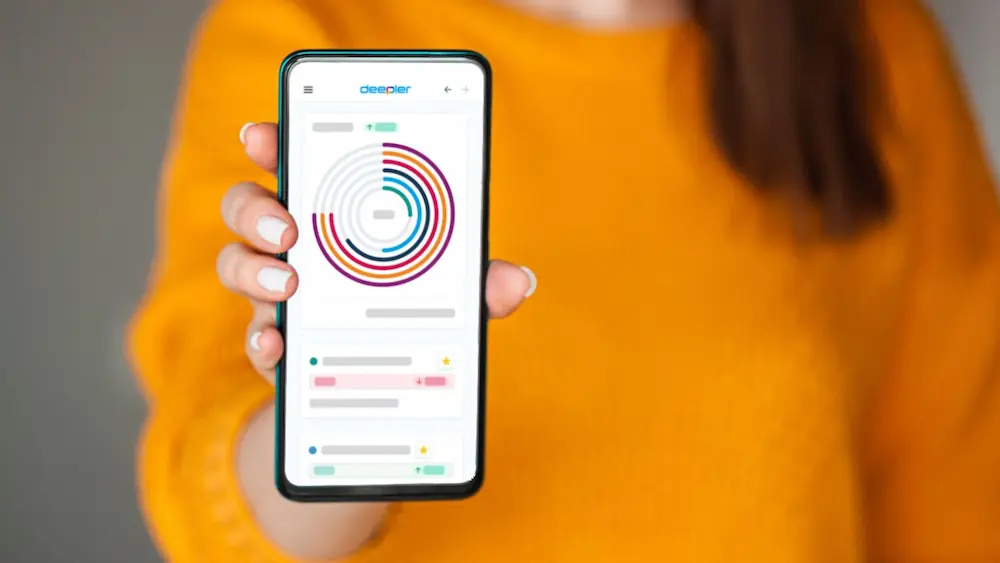
Person in a yellow jumper holding a smartphone with the Deepler app and colourful data visualisation on the screen.
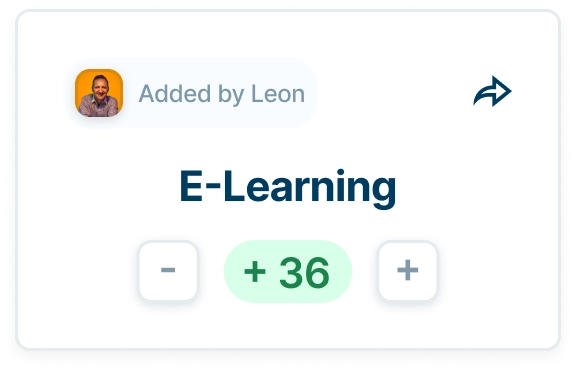
E-learning card added by Leon with a score of 36 and plus and minus buttons.
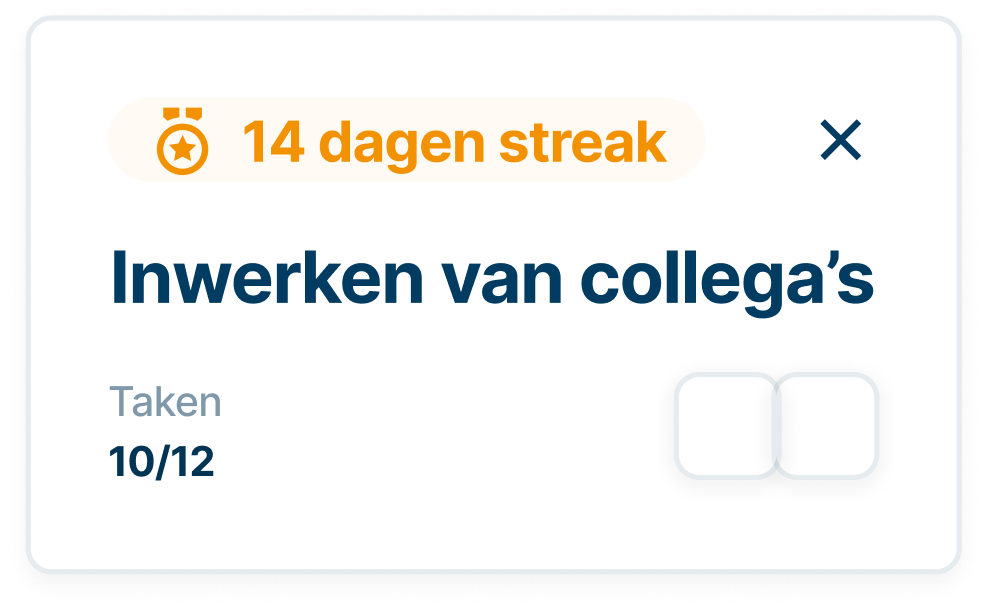
Card titled "Onboarding colleagues" showing a 14-day streak and 10 of 12 tasks completed.
Background-circles-Deepler