


Reduce employee turnover with targeted insights

Employee turnover rarely happens suddenly. Doubt builds up gradually: employees lack perspective, feel unheard, or no longer see a future within the organization. With Deepler’s Reduce Turnover module, you measure which signals precede departure intent. This way, you don’t just respond to outflow figures after the fact, but discover earlier where employees disengage and what’s needed to retain staff sustainably.

  • Commitment and belonging
  • Departure intent and doubt
  • Growth opportunities
  • Recognition and appreciation
  • Work-life balance
Mensen die aan het luisteren naar 2 mannen

What is staff turnover and when does it become a problem?

Staff turnover means that employees leave the organization and need to be replaced. Some of this is normal and sometimes even healthy. It only becomes a problem when valuable employees leave, teams continuously lose knowledge, or vacancies arise faster than they can be filled.

Unwanted turnover is about employees you would have liked to retain. This group is particularly interesting for research. There are often patterns behind it: limited career growth, insufficient recognition, poor leadership, unclear expectations, or a mismatch between promise and reality.

By measuring regularly where engagement is under pressure, you gain insight into the causes behind staff turnover before knowledge, experience, and capacity disappear. This shifts the focus from reactive to proactive: from exit interviews to retention policies.

How does the module help reduce staff turnover?

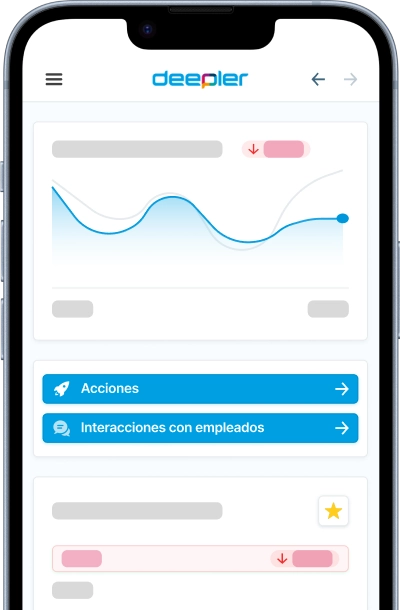
Recognize early signals

The module measures intention to leave, engagement, and satisfaction before employees resign. This way you don't only see what's going on at the exit interview, but you get early signals of where doubt and distance arise.
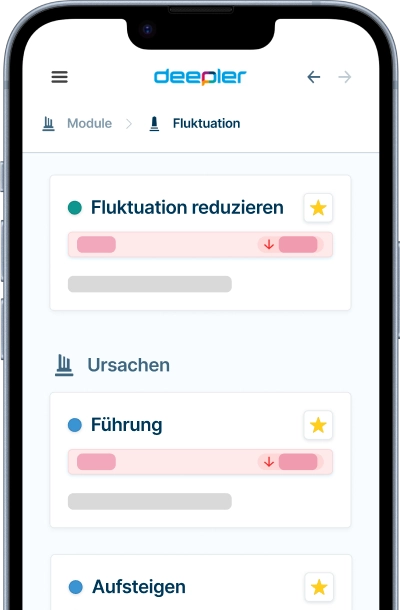
Identify patterns per team and function

Turnover varies greatly by team, location, or function. The module analyzes where unwanted turnover is concentrated and which themes are involved, such as leadership, development, or workload. This way you can steer in a targeted manner rather than generically.
From insight to retention policy

By understanding why employees have doubts, you can choose targeted actions: development programs, performance reviews, career paths, or team interventions. Regular measurement shows whether these actions have an impact on employee engagement.

What is staff turnover?

Staff turnover is the percentage of employees who leave the organization and need to be replaced. It only becomes a problem with unwanted turnover: when valuable employees leave that you would have liked to retain. This affects continuity, knowledge, team cohesion and customer quality.

Why is staff turnover important?

When employees leave, not only capacity disappears but also knowledge, customer relationships and team rhythm. Colleagues have to fill the gaps, new people need to be onboarded and managers spend time on recruitment again. If this happens more often, a vicious cycle emerges where departures lead to higher workload, causing others to doubt as well.

Reducing staff turnover

Reducing staff turnover starts with understanding why employees leave or have doubts. That requires more than exit interviews. By regularly measuring where engagement is under pressure, you can intervene earlier. Targeted actions such as development programs, career conversations, better onboarding or improved leadership have more impact than general retention programs.

Can you predict staff turnover?

Yes, by measuring departure intention and engagement structurally. With the Deepler module, you map which employees have doubts, which factors influence their decision and where patterns become visible. This allows you to proactively steer towards retention instead of reactively responding to departures.

How to reduce staff turnover effectively

Regularly measure engagement and departure intention

Don't wait until the exit interview. By measuring regularly, you recognize doubt before employees decide to leave.

Identify patterns per team and role

Turnover varies greatly by context. Analyze where unwanted turnover concentrates and which factors play a role.

Discuss results and choose targeted actions

Translate insights into concrete interventions: development, leadership, work-life balance or career paths. One size does not fit all.

Monitor effectiveness of retention policy

Measure again to see if chosen actions have an impact on engagement and departure intention. This keeps staff retention an ongoing process, not a one-time campaign.

The approach of Deepler

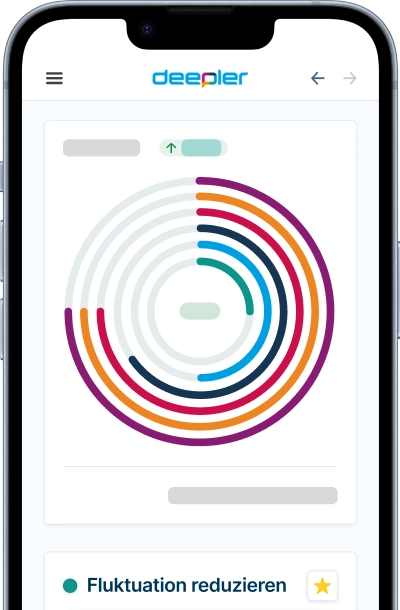
This module maps out why employees leave or stay, across four main themes. Click a theme to see the underlying subthemes: this is the depth with which we make each theme concrete.

Verloop terugdringen
Module Reduce turnover
Reducing turnover

The Reducing Turnover module measures the causes behind unwanted staff turnover, so you can actively steer retention efforts. Across four themes, it maps out how expectations, career development, working conditions and engagement relate to the choice to stay. The focus is on retaining talent.


Expectation and reality
3 Sub-themes
  • Role clarity
  • Alignment of expectations
  • Job satisfaction
Career development and learning
3 Sub-themes
  • Career advancement opportunities
  • Learning and development
  • Career perspective
Working conditions
3 Sub-themes
  • Compensation
  • Secondary benefits
  • Flexibility
Engagement and commitment
3 Sub-themes
  • Engagement
  • Recognition
  • Pride in the organization

See how you proactively address employee turnover with data

Discover in this video how organizations reduce employee turnover with Deepler’s module. From measurement to targeted retention actions, see how it works in practice and how you detect earlier where employees drop off.

Background-circles-Deepler

Combine with other research themes

Employee turnover rarely depends on a single factor. Themes such as leadership, work pressure, development, appreciation, and psychological safety influence the decision to stay or leave. Combine this module with other Deepler modules to get a more complete picture of what binds employees to the organization and where that bond is under pressure.

Trusted by young and old

Experiences of customers who make a difference with us.

  • Portrait of a smiling man in a suit in front of an orange background, titled "Review-image-Larren (1)."

    Larren

    Recruitment Lead, 

    De Selectie

    Icon Review Stars

    “Recently, I used Deepler to arrive at an EVP. Great what they were able to achieve in a short time! In a period of two weeks, we collected information and were able to continue with our AMC plan. In any other situation, it takes weeks, if not months, to get this done. Contact is good, friendly and constructive. Very nice club to work with.”

  • Portrait of a smiling man named Douwe with a bald head and light eyes, against a turquoise background.

    Douwe

    Recruiter, 

    Securitas

    Icon Review Stars

    “Ideal tool and company to gain more and better insight into the organization and employees as an organization! And especially with speed! For us, it was also the need to get tools for the topics of retention, to prevent future absenteeism or turnover. I also have experience with other parties and I sincerely value the speed of switching, follow-up and personal contact with Deepler. Absolutely recommended.”

  • Portrait of Jolanda with long blonde hair, wearing a black lace top, set against a purple background.

    Jolanda

    HR Business Partner, 

    Nedcargo

    Icon Review Stars

    “Deepler is a great tool for continuously collecting feedback from our employees. This input is then centrally available for us as management, but also for managers who benefit from it.”

  • Portrait of Jonathan in a blue suit and tie, smiling in front of a blue background.

    Jonathan

    Manager, 

    UWV

    Icon Review Stars

    “What makes Deepler special is that it doesn’t get stuck in numbers. It helps you immediately understand where it is and what teams need. For us, this ensured that employees themselves came up with areas for improvement and took responsibility for them. The insights were sharp and useful, but most importantly: the conversation that started afterwards made the difference. Thanks to Deepler, we didn’t get a paper plan, but change that was supported by the people themselves.”

  • Vector

    Amadeus

    COO, 

    OSRE

    Icon Review Stars

    “The software has a positive impact on us as a rapidly growing organization. By better understanding what is going on in the workplace and what people offer as solutions for improvements, we can make more effective decisions. The platform helps us to gain real-time insight and to respond directly to it via the tool.”

Ready to proactively address employee turnover?

Schedule a free demo and discover how Deepler helps your organization measure and reduce employee turnover. Our advisors are happy to think through effective retention policies with you.

Aantal stemmen voor het idee 'Gezondere lunch', toegevoegd door Leon, met een score van +36.
Kaart met de titel "Inwerken van collega's", waarop een streak van 14 dagen en 10 van de 12 voltooide taken worden getoond.
Background-circles-Deepler

Frequently asked questions about employee turnover

Voluntary turnover means employees decide to leave on their own. Unwanted turnover specifically refers to employees you would have liked to retain. This latter group is most relevant for research, because structural causes often underlie it that you can address.