




















4,9/5 reviews
Measure and accelerate business growth with insight into your organization
Business growth doesn’t just come from more customers, higher revenue or a larger market. Growth also requires an organization that can move with the times.
Teams need to know where priorities lie, processes must remain scalable and employees must understand what growth demands of them. With the Deepler Business Growth module, you investigate whether your organization is ready for the next step. You measure where growth creates energy, where growth stalls and which organizational factors cause acceleration or slowdown.
- Discover where business growth is being slowed down or accelerated
- Measure whether teams are ready for scalable growth
- Translate growth signals into targeted improvement actions
Business growth: what does it mean and how can you accelerate growth?
Many organizations are looking for business growth, but focus mainly on revenue, marketing or sales. That makes sense, but it’s not complete.
Growth really succeeds when the internal organization can keep up with the pace. Think of collaboration, leadership, decision-making, processes, customer focus and staffing. A study into business growth helps reveal whether the organization is ready to become bigger, stronger or more professional.
In this article we explain:
- What business growth means within an organization
- Why growth often stalls on internal factors
- How you can measure and accelerate business growth
- What role employees, teams and leadership play
- How Deepler helps enable controlled business growth
Table of contents
What is business growth?
Business growth means that an organization develops in size, revenue, impact, market share or maturity. Growth can be visible in more customers, more employees, new markets or a larger service offering.
But growth also has an internal side. As an organization grows, the way people collaborate, make decisions and distribute responsibility changes.
What worked first with short lines of communication can later cause noise, delays or confusion. That’s why business growth is not just about getting bigger, but especially about getting stronger while you get bigger.
Growth requires more than ambition
Ambition is important, but not enough. Organizations can only grow sustainably when the foundation is right.
Employees must understand where the organization is heading, leaders must be able to translate priorities to teams and processes must be clear enough to work repeatedly. A growth study makes it clear whether those conditions are present. This prevents growth from feeling like chaos, stress or constantly running harder without more results.
Why is it important to measure business growth?
Business growth is often assessed by figures: revenue, margin, number of customers or fte. Those figures are valuable, but they don’t always tell why growth succeeds or fails.
An organization can grow commercially while internally pressure increases, collaboration becomes sluggish or decision-making slows down. By measuring business growth from the perspective of employees and teams, you gain insight into the organizational conditions behind growth. This way you steer not only on outcome, but also on the ability to sustain growth.
Measuring business growth provides organizations with various advantages
A growth module helps close the gap between strategy and daily practice. You see where the organization is ready for acceleration and where strengthening is needed first.
That makes growth less dependent on feeling, loose signals or incidents. The insights help management, HR and leaders better determine what improvements are needed to responsibly reach the next growth phase.
1. Insight into growth blockers
Business growth often stalls on internal blockers that are not immediately visible. Think of unclear priorities, fragmented communication, dependence on a few key figures or processes that don’t scale. By asking employees how they experience growth, you discover where the organization slows down and which obstacles need to be tackled first.
2. Better choices when growing
When you know which factors stimulate or slow down growth, you can make sharper decisions. Should the organization invest in leadership, process improvement, team structure, staffing, or communication? Without measurement, growth decisions are quickly based on assumptions. With Deepler, you substantiate where the most impact lies.
3. Less growth pain in teams
Growth often brings extra work, new roles, and more coordination. If this development is not managed well, growth pain emerges: stress, frustration, duplicate work, or declining quality. A survey on business growth shows which teams can handle the growth well and where support is needed.
4. More control over scalability
An organization that wants to grow must be able to increasingly repeat things without constantly improvising. This requires clear processes, ownership, and collaboration. By measuring scalability, you see whether teams depend on individual heroes or whether the organization as a whole becomes stronger.
5. Link growth to culture and behavior
Business growth is not only a strategic matter. It is also a culture matter. Do employees dare to take ownership? Is learning from mistakes encouraged? Can teams prioritize? By linking growth to behavior, you gain insight into the culture needed to make growth real.
Measure your business growth with Deepler software
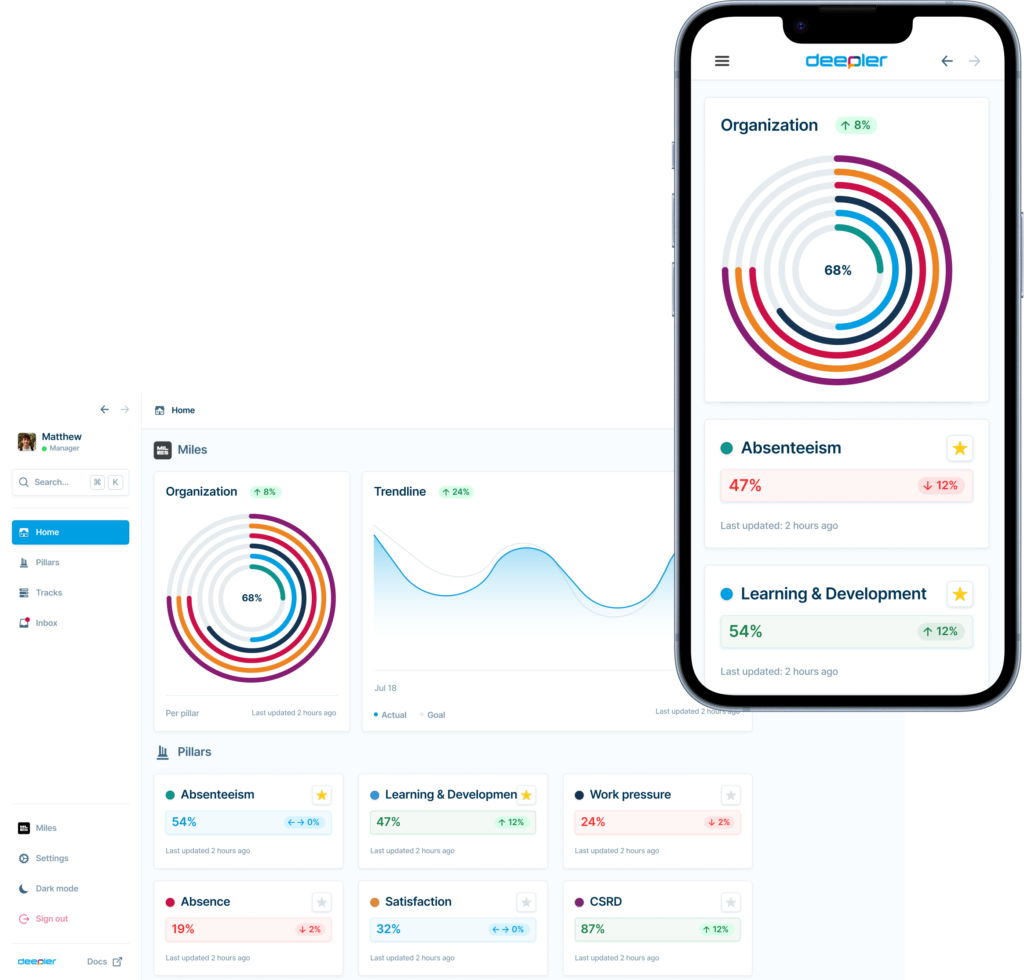
With the growth module from Deepler, you investigate where your organization stands in the development towards scalable and controlled business growth. Employees easily provide input on topics such as strategy, collaboration, leadership, processes, customer focus, innovation and prioritization.
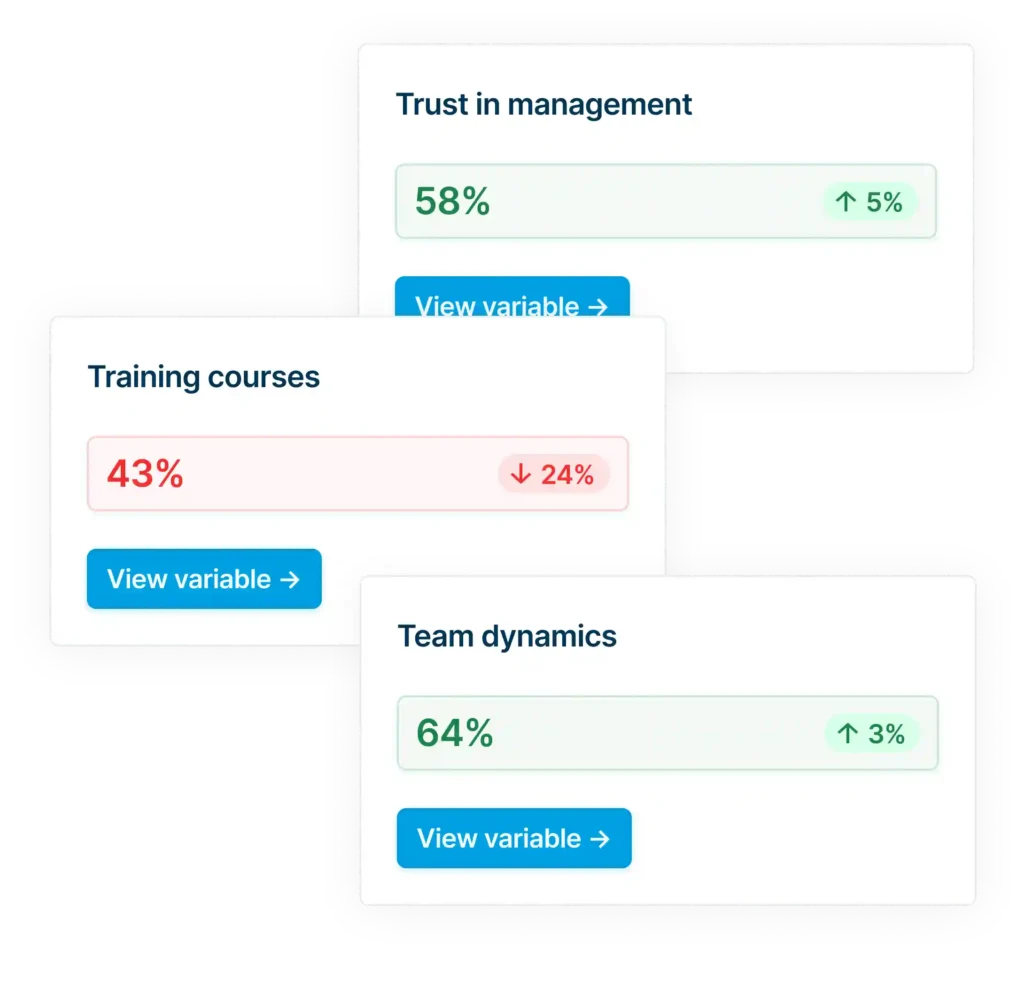
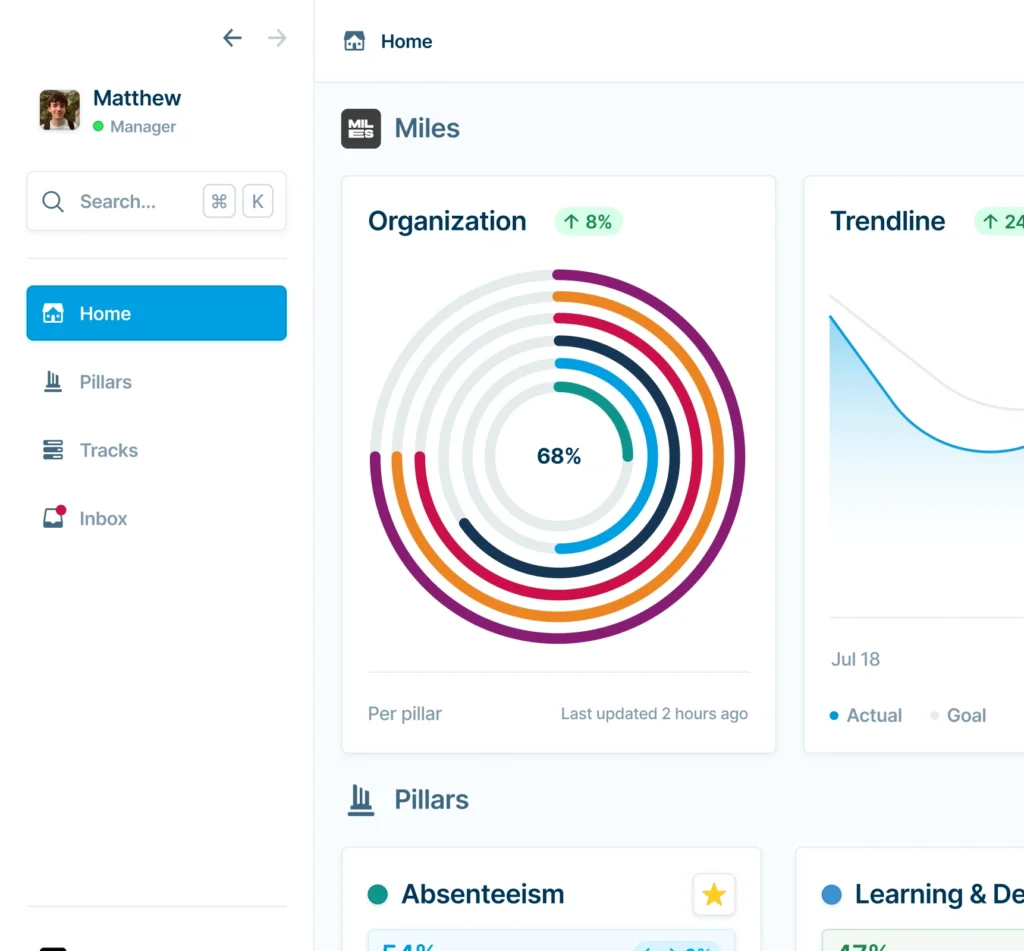
In the dashboard you immediately see which teams or departments support growth and where growth barriers arise. This way, business growth becomes not an abstract goal, but a concrete improvement process you can monitor and adjust.
Our satisfied customers
What are the benefits of a business growth survey?
A business growth survey delivers more than a list of improvement points. It helps organizations organize growth.
You see where ambition and execution reinforce each other, but also where growth leads to confusion, delays, or quality loss. This allows you to strategically build an organization that not only grows, but can also support that growth.
A powerful tool
A growth survey is especially valuable because it connects strategy with the work floor. Management often sees clearly where the organization needs to go, but employees feel daily where execution struggles.
By gathering these experiences in a structured way, you get an honest picture of growth capacity. This makes it easier to determine whether the next step requires better communication, clearer roles, stronger teams, smarter processes, or different leadership.
What are the benefits of a business growth survey?
A business growth survey delivers more than a list of improvement points. It helps organizations organize growth.
You see where ambition and execution reinforce each other, but also where growth leads to confusion, delays, or quality loss. This allows you to strategically build an organization that not only grows, but can also support that growth.
Strategic benefits for the organization
Business growth requires sharp choices. Not everything can happen at once and not every team is ready for the same change at the same time.
A growth survey helps link strategic choices to the reality of the organization. You see where employees lack direction, where decisions move too slowly, and where processes no longer fit the phase the organization is in. This makes strategy more concrete and more executable.
Organizing growth better
Many organizations grow organically first. This works as long as everyone knows each other and problems are solved quickly through informal channels.
But as organizations grow further, more structure is needed. Not as bureaucracy, but as support.
Deepler shows where the balance between freedom and structure no longer works. With this, you can strengthen the organization without losing entrepreneurial energy.
Enabling controlled business growth
Controlled business growth means you grow without quality, employees, or customers coming under pressure. This only works when you see in time where the organization becomes overloaded.
By measuring growth signals periodically, you can adjust earlier. This prevents growth from only being discussed when problems are already visible in absenteeism, turnover, customer loss, or declining productivity.
Trusted by small and large organizations
Ervaringen van klanten die met ons het verschil maken.
-
Larren
Recruitment Lead,
De Selectie
“Recently, I used Deepler to arrive at an EVP. Great what they were able to achieve in a short time! In a period of two weeks, we collected information and were able to continue with our AMC plan. In any other situation, it takes weeks, if not months, to get this done. Contact is good, friendly and constructive. Very nice club to work with.”
-

Douwe
Recruiter,
Securitas
“Ideal tool and company to gain more and better insight into the organization and employees as an organization! And especially with speed! For us, it was also the need to get tools for the topics of retention, to prevent future absenteeism or turnover. I also have experience with other parties and I sincerely value the speed of switching, follow-up and personal contact with Deepler. Absolutely recommended.”
-

Jolanda
HR Business Partner,
Nedcargo
“Deepler is a great tool for continuously collecting feedback from our employees. This input is then centrally available for us as management, but also for managers who benefit from it.”
-

Jonathan
Manager,
UWV
“What makes Deepler special is that it doesn’t get stuck in numbers. It helps you immediately understand where it is and what teams need. For us, this ensured that employees themselves came up with areas for improvement and took responsibility for them. The insights were sharp and useful, but most importantly: the conversation that started afterwards made the difference. Thanks to Deepler, we didn’t get a paper plan, but change that was supported by the people themselves.”
-
Amadeus
COO,
OSRE
“The software has a positive impact on us as a rapidly growing organization. By better understanding what is going on in the workplace and what people offer as solutions for improvements, we can make more effective decisions. The platform helps us to gain real-time insight and to respond directly to it via the tool.”

Is a business growth survey mandatory?
A business growth survey is not legally required. Yet many organizations choose to conduct one when they want to professionalize, scale up, or gain control over growth pain.
Especially with rapid growth, reorganization, expansion into new markets, or rising work pressure, such a survey can provide much clarity. It helps you see in time where the organization needs to be strengthened, before growth leads to structural problems.
Is a business growth survey anonymous?
A business growth survey is preferably conducted anonymously, so employees can honestly indicate where growth creates friction. This is important because topics such as leadership, decision-making, work pressure, or collaboration can be sensitive. Deepler helps collect results in a safe and reliable way, where insights remain useful without individual answers needing to be traceable.
What about GDPR and privacy in a growth survey?
In a business growth survey, personal data or indirectly traceable data may be processed, for example when results are examined by team, department, or job category. Therefore, it is important to handle privacy carefully.
Work with clear communication, limit access to results, and report only at group level where appropriate. Deepler supports organizations in safely setting up measurements, dashboards, and reports.
What is the role of management, HR, and leaders in business growth?
Business growth affects multiple layers of the organization. Management sets the direction and ambition.
HR looks at staffing, development, leadership, and culture. Leaders translate growth into the daily work of teams.
A growth survey brings these perspectives together. This makes it visible whether the strategy is clear, whether teams feel sufficiently supported, and whether the organization creates the right conditions to grow.
Why do many organizations still conduct a business growth survey?
Because growth without insight often becomes expensive. New customers, additional employees, or expansion into new markets seem positive, but can also lead to fragmentation, quality loss, or increased work pressure.
A growth survey helps you not only look at the opportunity for growth, but also at the organization’s capacity to sustain it. This way, you can invest where growth truly accelerates.
How to get more out of your business growth survey
Make growth concrete
Don’t just ask whether employees are positive about growth. Especially investigate what growth means in their work: more meetings, different customers, new roles, higher work pressure, or better opportunities. The more concrete the questions, the more useful the results.
Link results to strategic choices
A growth survey has the most value when results are linked to choices that need to be made anyway. Think of hiring, leadership development, process improvement, or customer segmentation. This way, the survey remains not just a standalone report, but becomes part of decision-making.
Monitor growth periodically
Growth changes continuously. What works well today may be too small, too slow, or too unclear in six months. By measuring periodically, you see whether improvements are effective and whether new growth pains emerge.
Do’s of a business growth survey
A strong growth survey starts with a clear question. Do you want to know whether teams work scalably, where growth friction occurs, or which preconditions are missing? Then involve the right target groups and communicate honestly why you are conducting the survey. Good do’s are:
- Link the survey to a concrete growth phase or ambition
- Measure strategy, processes, and behavior
- Look at differences between teams or departments
- Discuss the results with leaders and employees
- Translate insights into priorities that are truly actionable
Don’ts of a business growth survey
- Don’t measure growth only by revenue or customer figures
- Don’t ask vague questions about ambition without practical context
- Don’t ignore signals of work pressure, confusion, or role ambiguity
- Don’t create an action plan with too many improvement points at once
- Don’t use results to evaluate individual employees or managers
What do you do with the results of a business growth survey?
The results of a growth survey are especially valuable when they lead to choices. Not every signal immediately requires a major change program.
Sometimes more clarity is needed, sometimes better prioritization and sometimes a structural adjustment in roles, processes or leadership. By translating results step by step into actions, you make business growth concrete and manageable.
From insight to action and results
Translating research results into actual growth requires a structured approach. You first identify where growth is being hindered, then determine the most impactful improvements and set up a clear action plan. This ensures that you not only know where problems lie, but also exactly how to solve them and who is responsible for it.
By consistently applying this approach, you transform research results into concrete steps that directly contribute to business growth. Your team knows what needs to change, why it matters, and how progress is measured. This makes growth measurable, manageable, and most importantly: achievable. Deepler distinguishes six follow-up steps you can execute:
Wil je nog meer tips over hoe je een medewerkerstevredenheidsonderzoek (MTO) effectief op kan volgen? Lees dan ons artikel:
MTO Effectief Opvolgen: Waarom Is Dat Belangrijk?
1. Analyze where growth is being slowed down
Look at which themes score low and where differences between teams are visible. Pay special attention to recurring signals around priorities, collaboration, decision-making, processes and workload. These are often the places where growth gets stuck in practice.
2. Determine which growth phase the organization is going through
An initial growth phase requires something different than professionalization or international expansion. Therefore, place the results in the context of the current phase. This prevents you from taking measures that don’t fit the real growth challenge.
3. Discuss the insights with teams and managers
Numbers provide direction, but conversations provide meaning. Use the results as a starting point for dialogue. Ask teams where they see the greatest growth opportunities and what barriers they experience daily.
4. Choose a limited number of growth priorities
Don’t try to solve everything at once. Choose the themes that have the most impact on growth, quality and workability. Think of role clarity, decision-making, process improvement or leadership.
5. Translate insights into concrete actions
Make actions small enough to execute. For example: clarify decision-making routes, adjust meeting structures, better inform teams about priorities or make ownership more explicit.
Keep measuring whether growth becomes healthier
Business growth is not a one-time project. By measuring periodically, you see whether improvements have an effect and whether the organization is ready for the next step. This way you build growth that becomes stronger rather than heavier.
Steer growth with insight into what the organization can handle
With Deepler you see not only that the organization wants to grow, but also where growth is supported or slowed down in practice. Dashboards show which teams are ready for the next step, where processes are bottlenecks and which topics require priority. This way you have better conversations about growth, without getting stuck in assumptions.
Organizational research without high costs
Stem je wensen af met ons Basic- of Plus-pakket. Wil je meerdere landen of organisaties vergelijken? Dan is het Enterprise-pakket de beste keuze.
Basic
€2.99
Per user/per month
The best for your team or smaller organizations that want to gain insights quickly.
- Maximum of 1 module
- Score segmentation
- In-depth analysis for Managers
- Unlimited number of languages
- Personal dashboard for employees
Plus
€3.49
Per user/per month
The best option if you want to survey multiple teams and SMEs.
- Everything from Basic
- 2 additional research modules
- Personal success manager
- Non-desk employees
- Custom questions
Most popular
Enterprise
On request
Per user/per month
The best for large organizations and custom modules.
- Everything from Plus
- Single Sign-On
- Custom modules
- Advanced Security
- Personal onboarding
Basic
€36
Per user/per year
The best for your team or smaller organizations that want to gain insights quickly.
- Maximum of 1 module
- Score segmentation
- In-depth analysis for Managers
- Unlimited number of languages
- Personal dashboard for employees
- Suitable for employees company email address
Plus
€42
Per user/per year
The best option if you want to survey multiple teams and SMEs.
- Basic
- 2 additional research modules
- Personal support from a Deepler expert
- Suitable for all employees
- Add your own questions
- Option to conduct surveys using QR codes
Most popular
Enterprise
On request
Per user/per year
The best for large organizations and custom modules.
- Plus
- Unlimited research modules
- Custom modules
- Unlimited number of languages
- Personal dashboard for employees
- Suitable for employees company email address
Frequently asked questions
What is business growth?
Business growth means that an organization grows in revenue, customers, employees, market share or maturity. Real growth is not just about getting bigger. It is also about becoming stronger: better processes, clearer roles, better collaboration and more ability to handle change.
How can you accelerate business growth?
Accelerating business growth starts with understanding where growth is being held back. This can be due to strategy, processes, staffing, leadership, customer focus, or collaboration. By measuring these factors, you see where improvement will have the most impact.
What is controlled business growth?
Controlled business growth means that an organization grows without losing grip on quality, employees, customers, or processes. Growth then becomes not only faster, but also healthier and more sustainable.
Why does business growth often stall?
Growth often stalls when the internal organization doesn’t grow along with the ambition. Think of unclear priorities, slow decision-making, insufficient ownership, overloaded teams, or processes that remain dependent on individual people.
What role does teamwork play in business growth?
Teamwork is important because growth increasingly requires coordination. Teams need to know who is responsible for what, how priorities are chosen, and how they help each other maintain quality. Poor team dynamics can significantly slow growth.
How do you measure business growth with Deepler?
With Deepler, you measure the organizational conditions for growth. Employees provide input on topics such as collaboration, leadership, strategy, processes, customer focus, and workload. The results are visible in dashboards, so you can improve in a targeted way.
Is business growth the same as revenue growth?
No. Revenue growth is a form of business growth, but business growth is broader.
An organization can also grow in professionalism, customer value, innovation capacity, workforce size, or market position. For sustainable growth, the internal organization must be able to support that development.
What is a business growth model?
A business growth model helps to understand growth phases. In each phase, different challenges arise, such as introducing structure, strengthening leadership, or making processes scalable. Deepler helps you measure which topics in your organization need attention.
How do you prevent growing pains?
You prevent growing pains by measuring early where pressure, noise, or unclear communication emerges. Don’t wait until absenteeism, turnover, or customer complaints increase. By gathering signals earlier, you can make adjustments before growth comes at the expense of people or quality.
Which organizations is a growth assessment suitable for?
A growth assessment is suitable for organizations that are growing rapidly, want to professionalize, enter new markets, or notice that the current way of working is starting to strain. Organizations that are stagnating can also use it to discover where growth is being slowed down.
What do you do after a business growth assessment?
After the assessment, you determine which growth factors need the most attention. Then you discuss the results with teams and managers, set priorities, and implement improvement actions. After that, you continue to measure whether the organization is growing in a healthier and more scalable way.
How often should you measure business growth?
With rapid growth, it’s wise to measure multiple times per year. With more stable organizations, periodic measurement every six months or year may be sufficient. The most important thing is to link your measurement moments to growth phases, strategic choices, or changes.
How do you ensure employees are honest about growth?
Employees provide more honest answers when it’s clear why the research is being conducted, how anonymity is guaranteed, and what will be done with the results. Show that feedback is not used to control, but to make growth workable and successful.
Schedule a consultation
Klaar om stappen te zetten? Laat van je horen, dan kijken we samen naar de beste aanpak. Of je nu een vraag hebt of gewoon even wilt sparren, we zijn er voor je.
- Een inkijkje in het dashboard van Deepler
- Persoonlijk advies en start met eerlijk inzicht
- Een vrijblijvend gesprek voor al jouw vragen