
More insight into progress: does AI offer a solution?
What is staff turnover and why is more insight important? Staff turnover — the departure of employee...
Verder lezen



Managing and collaborating has not become easier. Remote work, growing organizations and changing generations don’t exactly help with that. As a result, teams don’t always work well, collaborate, and understand. why and how they can change this. Come here motives and MTO together to increase the effectiveness of teams.
Motives provide insight into people’s inner motivation, while employee research determines which topics and collaborative themes are important to discuss. In this blog, we extensively discuss how these two concepts complement each other and briefly discuss the cooperation between Deepler and Management Drives.
Motives are the inner forces that guide our behavior, choices, and reactions. Why do you react the way you do? They form the basis of our motivation and determine how we behave in different situations. In a business context, drivers are essential because they influence how employees collaborate, communicate and solve problems. They are at the core of what motivates people to do their best work, and to work effectively with others in the team.
Understanding and using drivers in the workplace can make a huge difference in how teams function. When managers and team leaders understand the motives of their employees, they can assign the right tasks, manage conflicts better, and create a work environment where everyone thrives. For example, someone driven by performance will thrive best in a competitive environment where success is clearly measurable, while someone driven by collaboration performs better in a people-centered environment.
Motives determine not only what we do, but also how we interact with others. When team members understand each other’s motives, they can communicate and collaborate more effectively. This leads to a more harmonious work environment where conflicts are resolved more quickly and productivity increases. Teams that work on the basis of shared or complementary motives, such as a mix of creativity and pragmatism, are often more successful and innovative.
In short: Motives help us to work together and communicate more effectively. But what do you need to collaborate on and what do you need to communicate about? This includes an employee survey. The combination between insight into motives and insight into the themes at play means that we can answer the why, what and how questions about effective collaboration.
Where motives give us insight into how people work best together, Deepler offers a powerful tool for determining why and which themes must be addressed to ensure that cooperation runs optimally. Deepler uses science-based surveys and AI algorithms to identify collaborative themes within a team. By identifying these themes, Deepler helps organizations focus on the topics that really matter, resulting in more focused and effective meetings and projects.
Deepler’s approach starts with collecting data through validated surveys tailored to the specific needs of a team or organization. This data is then analyzed by AI algorithms that identify patterns and relationships. In this way, with Deepler, we can determine what influences turnover or absenteeism, but also which themes exist among employees. These insights help managers make strategic decisions about which topics and forms of collaboration should be prioritized. For example, if the data shows that there is a strong need for clearer communication within a team, Deepler will immediately expose this.
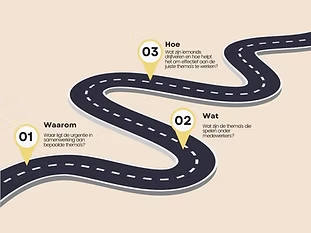
Deepler’s strength lies in identifying the themes that are critical to collaboration, while determining drivers how those themes can be addressed effectively. These two elements complement each other seamlessly. When teams have insight into their motives and know which themes are important to them, they can optimally organize their collaboration. This not only leads to better results, but also to higher levels of engagement and job satisfaction.
The collaboration between Deepler and Management Drives takes this power one step further. Management Drives offers in-depth insight into the motives of individuals and teams. This system categorizes drivers into different colors, each representing a specific behavioral pattern, such as focus on results, harmony, innovation or stability. By combining the results of Management Drives with Deepler’s insights, organizations can’t decide alone what needs to be discussed, but also how these conversations can be conducted most effectively.
A practical example: imagine that a team consists mainly of people with a strong “blue” drive (focused on structure and order). Deepler can determine that there is a need for more innovation within the team. With these combined insights, the organization can choose to structure discussions about innovation in a way that meets the need for order and clarity, significantly increasing the chances of successful implementation.
As teams become increasingly diverse and complex, understanding and exploiting drivers is essential for successful collaboration. Deepler provides the tools to determine what needs to be discussed. Management Drives helps how teams can best work together to achieve these goals. Through the combination between Deepler and Management Drives, organizations can why, what and how better organize cooperation and communication. This leads to better results, higher satisfaction and a more harmonious work environment.
Curious about how Deepler can help your team take advantage of the drivers and improve collaboration? Contact us for an informal consultation or check out our website.